
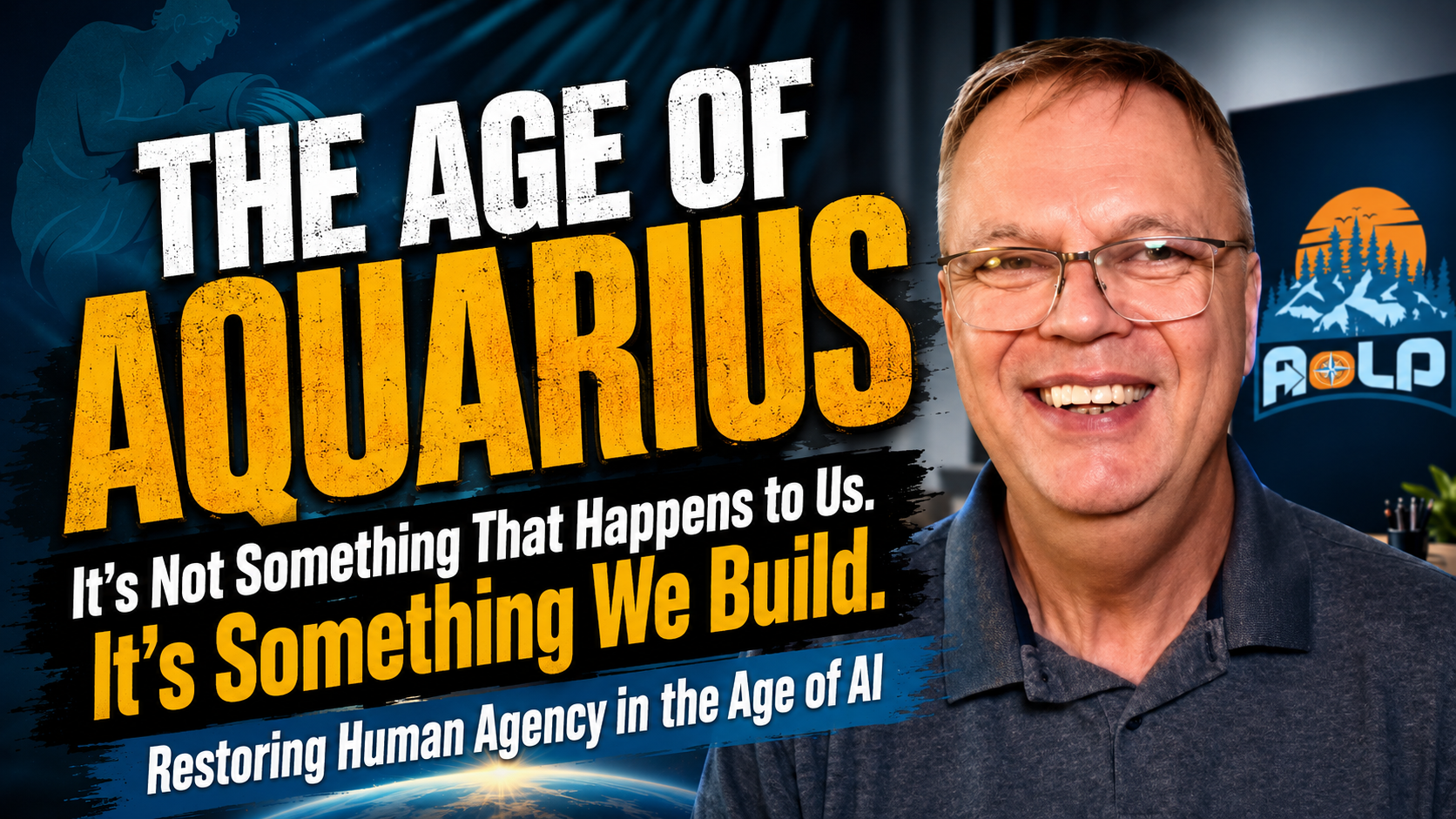
Restoring human agency in the age of AI
For most of human history, power has followed scarcity.
If knowledge was scarce, those who possessed knowledge held power.
If capital was scarce, those who controlled capital held power.
If access to markets, institutions, law, medicine, education or professional expertise was scarce, the organisations controlling that access became powerful intermediaries between ordinary people and the lives they wanted to live.
We came to regard this arrangement as normal.
You needed the priest to interpret the sacred.
The doctor to interpret the body.
The lawyer to interpret the law.
The banker to interpret money.
The adviser to interpret your financial future.
The institution knew.
You did not.
So you delegated.
For thousands of years, civilisation has largely been built around this asymmetry.
But something is changing.
And artificial intelligence may be accelerating that change faster than almost anything that came before it.
I have increasingly come to understand that the work of the Academy of Life Planning is not simply about financial planning.
It is not really about AI either.
It is about helping people through a much larger transition.
A transition from delegated agency to distributed agency.
In older language, I have described that transition as the movement from the Age of Pisces to the Age of Aquarius.
Today I would describe it more simply.
It is the restoration of human agency.
Pisces and Aquarius as a systems metaphor
I do not think we need to agree on astrology to recognise the usefulness of the metaphor.
The traditional contrast is striking.
Pisces represents hierarchy, faith, sacrifice, authority, institutions and dependence upon intermediaries.
Aquarius represents networks, knowledge, decentralisation, individuality, community and liberation.
Look around at what is happening.
Centralised media is giving way to distributed publishing.
Institutional knowledge is becoming universally searchable.
Education is moving beyond the classroom.
People can build businesses without factories, publish without publishers, create software without development teams and increasingly interrogate complex professional problems without first obtaining permission from a gatekeeper.
Artificial intelligence takes this transition much further.
For the first time, capabilities that previously required teams of analysts, researchers, administrators, technicians and specialists can increasingly be placed directly in the hands of an individual.
That does not make expertise worthless.
It changes where expertise sits.
And that may be one of the most important shifts of our time.
The old model concentrated capability inside institutions.
The emerging model can distribute capability among people.
That is the difference between merely digitising the old world and building something genuinely new.
AI can liberate people. Or perfect their dependency.
There is nothing inherently liberating about artificial intelligence.
The same technology that can increase human agency can also diminish it.
An institution can use AI to understand you more deeply, influence you more precisely, sell to you more effectively and automate decisions you barely realise are being made.
The result may be extraordinarily efficient.
But efficiency is not the same thing as agency.
A perfect recommendation engine can still leave the human being passive.
A brilliant robo-adviser can still say:
We have analysed your circumstances. Here is what you should do.
That is the old relationship wearing new clothes.
The computer has replaced the expert, but the individual remains dependent.
This is why I increasingly distinguish between two kinds of artificial intelligence.
Captured AI serves the objectives of the institution operating it.
Sovereign AI serves the agency of the person using it.
The critical question of the AI age is therefore not:
How intelligent will AI become?
It is:
Whose agency will that intelligence serve?
From advice to agency
This matters particularly in financial services.
The conventional financial model begins with a reasonable assumption.
People face complicated decisions, therefore they need experts.
But somewhere along the way we made an enormous conceptual leap.
We moved from:
People sometimes need expertise
to:
People should continuously delegate important decisions to experts.
Those statements are not the same.
A three-hour problem somehow became a thirty-year commercial relationship.
Temporary complexity became permanent dependency.
And recurring dependency became an extraordinarily profitable business model.
What if we reversed the assumption?
What if the objective of good financial planning were not to make the adviser indispensable?
What if its purpose were to make the client increasingly capable?
That gives us a different operating principle:
Continuous agency. Episodic expertise.
You remain the protagonist of your life.
Technology helps you understand.
Education helps you think.
Tools help you model choices.
Communities help you learn.
Experts appear when complexity, stress or change makes them valuable.
Then they step back again.
Agency remains with you.
Advice becomes a resource rather than a relationship of dependency.
That is a profoundly different architecture.
Academy OS is Aquarian architecture
I have sometimes thought of Academy OS as a collection of applications.
I no longer think that description goes far enough.
The applications are merely the visible layer.
Underneath them is an architectural principle.
Put capability on the individual’s side of the table.
My Life Record allows the individual to hold and control their own information.
Decision tools help people interrogate choices before handing them to someone else.
Financial planning applications help people understand pensions, investments, expenditure, protection, inheritance and trade-offs.
Goliathon helps individuals organise their position when confronting institutions.
Get SAFE helps people regain orientation after financial exploitation.
The Total Wealth Plan helps someone understand not merely their money, but what their money is for.
None of these tools exists primarily to tell someone what to do.
Their deeper purpose is to improve the person’s ability to:
understand, choose and act.
Those three words matter.
Understanding without choice is education.
Choice without the ability to act is frustration.
Action without understanding is vulnerability.
Agency requires all three.
Understand. Choose. Act.
That is why Academy OS should not become another institution people depend upon.
If we succeed, it should do almost the opposite.
It should make institutional dependency less necessary.
The strange role of the midwife
This changes how I understand my own role too.
For years, I have sometimes felt that I was fighting something.
The financial establishment.
Opaque institutions.
Exploitative business models.
Systems designed around extraction rather than human flourishing.
There are certainly things worth challenging.
But opposition cannot be the organising principle of what comes next.
You cannot create a new world simply by fighting the old one.
Perhaps my role is better understood as that of a midwife.
A midwife does not create the child.
She does not command the birth.
She recognises something that is already trying to emerge.
She understands the transition.
She protects the process.
She intervenes when necessary.
And eventually she steps aside.
That may be what the Academy is doing.
We are not inventing humanity’s desire for sovereignty.
We are not creating the technological revolution.
We are not causing the collapse of trust in old institutions.
We are living through forces much larger than ourselves.
Our job is to recognise what is trying to emerge and build practical structures that help people through the transition.
Not followers.
Not clients for life.
Capable human beings.
Rebalancing power
This is why the language of restoring human agency increasingly connects with arguments being made far beyond financial planning.
Across politics, economics, technology and public life, people sense that power has become too concentrated.
Too much knowledge sits behind professional walls.
Too much capital sits inside institutions.
Too much decision-making happens somewhere else.
Too many systems are designed around people rather than with them.
The response is often framed as redistribution.
Redistribute money.
Redistribute power.
Redistribute opportunity.
These things may matter.
But there is another form of redistribution that receives far less attention.
The redistribution of capability.
Give people the ability to understand the systems affecting them.
Give them access to powerful analytical tools.
Give them ownership of their information.
Give them the capacity to compare alternatives.
Give them affordable access to expertise when they genuinely need it.
Give them the confidence to ask better questions.
And something subtle begins to happen.
Power starts moving.
Not because someone seized it from above.
Because fewer people need to surrender it from below.
That may be one of the most peaceful forms of systemic change imaginable.
Ordinary people do not need another establishment
There is always a danger when reform movements succeed.
They become the next establishment.
Yesterday’s outsiders become tomorrow’s gatekeepers.
The symbols change.
The hierarchy survives.
If Aquarius means anything useful as a social metaphor, it cannot mean replacing one powerful elite with a more enlightened elite.
It must mean changing the structure through which power operates.
The goal cannot be:
Put better people in charge.
It must increasingly become:
Build systems in which ordinary people require fewer people to be in charge of them.
That distinction is fundamental.
Protection matters.
Regulation matters.
Expertise matters.
Institutions matter.
But protection without agency can become paternalism.
Expertise without agency can become dependency.
Institutions without agency can become domination.
The healthier relationship is partnership.
The human being remains sovereign.
AI makes intelligence cheap
Every great technological shift changes the economics of something.
The printing press made reproduction of knowledge cheap.
The internet made distribution cheap.
Smartphones made access cheap.
Artificial intelligence is making many forms of intelligence cheap.
That has enormous consequences.
Because entire industries have been built around intelligence being expensive.
Research was expensive.
Analysis was expensive.
Software development was expensive.
Financial modelling was expensive.
Access to specialised knowledge was expensive.
If those costs collapse, we should ask an uncomfortable question.
Who receives the decision dividend?
Do institutions simply use AI to reduce their own operating costs while continuing to charge customers as though expertise remained scarce?
Or does some of that capability migrate to the citizen?
That is ultimately a design choice.
Technology does not decide.
We do.
Enough
There is another reason this matters.
Human agency is not merely the ability to optimise.
A person can become extraordinarily efficient at pursuing goals they never consciously chose.
The deeper purpose of life planning is therefore not simply helping someone get more.
It is helping them decide what enough means.
Enough money.
Enough security.
Enough work.
Enough status.
Enough consumption.
Enough achievement.
Enough time.
Enough belonging.
Enough meaning.
A society organised around perpetual extraction struggles with the idea of enough.
Its institutions benefit when we remain dissatisfied.
Human agency begins when we can recognise the difference between desires that genuinely belong to us and desires manufactured by the systems surrounding us.
That is why Total Wealth must include more than financial wealth.
Money is a means.
Life is the end.
Perhaps this is the Age of Aquarius
I cannot tell you whether humanity has entered a literal astrological age.
Nor do I think the success of the Academy depends upon anybody believing that.
But I find the metaphor increasingly difficult to ignore.
An era organised around hierarchy, scarcity, intermediaries and concentrated knowledge is colliding with technologies capable of distributing extraordinary levels of capability.
Old institutions are not disappearing.
Nor should they.
But their relationship with individuals can change.
From authority to service.
From gatekeeper to resource.
From dependency to partnership.
From:
We know. Trust us.
to:
Here are the tools. Let’s understand this together.
That is the transition I want the Academy of Life Planning to help midwife.
Not the destruction of expertise.
Its democratisation.
Not rebellion against institutions.
A rebalancing of the relationship between institutions and human beings.
Not artificial intelligence replacing people.
Artificial intelligence helping people become harder to replace, manipulate, confuse or control.
And not another organisation asking ordinary people to surrender their agency.
An architecture that helps them reclaim it.
Perhaps that is what the Age of Aquarius means in practice.
Perhaps it does not arrive on a particular date written in the stars.
Perhaps every generation gets the opportunity to build a little more of it.
Every time knowledge is liberated.
Every time a gatekeeper becomes a guide.
Every time someone understands a decision they previously felt unable to make.
Every time technology gives capability back to the person rather than extracting power from them.
Every time an ordinary human being can say:
I understand my choices.
I know what matters to me.
I can decide.
I can act.
That is human agency.
And perhaps the Age of Aquarius is not something that happens to us at all.
Perhaps it is something we build.

