

Over the past year, a series of high-profile departures from St. James’s Place has attracted increasing attention.
Over the past year, the departures from St. James’s Place have become increasingly difficult to dismiss as ordinary adviser turnover. While normal churn happens in every large network, the recent exits have involved some of the firm’s largest and most established partner businesses. In 2025, Porta Wealth Management left the network. In 2026, SRB Financial Planning joined Quilter, Prospera Wealth Management and Wellesley Investment Management left together with more than £2 billion of client assets between them, and Sovereign Wealth, with around £3 billion under management, has also been linked with a move away from SJP. Taken together, these are not isolated advisers changing firms. They represent a pattern of substantial, independently successful practices choosing alternative business models. Ordinary adviser churn has become a selective structural migration.
On the surface, it looks like another wealth management story. Large partner firms leave. Competitors recruit them. Assets move. Markets react.
But I don’t think that’s the real story.
The real story is that we are beginning to see the early signs of a business model that no longer fits the world emerging around it.
This isn’t simply about one firm. It is about what happens when an entire profession is built around assumptions that are changing faster than the institutions built upon them.
The age of AI is restoring human agency.
And that changes everything.
The story behind today’s headlines
Today’s headlines are about billion-pound practices leaving St. James’s Place.
Those stories matter because they suggest that the partnership model is beginning to lose its appeal even for some of its most successful firms.
But there is another story that rarely makes the headlines.
For every large practice negotiating an orderly exit, there are individual advisers trying to leave quietly. Many have neither the scale nor the bargaining power of the larger firms. Some find themselves in professional disputes, facing BSP liabilities, uncertainty over client relationships, financial pressure and the prospect of costly legal action.
Their experience is very different.
The large firms have options.
Many individuals simply feel trapped.
This is where the Academy of Life Planning has found an unexpected but increasingly important role.
Over the past year we have supported advisers caught in these disputes—not by replacing solicitors or giving legal advice, but by restoring something that institutional conflict often strips away first: the person’s own decision-making capacity.
We call this pre-legal support.
When people come under intense commercial or legal pressure, they often move from making decisions to simply reacting. Fear replaces judgement. Emotion replaces structure. They can spend thousands of pounds on legal action before they fully understand their position.
Our role is to help restore human agency before those costly decisions are made.
That means helping people organise the facts, understand the issues, prepare evidence, ask better questions and become capable of using professional legal representation effectively.
In many ways, AI is changing this work too.
Just as AI is helping citizens understand financial planning before they seek advice, it is helping advisers understand contracts, correspondence, regulatory issues and legal processes before they engage solicitors.
AI does not replace lawyers.
It makes clients better prepared to work with them.
The same principle applies here.
AI restores human agency for advisers as well as their clients.
One adviser we recently supported described it like this:
“Steve provided key information and legal signposting, but more importantly, he gave me clarity, structure and perspective. He has a real ability to help people separate emotion from fact, regain confidence and make rational decisions when that’s incredibly difficult.
The concept of pre-legal support is excellent. Too many people jump straight into a legal battle without first understanding their position or getting themselves into the right mindset.”
That is why this article is not really about one firm’s departures.
It is about what happens whenever individuals find themselves in conflict with powerful institutions.
The public story is that large businesses are leaving.
The quieter story is that many individuals are trying to leave too.
Both point towards the same conclusion.
Business models built on dependency become harder to sustain when AI restores capability and decision authority to the people inside them.
The old model made sense
For decades, financial planning evolved around one fundamental assumption.
Professionals possessed knowledge that ordinary people could not realistically obtain for themselves.
Information was scarce.
Research was expensive.
Regulation was complex.
Products were difficult to compare.
If you wanted to make good financial decisions, you needed an expert.
That created a perfectly rational business model.
Clients delegated.
Professionals advised.
Institutions controlled distribution.
Everyone understood their role.
For many years, it worked.
AI changes the economics of expertise
Today, that assumption is disappearing.
AI is not replacing financial planners.
It is doing something potentially more disruptive.
It is making financial planners of us all.
Not in the sense that everyone suddenly becomes a Chartered Financial Planner.
But in the sense that every citizen can now:
- understand technical concepts;
- explore alternatives;
- challenge assumptions;
- ask better questions;
- interpret complex documents;
- prepare before meetings;
- identify risks;
- learn continuously.
For the first time, sophisticated financial reasoning is becoming widely available.
Knowledge is no longer scarce.
Capability is becoming distributed.
That changes the role of the professional.
Professionals do not lose value
This is not an argument against financial planners.
Quite the opposite.
Professionals do not lose their value when citizens become more capable.
Their value changes.
The future belongs to professionals who help capable citizens make better decisions, not professionals who exist because citizens remain dependent.
That is a healthier relationship for everyone.
The cracks begin to appear
Whenever technology changes where value is created, business models come under pressure.
That is exactly what appears to be happening across parts of financial advice.
The recent departures from St. James’s Place are interesting not because firms are leaving.
People have always left organisations.
The interesting question is who is leaving.
Ordinary adviser churn has become a selective structural migration.
Increasingly, the departures involve established businesses with substantial client relationships, experienced management teams and the capability to operate independently.
That suggests something deeper than normal staff turnover.
It suggests that successful businesses are beginning to ask whether the traditional vertically integrated partnership model still provides the best environment for serving clients.
Two very different exit experiences
The headlines focus on the largest firms.
These businesses often have decades of experience, substantial client assets and enough commercial strength to negotiate a managed transition into another organisation.
They may have options.
Many individual advisers do not.
For them, leaving can be an entirely different experience.
They may face:
- significant BSP liabilities;
- uncertainty over client relationships;
- restrictions on future business;
- financial pressure;
- legal uncertainty;
- considerable emotional stress.
The result is a two-tier exit system.
Established firms often negotiate.
Individuals often struggle.
That distinction deserves far more attention than it currently receives.
The ownership question
These disputes raise a much bigger issue than contractual interpretation.
They ask a fundamental question about modern professional services.
Who owns the value?
Is it:
- the institution that owns the contracts?
- the adviser who spent years building the relationship?
- or the client themselves?
Those questions are now appearing in legal disputes.
They are also becoming ethical questions.
Because ownership is not simply about contracts.
It is about whether value, risk and reward are being distributed fairly.
Whether any particular legal claim succeeds is for the courts to determine.
But the underlying question is one that the whole profession should be discussing.
Does the partnership model fairly distribute the value, risk and ownership created within it?
This is not just an SJP story
It would be a mistake to see this as a story about one firm.
Every advice business faces the same underlying forces.
Clients are becoming more capable.
AI is reducing information asymmetry.
Consumers increasingly expect transparency.
Technology is reducing the cost of knowledge.
Professional judgement is becoming more valuable than professional information.
Every business model built around information advantage will eventually need to evolve.
Some will adapt.
Some will resist.
History suggests the outcome.
Business models rarely collapse overnight.
They develop cracks.
Those cracks widen.
Eventually they become impossible to ignore.
The Academy’s role
This is where the Academy of Life Planning has found an unexpected but important role.
We are increasingly supporting advisers navigating difficult professional disputes.
Not by replacing solicitors.
Not by giving legal advice.
Not by encouraging litigation.
But by helping people regain decision-making capacity before emotion, institutional pressure and legal costs take control.
We call it pre-legal support.
When people find themselves in conflict, their thinking often narrows.
Emotion overwhelms analysis.
Urgency replaces judgement.
Expensive decisions are made before understanding the situation.
Our work is different.
We help people:
- reconstruct events;
- separate fact from emotion;
- organise evidence;
- understand their options;
- prepare for professional advice;
- regain confidence before making irreversible decisions.
One recent client described the experience perfectly:
“Steve provided key information and legal signposting, but more importantly, he gave me clarity, structure and perspective. He has a real ability to help people separate emotion from fact, regain confidence and make rational decisions when that’s incredibly difficult.
The concept of pre-legal support is excellent. Too many people jump straight into a legal battle without first understanding their position or getting themselves into the right mindset. This approach bridges that gap exceptionally well.”
That captures the Academy’s mission better than any marketing copy could.
Our role is not to make decisions for people.
It is to restore their ability to make their own.
The bigger transition
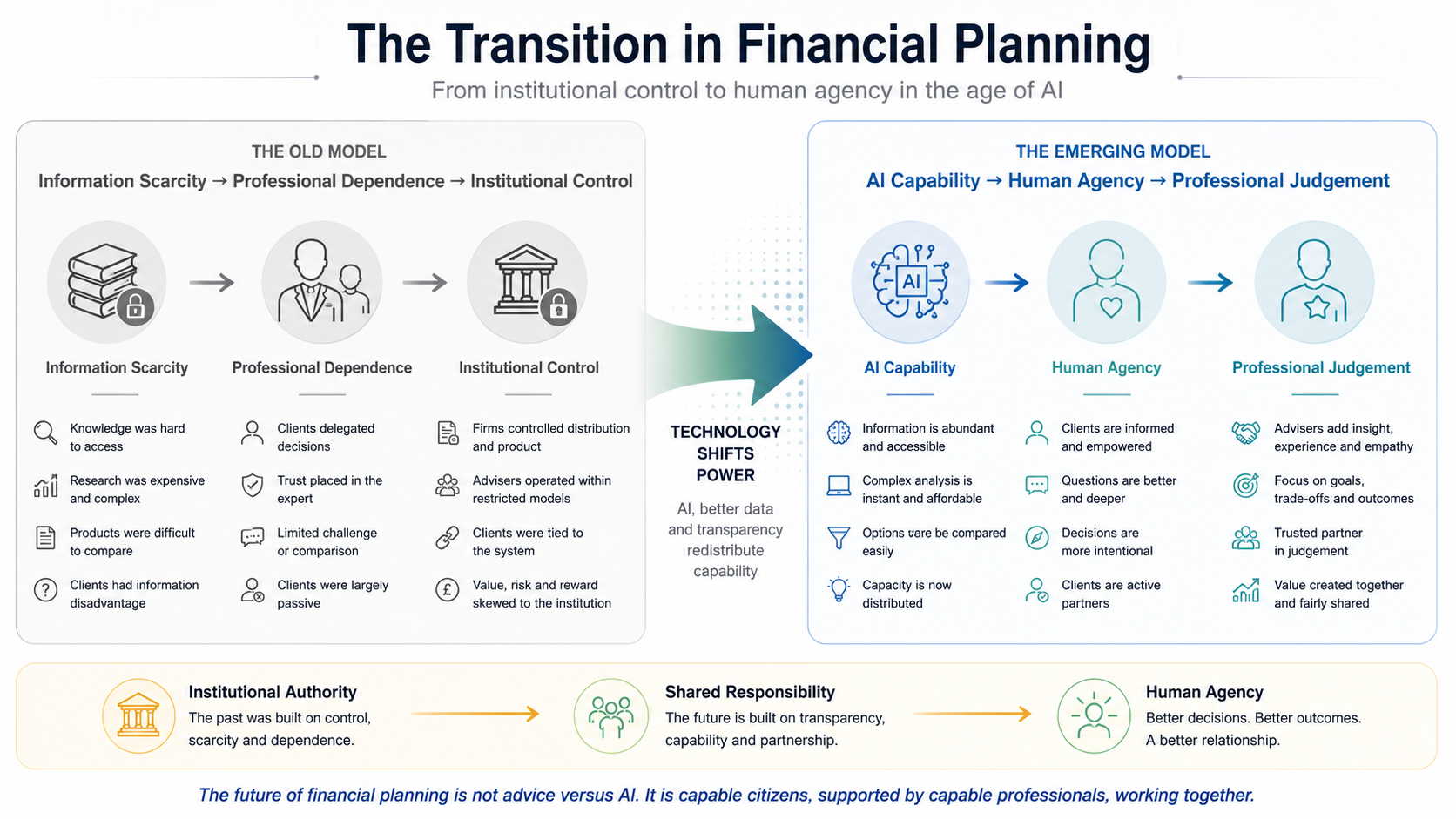
The financial planning profession is entering one of the most significant transitions in its history.
The question is no longer whether AI will replace advisers.
It won’t.
The question is whether advisers will redesign their role around a citizen whose capability is increasing every year.
The winners will not be those who defend dependence.
They will be those who cultivate agency.
They will help clients think rather than simply tell them what to do.
They will become trusted partners in judgement rather than gatekeepers of information.
That is a profoundly different profession.
And, I believe, a better one.
The future belongs to agency
The recent departures from St. James’s Place may prove to be remembered as ordinary commercial events.
Or they may become recognised as early indicators of something much larger.
Not the decline of one company.
The gradual transition from institutional authority towards human agency.
Every profession will experience this transition.
Law.
Medicine.
Accounting.
Financial planning.
AI is distributing capability.
The institutions that thrive will be those that recognise what this means.
The Academy of Life Planning was founded on a simple belief:
People make better decisions when they retain decision authority.
AI makes that possible at a scale never before imagined.
The future of financial planning is therefore not advice versus AI.
It is capable citizens, supported by capable professionals, working together.
That is not the end of financial planning.
It is the beginning of a better version of it.
If you’re considering leaving a financial services firm and would like independent support before making important decisions, visit the Academy of Life Planning to learn more about our Adviser Exit Support.

