
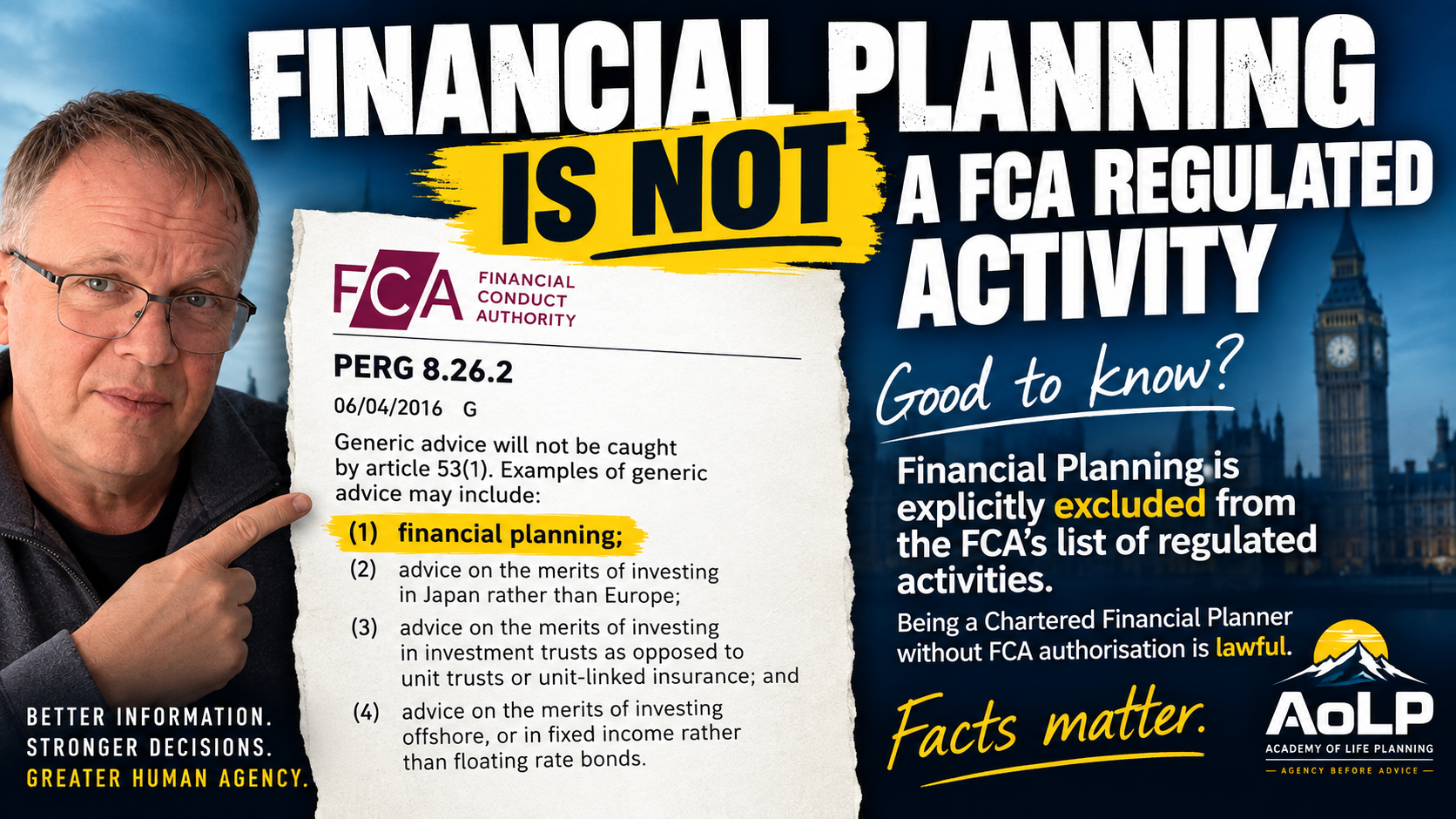
Why the trailblazers of financial planning are moving from the regulated 1% to the human 100%
Most financial planners did not enter the profession because they wanted a licence to sell products.
They entered because they wanted to help people.
They wanted to help people make better decisions, avoid costly mistakes, prepare for uncertainty and build lives that reflected what mattered to them.
Yet somewhere along the way, the profession became organised around a remarkably narrow proposition:
That financial planning begins and ends with the small portion of a person’s wealth that can be placed inside a regulated financial product.
For the average person, regulated retail investments represent well under 1% of total lifetime wealth.
The other 99% is found elsewhere:
- in earning capacity;
- knowledge and skills;
- physical and mental health;
- adaptability;
- relationships;
- family support;
- housing;
- pensions and employment choices;
- resilience;
- time;
- purpose;
- and the ability to make good decisions when life changes.
The financial-services industry has built an enormous professional and regulatory infrastructure around the investable 1%.
The Academy of Life Planning is building a profession for the human 100%.
That is what trailblazing means.
The profession has been looking through the wrong end of the telescope
Traditional financial advice starts with the part of the person’s life that can be intermediated.
Which pension?
Which investment?
Which platform?
Which fund?
Which wrapper?
Which product?
These may all be legitimate questions.
But they are rarely the first questions that determine whether a person lives well.
A career decision may affect lifetime wealth more than an investment selection.
A health crisis may overwhelm the most carefully constructed portfolio.
A divorce, redundancy, caring responsibility, business decision or housing choice may reshape a person’s future more profoundly than the performance of a fund.
Confidence, understanding and adaptability may matter more than the possession of an optimised product.
Yet the industry continues to treat the regulated slice as though it were the whole.
This produces a profound category error:
We have mistaken the part of wealth the industry can sell for the whole of wealth that people need to manage.
The fear that keeps the system in place
The narrowness of the model is not maintained by regulation alone.
It is maintained by fear.
Would-be independent financial planners are warned that the regulatory perimeter is like an electric fence.
They are told they could stray across it inadvertently.
They are encouraged to believe that helping someone with money is inherently dangerous unless it takes place under the umbrella of an authorised firm.
The result is predictable.
Capable professionals remain inside product-led institutions.
Independent planners hesitate to practise.
Professional bodies continue to associate legitimacy with regulatory permissions.
Insurers assess financial planning through the conduct risks created by product recommendation.
Technology platforms assume that anything involving personal finance must be a regulated financial service.
None of this is neutral.
It reinforces an existing market structure.
The more planners fear independence, the more likely they are to remain inside institutions whose growth depends upon products, assets and recurring revenue.
The story of the electric fence serves the interests of the field’s owners.
The perimeter is not the landscape
The regulated perimeter matters.
But it surrounds a very small part of the territory.
Financial planning is much larger.
For around a decade, the FCA Handbook has expressly recognised financial planning as an example of generic advice outside the regulated activity of advising on investments.
This should not be surprising.
Explaining principles is not the same as recommending a particular product.
Helping someone understand their position is not the same as directing a transaction.
Building a decision process is not the same as selecting an investment.
Helping a person clarify their goals is not the same as arranging the means by which a provider captures their assets.
These are different activities.
You do not accidentally become a product adviser.
Recommending a particular investment is a conscious act.
It requires the professional to move from helping the client understand to directing the client towards a specific regulated course of action.
That is not an invisible boundary.
It is a change of role.
The problem is not that the line is impossibly difficult to see.
The problem is that the industry has trained professionals to believe that every useful financial conversation must eventually lead towards it.
The adviser avatar
The deepest barrier is not regulatory.
It is psychological.
Most financial professionals have been trained inside what we call the adviser avatar.
The adviser avatar assumes that the professional must provide the answer.
The client brings uncertainty.
The adviser diagnoses the problem.
The adviser determines the solution.
The adviser recommends the product.
The adviser implements the transaction.
The adviser retains oversight.
The client becomes dependent upon the adviser’s continuing judgement.
This identity is so deeply embedded that many professionals struggle to imagine financial planning without it.
But there is another professional role.
The agency professional does not begin by asking:
What should I tell this person to do?
They ask:
What does this person need to understand so they can choose and act?
That is the dividing line.
Adviser requires a licence. Agency does not.
Advising transfers decision authority towards the professional.
Agency returns decision authority to the person.
Understand. Choose. Act.
The Academy of Life Planning is built around a simple purpose:
To increase each person’s capacity to understand, choose and act.
Understand what is happening.
Understand their resources.
Understand their risks.
Understand their options.
Understand the trade-offs.
Choose according to their own values, needs and priorities.
Act with confidence, independently where possible and with specialist support where necessary.
This is not diluted financial advice.
It is a broader and more ambitious discipline.
A Total Wealth Planner may help someone:
- understand their complete lifetime wealth;
- assess their human capital;
- think through a career transition;
- prepare for retirement as a life stage rather than an investment event;
- improve financial resilience;
- examine competing life choices;
- organise their affairs;
- make sense of complexity;
- identify risks;
- clarify priorities;
- navigate family decisions;
- understand broad financial principles;
- challenge assumptions;
- prepare to speak with a regulated specialist;
- or evaluate whether professional intervention is needed at all.
These decisions may shape far more than 1% of the person’s wealth.
They may shape the whole life.
A profession trained for more than product selection
Financial planners are already trained in the foundations of this wider work.
Professional examinations cover:
- financial-planning principles;
- taxation;
- risk;
- pensions;
- protection;
- investment theory;
- cash-flow management;
- estate planning;
- behavioural considerations;
- and the integration of competing needs.
Brands do not define this knowledge.
The curriculum does not depend upon choosing one provider over another.
It teaches transferable principles.
The profession is already trained to think generically.
What has been missing is permission—not legal permission, but cultural permission—to use that knowledge without converting every planning relationship into a product journey.
That is the transition the Academy is enabling.
From the 1% to the 100%
The traditional model focuses on what can be invested.
Total Wealth Planning focuses on what can be lived.
Traditional advice asks how financial assets should be managed.
Total Wealth Planning asks how all available resources can support a worthwhile life.
Traditional advice often treats the client as the owner of a portfolio.
Total Wealth Planning treats the client as the author of a life.
This does not make regulated advice unnecessary.
There will always be circumstances in which someone wants or needs a professional recommendation concerning a particular regulated product.
That is a legitimate specialist service.
But it should sit within the larger planning process.
It should not define the entire profession.
Regulated advice belongs inside financial planning.
Financial planning does not belong inside regulated advice.
That reversal is fundamental.
Why the industry resists
The established industry has powerful incentives to keep the regulated 1% at the centre.
Products create transactions.
Transactions create assets under management.
Assets under management create recurring fees.
Recurring fees create predictable firm value.
A profession centred on human agency behaves differently.
It may conclude that no product is needed.
It may help someone make a better career decision rather than an investment decision.
It may help a client simplify rather than accumulate.
It may reduce the need for ongoing professional involvement.
It may teach clients enough to act for themselves.
It may charge transparently for work performed rather than taking a percentage of assets indefinitely.
That is good for human agency.
It is not necessarily good for financial-sector growth.
This is why the independent planner can feel threatening.
They challenge the assumption that more intermediation is always better.
They demonstrate that professional value can exist without product capture.
They expose the difference between helping people and growing institutions.
The role of the trailblazer
A trailblazer does not merely take an unusual route.
A trailblazer makes the route credible for others.
That is what the Academy of Life Planning is doing.
We are working to help regulators become comfortable with the fact already reflected in their own perimeter guidance:
Financial planning need not be a regulated activity.
We are challenging professional bodies to recognise that Certified and Chartered Financial Planners do not need a product-sales licence merely to practise the discipline in which they have been trained.
We are helping professional indemnity insurers understand that planning designed to increase agency is not equivalent to product recommendation and does not create the same conduct risks.
We are challenging technology platforms, including Google, when they assume that every financial activity must be conducted by an authorised financial-services firm.
We are creating the professional standards, boundaries, tools, contracts and operating models that allow independent Total Wealth Planners to practise confidently.
We are pushing these walls down so that those who follow do not have to.
Why Academy membership matters
Academy membership is not simply access to training.
It is participation in the creation of a new professional category.
Members are helping to demonstrate that financial planning can:
- exist independently of product distribution;
- serve the whole person;
- build capability rather than dependency;
- operate with high professional standards;
- maintain clear boundaries;
- use technology to increase understanding;
- and deliver value across 100% of human wealth.
Every member who practises this way makes the path more visible.
Every client who becomes more capable strengthens the evidence.
Every insurer, regulator, professional body and platform that comes to understand the distinction removes a barrier for the next practitioner.
That is how a new profession emerges.
Not because an institution announces it.
Because people practise it successfully until the old assumptions can no longer survive.
The world is not flat
For years, the financial-services industry has behaved as though the regulated 1% defines the limits of financial planning.
It does not.
It defines the limits of particular regulated activities.
The larger profession lies beyond it.
The profession’s future will not be found merely in improving product recommendations, automating suitability reports or distributing investments more efficiently.
It will be found in helping people navigate the full complexity of modern life.
Human capital.
Financial capital.
Health.
Relationships.
Resilience.
Purpose.
Time.
Choice.
Agency.
The perimeter is not an electric fence surrounding financial planning.
It is a boundary around a narrow specialist activity within financial planning.
Once you understand that, the landscape changes.
You no longer ask:
How close can I safely get to the perimeter?
You ask:
How much of the person’s real life can I help them understand?
That is the trail ahead.
The world is not flat.
The regulated 1% is not the human 100%.
Let us show you.
If you or your firm want to help build a future-ready financial-planning profession, join the trailblazers.
Join the Academy of Life Planning.

