
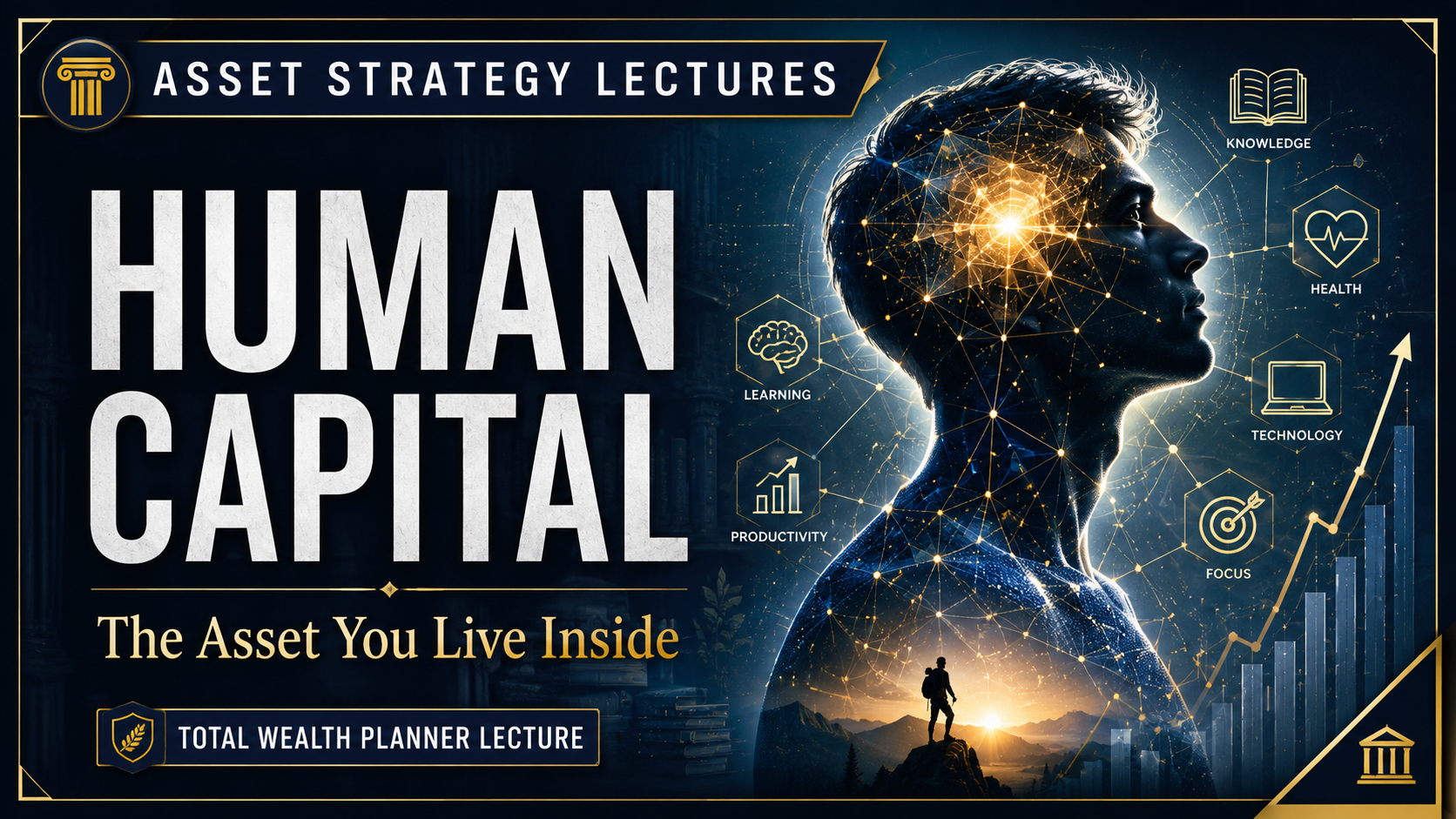
From Earning Capacity to Human Possibility: Human Capital Lessons for the Total Wealth Planner
The central argument is that conventional financial planning tends to treat human capital as an assumption behind the cashflow forecast—salary, retirement age and perhaps future earnings growth. The literature we have reviewed suggests something much richer. Human capital is an asset that can be formed, developed, impaired, protected, maintained, concentrated, rendered obsolete, redeployed and transmitted across generations. More importantly, its value depends not merely on what a person possesses, but on whether they have the health, motivation, technology, opportunity and agency to use it.
Abstract
Human capital has traditionally been conceptualised within economics as the knowledge, skills, health and productive capabilities embodied within individuals. Financial planning has adopted a narrower interpretation, commonly treating human capital as the discounted present value of expected future labour income. This lecture reviews twenty-one studies spanning human capital theory, measurement, economic development, inequality, health, education, technological adaptation and intergenerational effects, and considers their implications for Total Wealth Planning.
The literature strongly supports the proposition that human capital is an investable and depreciating asset whose economic value depends upon education, health, experience, adaptability and the environment within which capabilities are deployed. It also reveals important limitations in reducing human capital to earning capacity. Human capital produces non-market benefits; interacts with physical, financial and social capital; contains both potential and realised dimensions; generates intergenerational effects; and may remain substantially underutilised despite being present.
The resulting implication for Total Wealth Planners is that human capital should not merely be valued. It should be stewarded. This requires planners to consider its formation, deployment, protection, maintenance, adaptability, realisation and transmission, while recognising that the ultimate purpose of human capital is not maximisation of economic output but expansion of human capability and agency.
Keywords: human capital; Total Wealth Planning; financial planning; agency; capability; education; health; productivity; technology; inequality; longevity; financial wellbeing.
1. Introduction: the missing asset on the personal balance sheet
A curious asymmetry exists in conventional financial planning.
A planner may devote considerable analytical attention to a client’s £250,000 investment portfolio while treating the asset responsible for producing perhaps several million pounds of lifetime earnings as little more than a line in a cashflow model.
That asset is human capital.
This omission is partly understandable. Human capital cannot readily be bought, sold or separated from its owner. Its value is uncertain. It is affected by health, labour-market conditions, technology, motivation, geography, family circumstances and individual preferences. Attempts to assign it a single capital value therefore risk considerable false precision.
Yet measurement difficulty does not make an asset unimportant.
The reviewed literature repeatedly identifies human capital as comprising knowledge, skills, experience, abilities and health, with some definitions extending further into motivation, behaviour, energy and mental and emotional wellbeing. Moyo’s review records the widening of the OECD definition from attributes relevant to economic activity towards those facilitating personal, social and economic wellbeing. Voichuk’s review similarly describes Schultz’s conception as including knowledge, skills, experience, health, abilities, motivation and energy.
This immediately creates a conceptual problem for financial planning.
If human capital is reduced to the present value of salary, then the measurement captures one potential output of the asset while mistaking that output for the asset itself.
The Total Wealth Planner therefore needs a wider conception.
A useful working definition emerging from today’s literature is:
Human capital is the embodied capacity of a person to understand, create, adapt, contribute and generate valued outcomes over time, together with their ability and opportunity to deploy that capacity.
This definition deliberately moves beyond earning power without denying its economic importance.
2. From expenditure to investment
One of the most consistent findings across the literature is that human capital can be deliberately accumulated.
Education, training, healthcare, workplace experience, adult learning, information acquisition and migration repeatedly appear as forms of investment in human capability. Schultz’s classic categories—summarised across several of today’s papers—include health expenditure, on-the-job training, formal education, adult education and migration in response to employment opportunities.
This reframes a familiar household distinction.
Conventional accounting separates spending from saving. Human-capital theory shows that some expenditure is simultaneously consumption and investment.
A course may cost money today while increasing future earnings.
Healthcare may improve current wellbeing while preserving future productive capacity.
Relocation may incur immediate expenditure while moving existing capability into a labour market where it commands a higher return.
Experience may even involve accepting lower current remuneration in exchange for future capability.
For the Total Wealth Planner, the question therefore changes from:
How much of your income should you invest?
to:
How much should you invest in the asset producing the income?
This is not an argument that every degree, qualification or training course is worthwhile. Human-capital investment requires the same discipline as other capital allocation. The expenditure needs to create additional capability, resilience, opportunity, wellbeing or future value.
It does, however, challenge any planning model that automatically regards contributions to an ISA as investment while categorising retraining, therapy, professional development or health expenditure merely as costs.
3. Human capital has an asset lifecycle
The literature supports treating human capital as an asset with a lifecycle.
Leka and Pojani make this unusually explicit in a family-finance context. They identify three central decisions: acquiring human capital, protecting it and maintaining it. They argue that human capital depreciates, making continuing education and flexibility throughout working life necessary rather than luxurious.
Today’s wider evidence allows that lifecycle to be extended:
Form → Develop → Deploy → Protect → Maintain → Adapt → Redeploy → Transmit
Formation includes childhood health, education and environment.
Development includes qualifications, work experience, practice, information and accumulated judgement.
Deployment converts capability into activity.
Protection reduces risks of catastrophic loss or impairment.
Maintenance prevents deterioration.
Adaptation responds to technological and economic change.
Redeployment moves capability into new roles, sectors, organisations or forms of contribution.
Transmission captures the intergenerational effects through which one generation affects the capabilities of another.
This is much closer to portfolio stewardship than to cashflow forecasting.
4. Health is not adjacent to human capital. It is part of it
The relationship between education and health appears repeatedly in the studies.
Akinyemi and Abiddin describe them as effectively inseparable: education creates intellectual capability, while health maintains the person’s ability to exercise it.
The distinction is important because possessing an ability and being able to deploy it are different things.
A highly qualified person experiencing substantial deterioration in physical or mental health may retain most of their knowledge while losing much of their capacity to apply it.
We might therefore distinguish:
Human capital stock — what the person is capable of doing.
Human capital capacity — how much of that capability can currently be exercised.
This makes health relevant far beyond conventional protection planning.
Income protection and life insurance address particular consequences of loss. Human-capital stewardship asks an earlier question:
What protects the functioning of the asset itself?
Sleep, mental health, physical health, workload, nutrition, relationships, recovery and occupational design may consequently become financially relevant without needing to be financial products.
5. Longevity changes the economics of investing in yourself
Castello-Climent and Doménech provide one of the most important mechanisms encountered in today’s literature.
Their model links life expectancy and education decisions. People expecting longer lives have a longer period over which to receive the returns from human-capital investment and therefore stronger incentives to acquire education. Conversely, shorter life expectancy raises the effective opportunity cost of investing in education.
This has a striking implication for retirement planning.
A longer life does not merely mean:
You need a larger pension pot.
It may also mean:
Investing in yourself remains economically rational for longer.
If a 55-year-old could have another thirty productive years, a new qualification, business, profession or technological capability may represent an entirely reasonable investment.
This suggests the concept of a Human Capital Horizon: the period over which current investment in capability may continue generating benefits.
Longevity therefore changes both sides of the Total Wealth balance sheet.
It increases the period that financial capital may need to support.
But it may also increase the productive life of human capital.
6. Human capital depreciates in more than one way
Human capital does not simply rise through education and fall through ageing.
Today’s studies suggest several forms of deterioration.
Skills can atrophy through lack of use. Health can impair the ability to deploy them. Knowledge can become technically obsolete. Market demand can shift even while personal capability remains unchanged.
This last distinction deserves particular attention.
A person can remain equally capable while the economic value of their capability falls.
That is not personal deterioration.
It is human-capital repricing.
AI makes this distinction increasingly important.
The relevant question becomes less:
How skilled are you?
and more:
How valuable are those skills under the conditions likely to prevail next?
Human-capital risk therefore includes both capability risk—whether the person can still perform—and relevance risk—whether the environment continues to value the capability.
7. Adaptability may be the most durable human asset
Several studies connect human capital with technological adaptation.
The Vietnam study reports that education and health are significant dimensions of labour quality and notes that more highly educated workers can adapt to new technology more rapidly. Saksiriruthai similarly describes higher education as helping people understand and adapt new technologies and ideas within productive processes.
Appleton and Teal add an important contextual insight: educational returns can be much greater in modernising environments where new technologies are available for adoption than in relatively static environments.
This suggests that the most valuable human capital may not always be accumulated knowledge.
It may be the ability to acquire the knowledge required next.
For Total Wealth Planning in the AI age:
The safest skill may not be a particular skill. It may be the ability to acquire the next one.
Adaptive capacity therefore deserves explicit consideration alongside qualifications and experience.
8. Technology can amplify, substitute or transform human capital
Purmiyati’s Indonesian study introduces technological literacy explicitly into its empirical model and reports a positive association between regional income and education expenditure, domestic investment and technological literacy.
This suggests that digital capability is increasingly part of human-capital deployability.
A person may possess deep professional knowledge but receive diminishing returns from it if they cannot operate effectively with contemporary digital tools.
The Total Wealth Planner might therefore assess the relationship between a person’s human capital and technology as one of three broad states.
Technology can be complementary, amplifying capability.
It can be substitutive, reducing demand for capability.
Or it can be transformative, leaving the underlying capability valuable but requiring it to be recombined with something new.
This is far more useful than asking whether a profession is simply “safe from AI”.
9. Human capital has concentration risk
Becker’s distinction between general and specific human capital also has obvious planning relevance.
Some capabilities are widely transferable.
Others create substantial value primarily inside a particular firm, profession, technology, jurisdiction or institutional structure.
Two people earning £100,000 therefore need not possess equally resilient human capital.
One may be capable of moving readily between employers and sectors.
The other’s economic value may depend almost entirely on one organisation’s systems, one regulatory permission or one ageing technology.
Their current income is identical.
Their risk is not.
This can be understood as Human Capital Concentration Risk: excessive dependence of future opportunity upon a particular employer, occupation, industry, technology, location or institutional structure.
Traditional financial planning would probably enter £100,000 into both cashflows.
Total Wealth Planning should see two different assets.
10. Capability and credentials are not the same thing
Today’s papers repeatedly warn against treating educational attainment as equivalent to human capital.
Son notes the limitations of using years of schooling as a measure, particularly because quantity tells us little about educational quality. Appleton and Teal likewise discuss signalling and credentialism: higher qualifications may correlate with higher income because education creates productivity, because more able people acquire more education, or because institutions reward the credential itself.
This suggests a memorable distinction:
Credentials certify. Capability produces.
A qualification may nevertheless have considerable value. It may create capability, signal capability or provide access permission to an occupation.
But those are three different mechanisms.
The Total Wealth Planner therefore needs to look behind the certificate and ask what capability was actually acquired and how transferable that capability is.
11. Human capital can exist without being realised
One of the strongest themes emerging across the twenty-one studies is that having human capital is not the same as benefiting from it.
Son emphasises that education contributes economically only where capability can be employed productively; mismatches between education and labour-market requirements can leave highly educated people performing low-productivity work.
Muravska and colleagues similarly discuss educated unemployment, underemployment and graduates working in roles below their qualification levels.
Voichuk’s review distinguishes between potential and realised dimensions of human capital and observes that human potential need not result in realised benefits.
We can therefore distinguish four states:
Potential → Capability → Deployment → Realisation
Potential describes what might be developed.
Capability describes what has actually been developed.
Deployment describes what is being exercised.
Realisation describes the outcomes being produced.
This is fundamental.
A person can have enormous human capital and still experience poor economic outcomes because the asset is stranded.
12. Complementary capital determines what human capital can do
Appleton and Teal add an especially important systems insight.
Human and physical capital can be complementary. Their analysis warns against assuming that simply increasing education automatically increases economic outcomes. Skills require suitable technologies, capital and productive opportunities.
Their African evidence shows how expansion of education without corresponding physical investment can contribute to disappointing economic returns.
At the personal level, this translates remarkably well.
A photographer needs equipment.
A consultant needs digital tools and distribution.
A tradesperson needs tools and transport.
An entrepreneur may need capital and networks.
A knowledge worker increasingly needs AI capability.
Thus:
Capability without complementary capital can remain stranded.
A Total Wealth Planner should therefore sometimes recommend investment not in more capability, but in the infrastructure that allows existing capability to generate value.
13. Human capital has an enabling environment
Daru’s four-pillar framework includes education, health and wellness, workforce and employment, and an enabling environment encompassing infrastructure and legal conditions through which returns to human capital are produced.
Muravska and colleagues demonstrate what happens when that environment is dysfunctional: corruption, weak institutions, labour-market mismatch and inadequate opportunities can prevent human-capital investment from producing its intended return.
This reinforces the idea that human-capital value cannot be evaluated independently of context.
A capability possesses different value depending on where it is deployed.
Which leads to another useful concept:
Human Capital Arbitrage — moving capability from an environment where it is poorly recognised or rewarded to one where it can generate greater value.
That may involve changing employer, profession, business model, geography or country.
14. Aspiration and agency influence capital formation
Rizzica’s work adds a behavioural dimension.
Her research on educational interventions shows that aspirations can be changed and can affect continued participation in education, but that aspiration alone may be insufficient where financial or other constraints remain.
The broader lesson is that possibility and feasibility are different.
A person can believe something is possible without possessing the resources or conditions required to act.
Equally, someone may possess the resources while lacking confidence or perceived agency.
This suggests:
Agency creates possibility. Resources make possibility actionable.
For Total Wealth Planning, beliefs, confidence and aspirations are therefore not merely “soft” considerations.
They affect whether people invest in themselves at all.
15. Motivation and energy belong in the model
Voichuk’s review is valuable because Schultz’s conception explicitly encompasses motivations and energy as well as knowledge, skills, health and experience.
This produces a useful four-question diagnostic:
Competence: Can I do it?
Capacity: Do I have the health and energy to do it?
Motivation: Do I want to do it?
Opportunity: Is there somewhere worthwhile to do it?
A planner who considers only the first question may substantially overestimate effective human capital.
This becomes particularly important around burnout, career transitions and retirement.
A person may still be fully capable of doing their existing job while having no desire whatsoever to continue doing it.
That is not a failure of financial planning.
It is information about the asset owner’s objectives.
16. Retirement should not automatically mean capital destruction
Omowaye’s “Waste Power” hypothesis is imperfect terminology but contains an important idea: significant productive ability may remain unused among older people and people with disabilities because systems fail to recognise or accommodate it. His paper explicitly links human-capital development with inclusion of older and disabled people in productive activity.
For Total Wealth Planning, the relevant concept might be Dormant Human Capital.
This is capability that exists but is not currently being expressed because of missing opportunity, accommodation, technology, confidence or purpose.
Retirement planning should therefore distinguish:
ending compulsory employment,
ending a particular career,
ending paid activity,
and ending meaningful contribution.
These are not the same event.
A longer life should not necessarily produce a longer period of economic or intellectual disengagement.
17. Some human-capital investments have closing windows
Appleton and Teal highlight the long-lived and partly irreversible nature of some human-capital investments.
Childhood nutrition, health and education can affect later cognitive and physical outcomes in ways that cannot simply be repaired during adulthood.
Financial capital often allows delayed catch-up.
Human capital does not always.
A missed pension contribution can potentially be compensated for later.
A missed developmental window may not be recoverable.
This introduces the concept of Human Capital Windows.
The Total Wealth Planner should distinguish between investments that can reasonably be postponed and opportunities whose value decays with delay.
That can radically change capital allocation.
A pound directed towards health, childcare, education or retraining today may occasionally be more valuable than a pound contributed to financial assets precisely because the financial contribution remains possible later while the human opportunity may not.
18. Human capital creates both private and social returns
Human-capital returns are not restricted to wages.
Appleton and Teal distinguish private and social returns, noting that education and health can generate spillovers that the individual investor does not capture.
Moyo’s review similarly records broader benefits including health, personal wellbeing and social cohesion.
This matters for Total Wealth Planning because much valuable human activity takes place outside markets.
Parenting has value.
Caregiving has value.
Volunteering has value.
Mentoring has value.
Learning has value.
Community participation has value.
A present-value-of-wages calculation assigns much of this a value of zero.
Total Wealth Planning cannot.
It may therefore be useful to distinguish:
exchange value — what capability earns in a market;
and
agency value — what capability allows a person to understand, choose, create, contribute and participate in.
The latter may persist long after employment income disappears.
19. Human capital and human development must remain distinct
This is an important philosophical boundary.
Appleton and Teal distinguish human capital theory, which treats education and health as inputs into production, from human development, which recognises education, health and longevity as intrinsically valuable outcomes.
Kaur’s Sen-influenced account makes the distinction clearer still. Human development concerns the expansion of people’s capabilities, choices and freedoms rather than simply increases in per-capita income.
The Total Wealth Planner should therefore resist an uncomfortable implication of excessively economic language.
People do not exist to maximise their human capital.
Human capital exists to serve the person.
Human capital serves the human. The human does not serve the capital.
This is where agency must sit above optimisation.
20. Inequality is both a cause and consequence of unequal human capital
The final studies add another important systems loop.
Taş finds a positive association between tertiary education enrolment and income equality across 89 countries. The paper’s literature review also describes the reverse relationship: income inequality can inhibit investment in education and health where people face financing constraints, creating lower subsequent human-capital accumulation.
Castello-Climent and Doménech provide an especially powerful intergenerational mechanism. Lower parental human capital can influence children’s life expectancy, which affects incentives to invest in education and may reinforce poverty across generations.
The result is a reinforcing loop:
Low resources → less human-capital investment → fewer future options → lower resources.
And its positive counterpart:
Resources → capability investment → greater optionality → greater future resources.
This could reasonably be called Human Capital Compounding.
It also means that Total Wealth Planning should examine not only family financial wealth but the distribution of capability-development opportunities inside the household.
21. Human capital is intergenerational wealth
Financial inheritance receives enormous attention in financial planning.
The literature suggests that human inheritance may be at least as consequential.
Appleton and Teal describe favourable effects of educating one generation upon the cognitive skills and health of the next, including health effects that may extend beyond one generation.
Thus:
Financial inheritance transfers assets. Human inheritance transfers capability.
Parents transmit far more than money.
They influence expectations, language, health, education, behaviour, confidence, networks and the environment within which children learn what is possible.
Inherited financial wealth is visible.
Inherited human-capital opportunity is much less so.
Two adults with identical bank balances may therefore start with radically different total wealth.
22. Human capital cannot safely be reduced to a single valuation
Moyo’s review examines cost-based, income-based and other measurement approaches. The lifetime-income method values human capital through the discounted value of expected future earnings, but this requires assumptions about earnings, survival, discounting and risk and omits many forms of non-market value.
Son likewise notes that individual skill is difficult to observe and that comparable measurement is problematic.
The problem is not that financial valuation is useless.
A present value of expected earnings may be highly informative for protection planning or asset allocation.
The problem arises when the estimate is mistaken for the thing being estimated.
A £1.2 million earnings valuation does not tell us whether the person:
likes their occupation;
could change occupation;
is healthy enough to continue;
is vulnerable to AI;
has transferable capabilities;
has unused creative potential;
could start a business;
could teach;
could care;
could contribute after retirement;
or possesses the agency to change direction.
The Total Wealth Planner should therefore prefer useful approximation over artificial precision.
23. A Human Capital framework for Total Wealth Planning
The twenty-one studies collectively suggest a coherent architecture.
Human capital can be understood through five states:
Potential → Stock → Deployability → Utilisation → Realisation
Potential asks what could still be developed.
Stock asks what capability already exists.
Deployability asks whether health, energy, motivation and circumstances permit its use.
Utilisation asks how much of that deployable capability is actually being exercised.
Realisation asks what economic, personal, family and social outcomes it generates.
Four surrounding systems then influence movement between these states.
Formation comprises health, education, experience, practice, training, information and development.
Infrastructure comprises physical capital, technology, social networks, institutional conditions and access.
Risk comprises loss, impairment, depreciation, obsolescence, concentration, mismatch, underutilisation and constraint.
Transmission comprises family, education, culture and intergenerational effects.
At the centre sits agency.
Because having capability is not enough.
A person must also be able to understand their circumstances, recognise alternatives, choose deliberately and act.
That is the point at which human capital becomes particularly relevant to Total Wealth Planning.
24. Implications for the Total Wealth Planner
The practical shift is profound.
The planner should not merely ask:
What do you earn?
When will you retire?
How much life cover do you require?
What percentage should you invest?
They should progressively become curious about a different set of questions.
What capabilities have you accumulated?
Which are transferable?
Which are becoming more valuable?
Which are becoming obsolete?
What is preventing existing capability from being fully used?
Where is your human capital excessively concentrated?
What complementary financial, technological or social capital would amplify it?
What investment in health or development would preserve it?
What capability do you want to acquire next?
Which opportunities have a closing window?
What part of your capability would you continue using even if you no longer needed the money?
What do you want to transmit to the next generation beyond financial assets?
The objective is not to turn every client into a productivity-maximising machine.
It is almost the opposite.
It is to help clients recognise that wealth exists partly within them and that financial capital should sometimes be deployed in service of developing, protecting and liberating that wealth.
25. Conclusion: from valuing human capital to realising human possibility
The conventional financial-planning treatment of human capital begins with future income.
Today’s literature suggests Total Wealth Planning should begin one level earlier.
Income is an output.
Behind it sits capability.
Behind capability sit health, education, experience, motivation, opportunity and environment.
And behind decisions about all of these sits agency.
The most important lesson from today’s study may therefore be expressed simply:
Human capital does not create wealth merely because it exists. Wealth emerges when capability meets opportunity, complementary resources and agency.
This changes the role of the planner.
The planner is no longer merely capitalising expected earnings and arranging financial assets around them.
They are helping a person steward the asset they live inside.
And that leads to the theme I would retain for this Academy lecture:
The Asset You Live Inside
Human capital is not simply earning capacity. It is developed human possibility.
The purpose of Total Wealth Planning is therefore not merely to calculate its value, but to help people form it, develop it, protect it, maintain it, adapt it, deploy it, realise it and transmit it—on their own terms.
References: studies reviewed for this lecture
- Castelló-Climent, A. & Doménech, R. (2008). Human Capital Inequality, Life Expectancy and Economic Growth. The Economic Journal, 118, 653–677.
- Daru, M. U. (2015). Human Capital: The Tool for Economic Growth and Development. International Journal in Commerce, IT & Social Sciences, 2(8).
- Akinyemi, G. M. & Abiddin, N. Z. (2013). Human Capital Developments: An Interdisciplinary Approach for Individual, Organization Advancement and Economic Improvement. Asian Social Science, 9(4).
- Rizzica, L. (2013). Essays on the Economics of Human Capital Accumulation. PhD thesis, University College London.
- Susan, O. I. (2020). Human Capital Development, Income Inequality and Economic Growth. The International Journal of Humanities & Social Studies, 8(3).
- Choriyevich, Y. S. & Qizi, C. M. S. (2022). The Importance of Human Capital Development in Ensuring Sustainable Economic Growth. International Journal for Research in Applied Science & Engineering Technology, 10(XII).
- Son, H. H. (2010). Human Capital Development. Asian Development Review, 27(2).
- Moyo, N. (n.d.). Measuring Human Capital: A Review of Methodologies. Peking University, Institute of Population Research.
- Kaur, S. (n.d.). Role of Human Capital Formation in Economic and Human Development.
- Kang, S. (n.d.). Human Capital Theory: A Review and Critique. University of Sussex.
- Omowaye, G. (n.d.). Further Theoretical Discourse on Human Capital Development. Lead City University.
- Leka, B. & Pojani, E. (n.d.). Human Capital – Theoretical and Statistical Study Focused Mainly on Education.
- Appleton, S. & Teal, F. (1998). Human Capital and Economic Development. Background paper prepared for the African Development Report 1998, Centre for the Study of African Economies, University of Oxford.
- Ha, C. T. & Nguyen Manh, C. (2019). The Relationship Between Human Capital and Economic Growth: A Case of Vietnam. Industrial Engineering Letters, 9(5).
- Ahmed, A. M. (2024). What Is the Major Relationship Between Human Capital and Economic Growth? Oda Bultum University.
- Muravska, T., Medukhanova, L. A. & Bekmurza, A. Zh. (2020). Problems of Development and Effective Use of Human Capital in Developing Countries. Central Asian Journal of Social Sciences and Humanities.
- Saksiriruthai, S. (2018). Human Capital as a Determinant of Long-Term Economic Growth. Chapter 13, IGI Global.
- Trifu, A. (2012). The Necessity of the Development of the Human Capital Concept. Philosophy, Social and Human Disciplines.
- Taş, B. (2022). The Effect of Human Capital on Income Equality: Cross-Sectional Analysis. Sinop Üniversitesi Sosyal Bilimler Dergisi, 6(1), 183–199.
- Purmiyati, A. (2019). The Impact of Human Capital on Economic Growth: An Education Approach. Advances in Economics, Business and Management Research, 101.
- Maksym, V. (2021). Scientific Approaches to the Understanding of Human Capital Concept. National Interest, No. 4.

