
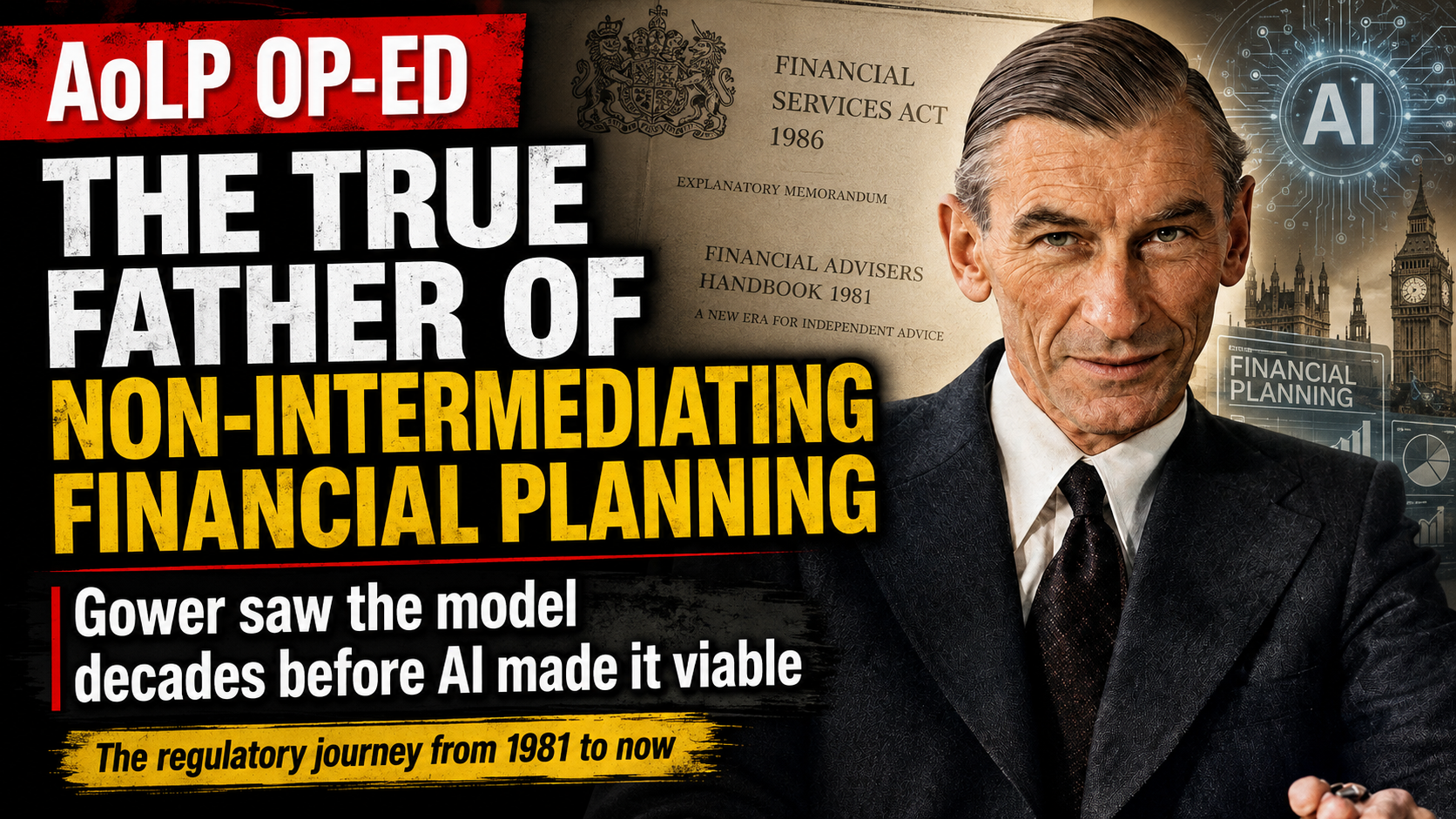
Non-intermediating financial planning is older than my career. AI may finally make it economically obvious.
I joined Refuge Assurance as an actuarial student in 1982.
At the time, Professor Laurence Gower was already conducting the Review of Investor Protection that would help reshape British financial regulation.
So there is an irony I had never appreciated until recently.
The idea of helping people with their financial decisions without necessarily intermediating a financial product is older than my entire working life.
It wasn’t invented by fintech.
It wasn’t invented by robo-advice.
It wasn’t invented by the Academy of Life Planning.
And it wasn’t created by some recent regulatory loophole.
Parliament was discussing the distinction explicitly by 1986.
What Parliament struggled to imagine was not whether such advice could lawfully exist.
It was whether anybody could make a living doing it.
That assumption may finally have run out of road.
Gower’s original problem
To understand why, we need to go back to the beginning.
Laurence Gower’s Review of Investor Protection began in 1981.
The problem he was trying to solve was not that ordinary people were incapable of making financial decisions.
It was that financial markets placed them in a structurally disadvantaged position.
The emerging investment world was increasingly complex. Products were difficult to understand. Information sat overwhelmingly with the professionals. Investors had to rely upon intermediaries who often knew far more than they did and who could simultaneously control information, recommendations and access to products.
The average investor was, as the subsequent Parliamentary debate put it, very much “in the hands of the expert.”
That is the essential Gower problem.
Not ignorance alone.
Not risk alone.
But structural asymmetry.
The intermediary possessed knowledge the citizen could not reasonably obtain.
The intermediary could influence what the citizen bought.
And frequently the intermediary’s own economic interests were entangled with the transaction.
That combination creates conduct risk.
Fraud was part of the problem, but Gower’s concern went much wider: misleading conduct, conflicts of interest, inadequate competence, misuse of client assets and other failures of market structure.
The system did not require everyone within it to be dishonest to become structurally untrustworthy.
Reasonable people could still be exploited.
Gower’s famous formulation captured the balance he was seeking: regulation should be no greater than necessary to protect reasonable people from being made fools of. (Hansard)
That contains two principles.
People should remain responsible for ordinary investment judgement.
But regulation should intervene where structural conditions prevent reasonable people from protecting themselves.
I call this the Gower Boundary:
Regulation should compensate for structural asymmetry, not replace human agency.
Then Parliament had to decide what “investment advice” actually meant
The first attempts at putting Gower’s thinking into legislation created another problem.
The definition of investment advice was too broad.
It risked catching accountants giving tax advice, lawyers explaining legal consequences, directors discussing corporate transactions and other professional work that happened to touch investments.
Parliament therefore faced a perimeter question.
What exactly was the regulated harm?
Was every discussion involving investments to require authorisation?
The answer was no.
By October 1986, the Government had deliberately narrowed the definition.
Investment advice would concern advice given to somebody in their capacity as an investor, about the merits of taking specified actions concerning investments.
More importantly, the Government expressly excluded advice about investment classes rather than particular investments.
Michael Howard explained to the Commons that advice about classes of investment, as opposed to particular investments, would not be caught. (Hansard)
The Lords debate is even more revealing.
The Government said it had “deliberately narrowed the definition to exclude general advice.” (UK Parliament API)
And then came a remarkable exchange.
Lord Cameron of Lochbroom explained that if someone restricted themselves to general advice and never mentioned particular investments, they would not require authorisation.
Then he added:
“It scarcely seems likely that he could sustain a business doing so.”
There, almost forty years ago, is the business model we are talking about today.
Parliament could imagine it legally.
It simply struggled to imagine it economically.
Why wouldn’t the model work in 1986?
Because sophisticated financial planning was expensive.
Think about what an adviser needed in 1986 to help somebody seriously understand their financial position.
Information was fragmented.
Investment research was expensive.
Prices and market data were difficult to access.
Financial modelling required specialist expertise.
Cash-flow projections involved substantial manual work.
Pension calculations were complex.
Tax information had to be researched.
Documents were paper.
Transactions depended on institutions.
Comparing financial products required proprietary information.
Expert knowledge was scarce.
Human processing capacity was expensive.
Someone had to pay for all of that.
And the easiest way to finance it was through the financial product.
So a commercial bundle emerged:
planning + advice + recommendation + transaction + product + assets + remuneration
Over time, those activities became so tightly bundled that the industry began to regard them as essentially the same thing.
Financial planning became associated with investment recommendation.
Investment recommendation became associated with implementation.
Implementation became associated with assets under management.
Assets generated recurring fees.
And eventually the economic tail began wagging the professional dog.
The industry did not simply sell financial planning.
It built an intermediation model capable of paying for financial planning.
That distinction matters.
The regulatory perimeter never required the bundle
The modern FCA Handbook still contains the descendant of that 1986 distinction.
PERG 8.26 is headed:
“The investment must be a particular investment.”
It states that generic or general advice is not caught by Article 53(1) and specifically gives financial planning as its first example. (FCA Handbook)
The current guidance therefore preserves an idea with deep historical roots:
Financial planning and regulated investment recommendation are not necessarily the same activity.
A planner might help someone understand:
Can I retire?
Should I work less?
How much is enough?
Should I repay debt?
How much liquidity should I hold?
What risks can I afford to carry?
How should I balance current consumption and future security?
What would happen if I lived to 100?
What are the implications of helping my children now?
Those can be highly personal, sophisticated and consequential questions.
But they do not automatically become regulated investment advice merely because money is involved.
The perimeter turns on the specified regulated activity.
In the case we are discussing, a critical boundary remains the recommendation concerning a particular investment.
That is why this distinction matters:
Financial planning chooses the destination.
Regulated investment advice may choose the vehicle.
The financial-services industry bundled the two.
The law did not require us to.
Then technology changed
This is where the 1986 assumption finally becomes interesting.
Today we have:
financial modelling,
cash-flow engines,
open banking,
real-time market information,
automated document analysis,
probabilistic forecasting,
AI reasoning,
digital records,
natural-language interfaces,
and rapidly falling information-processing costs.
The constraint Parliament assumed in 1986 has largely disappeared.
It is now entirely possible to give a person sophisticated financial decision-support without requiring a financial product to finance the exercise.
That changes the economics fundamentally.
The opportunity did not suddenly appear because the regulator liberalised financial planning.
The opportunity was already there.
The law did not suddenly create an opportunity for product-independent financial planning. Technology has made commercially viable an opportunity that the law appears to have left open since 1986.
That is the historical irony.
AI does something regulation could never fully do
Gower’s regulatory model responded to information asymmetry by making the intermediary safer.
That was rational.
If the investor must depend upon the expert, then regulate the expert.
Require standards.
Control conflicts.
Demand disclosure.
Supervise conduct.
Provide remedies when things go wrong.
But AI offers another possibility.
It can reduce the asymmetry itself.
The old model looks approximately like this:
intermediary knows
→ citizen depends
→ regulation constrains intermediary
The emerging model can look different:
citizen can understand
→ citizen can choose
→ citizen retains control
→ specialist support is used when required
That does not make regulation obsolete.
Nor does it eliminate fraud or conflicts.
It does something more interesting.
It may reduce the conditions from which much intermediary conduct risk arises.
Remember the structural problem.
Somebody else has been entrusted with influence over the investor’s capital.
If a citizen becomes able to independently:
understand their circumstances,
model different futures,
interrogate recommendations,
compare costs,
identify conflicts,
understand alternatives,
and decide when expert intervention is genuinely necessary,
then the balance of power changes.
The question becomes less:
How do we make dependency safer?
and more:
How much dependency is necessary in the first place?
This is not “AI instead of advisers”
That would simply replace one dependency with another.
An AI system can itself become structurally untrustworthy.
It can be opaque.
It can be biased.
Its operator can have commercial incentives.
It can persuade rather than inform.
It can create false confidence.
So restoring agency does not mean moving authority from the adviser to the machine.
It means moving authority back to the person.
AI should be infrastructure for agency.
The person remains the principal.
The AI helps them understand.
The planner helps them reason.
The regulated specialist intervenes where the activity genuinely requires regulated expertise.
That creates a different professional architecture:
capable citizen + AI infrastructure + proportional human support + regulated specialists when necessary
That is not DIY.
It is not traditional advice either.
It is assisted self-direction.
The opportunity for financial planners
This opens an extraordinary professional opportunity.
For forty years, planners have largely been forced into a false choice.
Either become part of the financial intermediation industry.
Or somehow persuade people to pay directly for planning that many had been conditioned to believe came “free” with the product.
AI changes that.
The planner no longer needs to personally perform every piece of information retrieval, calculation, modelling, documentation and monitoring.
Much of the processing can be moved into infrastructure.
That allows the human professional to concentrate on what humans are particularly valuable for:
judgement,
context,
challenging assumptions,
exploring values,
navigating uncertainty,
dealing with competing priorities,
supporting difficult decisions,
and recognising when specialist intervention is necessary.
The planner stops being the repository of information.
They become the client’s thinking partner.
And because that support no longer needs to be financed from assets, the commercial relationship can change too.
Less intermediation.
Less recurring extraction.
Less manufactured dependency.
More episodic support.
More transparent pricing.
More client capability.
More agency.
And the opportunity for citizens may be even bigger
The greatest opportunity is not a cheaper adviser.
It is a different relationship with expertise.
The successful planner of the future should not measure success by how long the client remains dependent upon them.
They should ask:
Does this person understand more than they did before?
Can they make more decisions independently?
Can they recognise when they need help?
Can they interrogate experts rather than simply defer to them?
Do they retain control over their financial life?
That brings us remarkably close to Gower’s original problem.
In the early 1980s, the investor was described as being very much in the hands of the expert.
Regulation tried to make those hands safer.
Perhaps the next stage of financial planning is to help people stand on their own feet.
The Gower Boundary for the age of AI
Forty-five years after Gower began his Review, we can restate his problem.
Where citizens face structural asymmetry that they cannot reasonably overcome, protection is necessary.
Where technology can genuinely eliminate or reduce that asymmetry, we should use it to increase human capability.
So perhaps the Gower Boundary needs a twenty-first-century companion:
Regulate unavoidable dependency. Design away unnecessary dependency.
I began working in financial services in 1982.
For virtually my entire career, the industry has assumed that sophisticated financial planning and financial intermediation naturally belong together.
History suggests otherwise.
Parliament recognised the distinction decades ago.
It simply doubted anyone could make a viable business out of sophisticated general financial advice without ultimately recommending particular investments.
In 1986, that was probably a perfectly reasonable assumption.
In 2026, it isn’t.
The law has not suddenly changed.
The economics have.
And that may offer financial planners something rather more important than another advice model.
It offers us the opportunity to finish separating a profession devoted to helping people live better financial lives from an industry devoted to intermediating their money.
Invest in your future earnings, not someone else’s AUM model.
The Total Wealth Planning accreditation pathway helps financial planners build the skills, tools and professional identity for an agency-first, non-intermediating practice.

