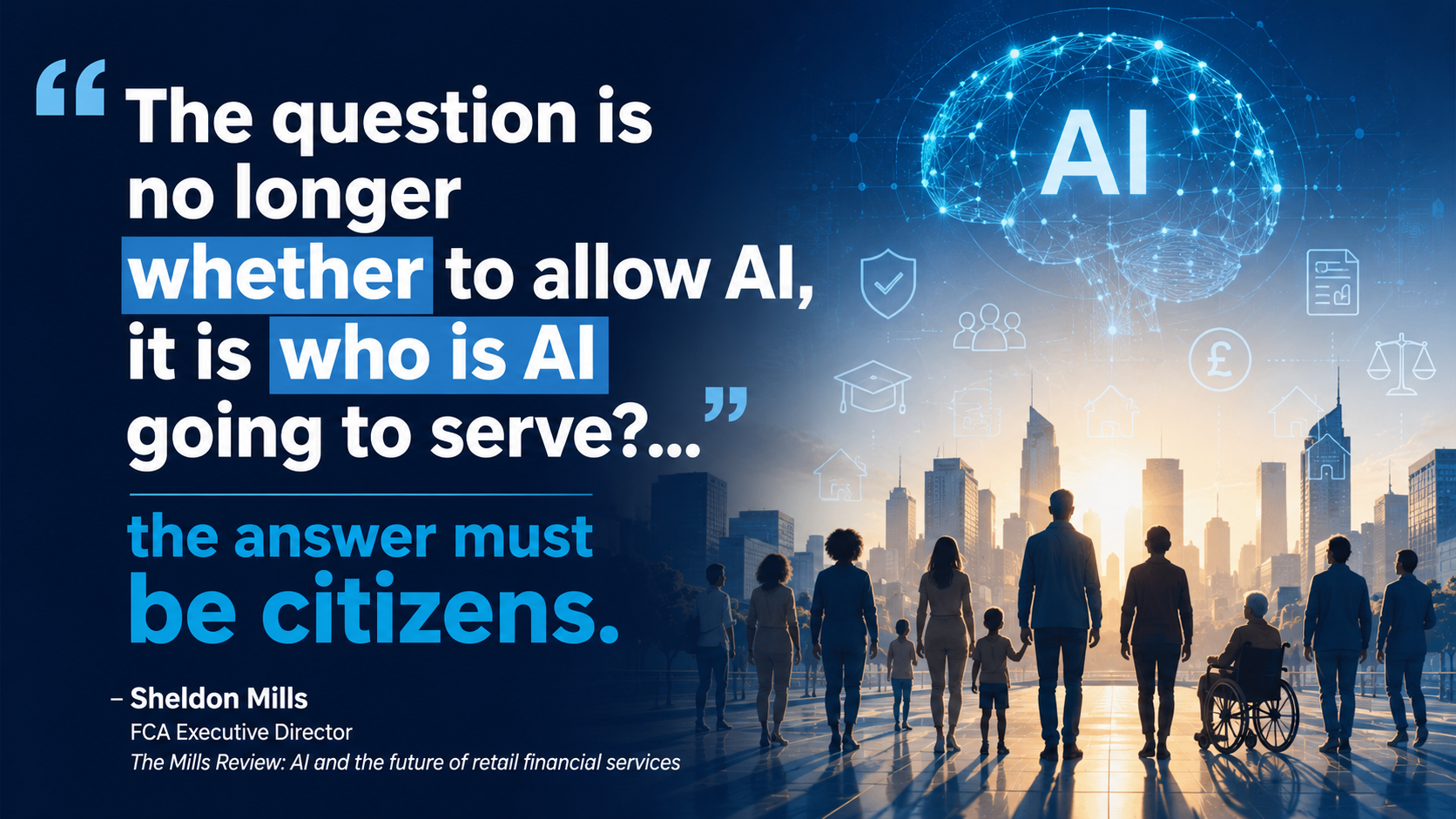
Why the FCA’s AI Review could transform financial planning—if we put citizens first
For more than two decades, policymakers have talked about the advice gap.
Millions of people cannot afford regulated financial advice, do not qualify for it, or simply choose not to use it.
The result has been a familiar debate.
Should advice become cheaper?
Should firms automate more?
Should regulation change?
The FCA’s new Mills Review suggests something much bigger is happening.
Artificial intelligence is changing not only how firms operate, but how people themselves make financial decisions.
That means we need a new conversation.
Not about the advice gap.
About the agency gap.
Advice has never really been the scarce resource
For years, financial services has assumed that the problem was a shortage of advice.
But perhaps the real shortage has always been something else.
Understanding.
Confidence.
Capability.
The ability to ask good questions.
The ability to understand complex contracts.
The confidence to compare alternatives.
The confidence to challenge poor value.
These are all forms of human agency.
Advice can sometimes compensate for a lack of agency.
It cannot replace it.
The Mills Review quietly changes the conversation
One recommendation stands out above all the others.
Among its seven priorities is the creation of:
“A trusted public-interest AI-enabled financial capability service.”
This may prove to be the most significant recommendation in the entire report.
Not because it proposes another regulatory initiative.
But because it recognises something profound.
The future of financial services cannot simply consist of firms becoming more intelligent.
Consumers must become more capable too.
AI changes the balance of power
Until now, financial services has largely operated on information asymmetry.
Firms knew more.
Advisers knew more.
Consumers depended upon experts to interpret products, contracts and choices.
AI changes that equation.
People can now upload pension statements.
Compare investment propositions.
Understand insurance exclusions.
Model retirement scenarios.
Question charges.
Review legal agreements.
Explore alternatives.
Not because AI makes decisions for them.
Because AI helps them understand enough to make better decisions themselves.
This is not automation.
It is capability.
The next gap is the Agency Gap
The FCA correctly identifies the advice gap.
But AI exposes something deeper.
Two people may have access to exactly the same financial products.
One understands them.
The other does not.
One asks difficult questions.
The other signs whatever is placed in front of them.
One notices poor value.
The other pays unnecessary charges for decades.
The difference is not access to advice.
It is access to capability.
That is the Agency Gap.
AI should become a thinking partner—not a replacement decision-maker
The Mills Review describes a future of increasingly autonomous AI systems acting on behalf of consumers within agreed boundaries.
That creates enormous opportunities.
But it also creates an important choice.
Do we build AI that replaces human judgement?
Or AI that strengthens it?
The Academy of Life Planning believes the second path is the one most consistent with long-term consumer wellbeing.
Our aim has never been to create AI that tells people what to do.
It is to create AI that helps people understand enough to decide for themselves.
That is a subtle difference.
But it changes everything.
Trust comes from control
The Mills Review found consumers are interested in AI, but only if three conditions exist:
- Trust
- Control
- Access
Those three principles align closely with restored human agency.
People are far more likely to trust AI when they remain in control.
Not when control quietly moves from adviser to algorithm.
The future should not be one of passive delegation.
It should be one of informed delegation, where people consciously decide what to automate, what to review, and what to retain for themselves.
What might a public-interest financial capability service look like?
Rather than recommending products, it would help people:
- understand financial documents before signing them
- identify risks they may have overlooked
- compare alternatives fairly
- prepare questions before speaking with a professional
- organise complex financial information
- recognise poor value
- build confidence without removing responsibility
It would not replace advisers.
It would improve conversations with them.
Professionals would spend less time explaining documents.
More time helping people think.
From advice to agency
The biggest message of the Mills Review is not that AI is coming.
That is already obvious.
The real message is that AI creates an opportunity to redesign financial services around informed, capable citizens.
The question is no longer whether firms should use AI.
They already will.
The public-interest question is whether consumers will have equally powerful tools working for them.
If AI simply makes financial institutions more efficient, we will have missed the opportunity.
If it helps millions of people understand, question and participate more confidently in their own financial lives, then AI will have done something far more important.
It will have restored human agency.
Rather than waiting for someone else to build the future, we’ve started building one possible answer. Academy OS is an open demonstration of what a trusted, citizen-first, AI-enabled financial capability service could become. Not to replace professional advice. Not to make decisions for people. But to help every individual understand more, ask better questions and remain firmly in control of their own financial life. If that vision resonates with you, come and explore it with us.