
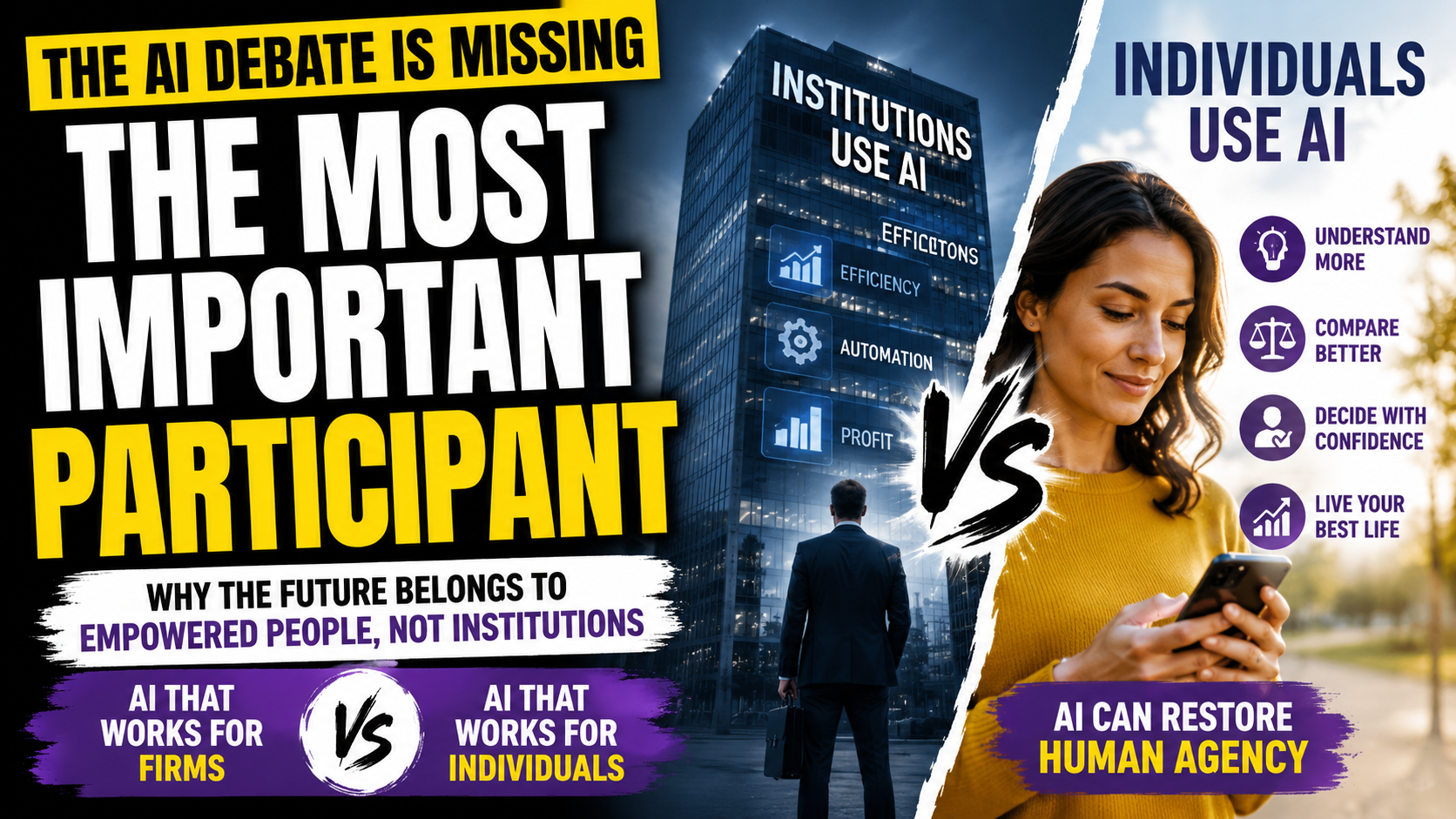
Why the future of financial planning won’t be decided by firms adopting AI—but by citizens doing the same.
Every week there seems to be another discussion about artificial intelligence in financial services.
Should advisers build their own AI?
Should firms rely on specialist providers?
Will AI replace paraplanners?
Are the productivity gains worth the investment?
These are important questions.
But they all share the same assumption.
That AI exists primarily to make financial firms more efficient.
What if that assumption is wrong?
The Missing Participant
The most important participant in the AI revolution isn’t the adviser.
It isn’t the paraplanner.
It isn’t the technology provider.
It’s the citizen.
For decades, the financial services industry has operated within a world of information asymmetry. Firms understood products, contracts, regulation and markets far better than the people buying them.
Professional advice evolved to bridge that knowledge gap.
Today, something fundamentally different is happening.
For the first time, ordinary people have access to remarkably capable AI systems that can help them understand pension contracts, compare charges, interpret investment documents, explore tax rules, organise complex life decisions and prepare informed questions before ever speaking to a professional.
This doesn’t replace professional judgement.
It changes who arrives at the conversation informed.
From Information Asymmetry to Capability Symmetry
This is the transition the profession has barely begun to discuss.
For years, technology has largely been deployed inside firms.
The next phase is technology working alongside individuals.
That creates something new: capability symmetry.
Both adviser and client can arrive equipped with powerful analytical tools.
The adviser’s value no longer comes from controlling access to information.
It comes from applying judgement, experience, ethics, accountability and human understanding to decisions that matter.
That is a healthier relationship for everyone.
AI Doesn’t Replace Thinking
Some worry that AI will stop people thinking for themselves.
It certainly could—if designed badly.
But AI can also strengthen independent thinking.
A well-designed system shouldn’t tell someone what to do.
It should help them understand:
- What does this contract actually say?
- What assumptions am I making?
- What questions haven’t I asked?
- What are the consequences of each option?
- What information am I still missing?
Those are agency-building questions.
The objective isn’t automated decision-making.
It’s informed decision-making.
The Future Isn’t Better Advice.
It’s Better Agency.
For decades, the industry’s success has often been measured by how effectively professionals could deliver advice.
The next chapter may be measured by something different.
How effectively professionals help people develop the confidence and capability to participate in their own financial decisions.
Advice remains valuable.
Expertise remains valuable.
Human judgement remains valuable.
But value increasingly comes through partnership rather than dependence.
What Institutions Need to Do
If citizens increasingly arrive equipped with AI, institutions will need to adapt.
That means moving beyond business models that rely on information advantage.
Instead, organisations should ask:
- Can our products withstand informed scrutiny?
- Can customers easily understand what they’re buying?
- Are our charges genuinely competitive?
- Can AI explain our terms in plain English without exposing hidden complexity?
- Are we helping people make good decisions, or simply easier sales?
These questions aren’t threats to good businesses.
They’re opportunities.
Firms offering genuinely good value should welcome more informed customers.
Better-informed consumers reward transparency, simplicity and fairness.
Poor-value products become harder to justify.
Good-value products become easier to recognise.
Markets begin to compete on quality rather than opacity.
A Different Role for Financial Planners
Far from making financial planners less important, this shift makes their human contribution more valuable.
Clients won’t need professionals simply to access information.
They’ll need them to interpret competing priorities, navigate uncertainty, understand family dynamics, challenge assumptions and exercise wisdom where algorithms cannot.
Planning becomes less about transferring authority.
More about strengthening capability.
Less about dependency.
More about partnership.
Restoring Human Agency
At the Academy of Life Planning, we believe AI should not simply make institutions more productive.
It should make people more capable.
The purpose of technology should be to restore human agency—not replace it.
That means designing systems that help people understand before they decide, question before they commit, and participate more confidently in shaping their own futures.
The AI debate isn’t really about technology.
It’s about where capability resides.
One future concentrates intelligence inside institutions.
The other distributes it across society.
We believe the second future creates stronger citizens, healthier markets and more meaningful relationships between professionals and the people they serve.
That isn’t the end of financial planning.
It may be its most important evolution.

