
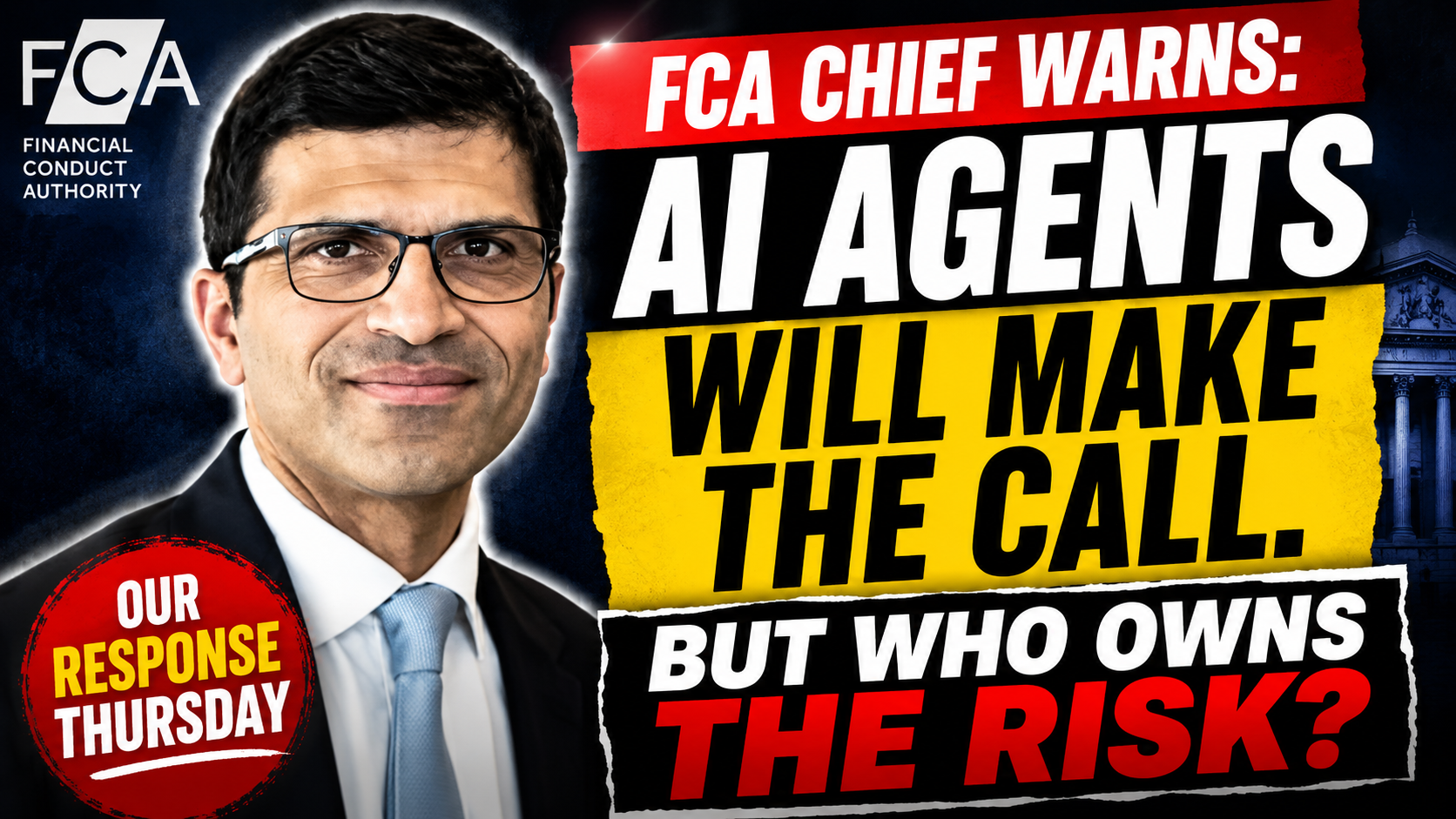
This week, FCA Chief Executive Nikhil Rathi made it clear that artificial intelligence is moving beyond assistance and into action.
The next phase, he argued, is not simply AI helping people analyse information. It is the emergence of agentic systems that can coordinate, transact and execute decisions on behalf of others. The FCA has signalled its intention to support innovation, encourage experimentation and help the UK become a leading AI economy.
Yet hidden within the speech is a deeper question that may prove more important than any sandbox, accelerator or innovation programme.
If AI agents are increasingly making decisions and taking actions in financial services, who should they work for?
Should they work for the institutions that manufacture products, distribute services and manage customer relationships?
Or should they work for the individuals whose money, opportunities, risks and life outcomes are affected by those decisions?
The financial services industry appears to be assuming the former.
Much of the current conversation focuses on how banks, platforms, wealth managers and advisers can deploy AI to improve efficiency, automate processes and scale existing business models. In this vision of the future, the institution remains at the centre and AI becomes a more powerful extension of institutional capability.
But there is another possibility.
What if every individual had access to an AI agent that acted primarily in their interests?
What if technology reduced dependence on institutions rather than increasing it?
What if AI became a tool for restoring human agency rather than simply scaling professional expertise?
These questions become even more important when considered alongside the FCA’s observation that accountability for regulated activities and outcomes must remain clear.
That raises a practical challenge.
As agentic systems become capable of recommending, preparing, representing and eventually executing decisions, how do we preserve accountability without stifling innovation?
The answer may not lie in treating AI purely as a firm-side technology problem.
It may require a new framework for human-AI collaboration in which authority, responsibility and delegation are explicitly defined.
In other words, the challenge is no longer simply regulating AI.
The challenge is designing a future in which AI strengthens human agency rather than replacing it.
The real question emerging from the FCA’s speech is therefore not whether agentic finance is coming.
It is.
The question is whether the age of agentic finance will create greater dependence on institutions—or greater agency for individuals.
The answer to that question may determine the future shape of financial services itself.
I think this speech is remarkably aligned with where AoLP is heading, but it also highlights a strategic fork in the road.
The FCA is effectively saying:
- AI will increasingly act, not just advise.
- Agentic systems will coordinate and transact.
- Consumers will delegate decisions to machines.
- Firms should scale rapidly.
- Accountability must remain clear.
The interesting question for AoLP is:
Who is the principal, and who is the agent?
Most of the financial services industry appears to be interpreting agentic AI as:
Consumer → delegates to institution → institution’s AI acts.
That is essentially an extension of the existing advice model. The adviser, platform, provider, bank or wealth manager remains the centre of gravity. The AI simply scales the institution.
AoLP’s direction is almost the opposite:
Consumer → owns AI → AI acts for consumer → institutions compete for access.
In other words, the FCA speech is largely about scaling AI inside firms, whereas AoLP is about scaling AI on the consumer side.
That distinction matters enormously.
The sentence that jumped out at me was:
“Accountability for regulated activities and outcomes must remain clear.”
That is essentially the challenge our Agency Constitution is trying to solve.
If Navigator™ starts performing delegated tasks, there needs to be a clear framework around:
- What the human decides.
- What the AI recommends.
- What the AI prepares.
- What the AI executes.
- When human approval is required.
That is almost exactly the Delegation Ladder we’ve been developing.
The deeper strategic implication is that the FCA appears to recognise that agentic finance is coming but is still viewing accountability largely through the lens of regulated firms.
AoLP’s emerging thesis is that accountability can sit with the individual principal, provided the system is transparent, explainable, and operating within clearly defined delegation boundaries.
This is why our concept of Agency Infrastructure may become more important than financial planning itself.
The industry is asking:
“How do we scale advice using AI?”
AoLP is asking:
“How do we scale human agency using AI?”
Those are not the same question.
In fact, this speech strengthens several AoLP themes:
- Advice out. Agency in.
- Consumer-side AI as a public-interest use case.
- Total Wealth Planner™ as an agency-restoration facilitator rather than an advice-giver.
- Navigator™ as a digital fiduciary acting under the authority of the individual.
- The Agency Constitution as a governance layer for agentic finance.
- The Delegation Ladder as a practical control framework for AI execution.
The biggest opportunity I see is that the FCA is currently focused on firms deploying agentic systems. Very few people appear to be discussing what happens when millions of consumers have their own financial agents.
That may be the next debate.
A question worth posing in our commentary might be:
“If agentic AI is going to make financial decisions and execute transactions, should those agents belong to institutions—or to the people whose lives they affect?”
That is where AoLP has a genuinely differentiated position.

