
For decades, we have been encouraged to place our trust in institutions.
Banks hold our money. Platforms hold our conversations. Governments hold our records. Technology companies hold our digital lives.
In return, we are promised convenience.
Most of the time, the arrangement works.
Until it doesn’t.
A company is acquired. A platform changes its terms. An account is suspended. A service closes. A data breach occurs. A trusted provider disappears.
At that moment, an uncomfortable question emerges:
Who actually owns the information that describes your life?
The answer is often surprising.
In many cases, you do not.
You may have access to your information. You may be able to view it. You may even be able to download a copy of it.
But access is not ownership.
Ownership means something very different.
Ownership means that your information remains yours regardless of what happens to the organisation that helped create it.
That distinction sits at the heart of a fundamental design choice behind AoLP’s My Life™.
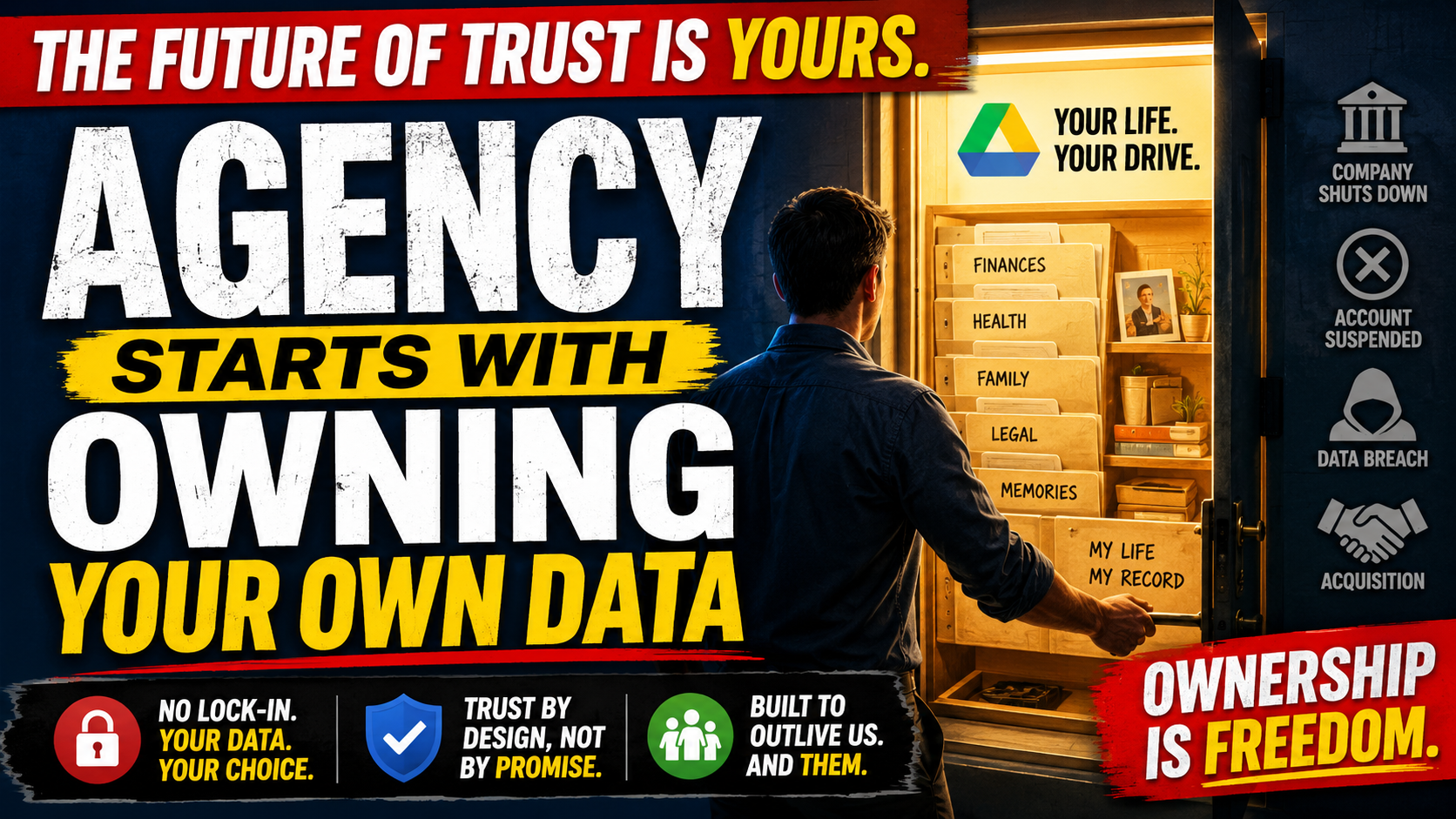
My Life™ is the Personal Economic Digital Twin — a sovereign personal life record, owned by the individual and stored in their own Google Drive, that every other Academy OS app reads from and writes to.
The Traditional Approach
Most digital platforms work in the same way.
You create an account.
You upload information.
The company stores that information in its own databases.
The service works well because everything is centralised.
Search is fast.
Integrations are easy.
New features can be added quickly.
From an engineering perspective, it is the obvious choice.
The challenge is that centralisation creates dependency.
If the platform disappears, your data may disappear with it.
If the company changes direction, you must adapt.
If the business is acquired, your information becomes part of an asset transfer you never participated in.
The relationship is built on trust.
You trust the organisation to do the right thing.
Case Study: LinkedIn and the Hidden Cost of Convenience
Most people use LinkedIn every day without thinking too much about who owns the underlying relationship.
After all, it feels like our profile.
Our connections.
Our posts.
Our professional reputation.
Yet the reality is more complicated.
LinkedIn is a centralised platform. The company owns and controls the infrastructure on which every profile, post, article, message and connection exists. Access to that ecosystem is governed by LinkedIn’s terms, not by the individual user.
The Leveller™ recently reviewed LinkedIn’s platform terms and identified a number of significant asymmetries. Among other things, the analysis highlighted LinkedIn’s broad licence to use and distribute content posted on the platform, its ability to modify terms, suspend accounts, and limit liability for losses arising from use of the service.
That does not mean LinkedIn is acting improperly.
It simply illustrates a fundamental reality of centralised platforms:
The platform owns the environment.
The user participates within it.
For most purposes, that arrangement is perfectly acceptable. LinkedIn provides enormous value. It enables professional networking on a global scale. Millions of people benefit from it every day.
The question becomes more interesting when we imagine storing not just professional posts, but an entire lifetime record.
Suppose your health records, legal documents, financial history, family archive, personal journals, evidence files and future plans all lived exclusively on a platform owned by somebody else.
What happens if:
- The platform changes its terms?
- The business is acquired?
- Your account is suspended?
- The service is discontinued?
- The organisation decides to use your information in ways you did not anticipate?
These are not criticisms of any particular company.
They are questions about dependency.
The more important the information becomes, the more important ownership becomes.
LinkedIn demonstrates the trade-off clearly.
Centralisation delivers convenience, scale and powerful features.
Sovereignty delivers independence, continuity and control.
Neither model is free.
Each carries costs.
The real question is which model is more appropriate for information that may need to survive for decades, outlive the organisation that created the software, and potentially pass from one generation to the next.
That is the question that led My Life down a different path.
Instead of asking people to trust us with their life’s most important information, we asked a different question:
What if they kept ownership of it themselves?
LinkedIn acquires a worldwide, transferable, sublicensable licence to use, copy, modify, distribute, and publicly display everything you post, without additional consent or payment. This means Microsoft and its affiliates can exploit your professional content commercially. Even after you delete content or close your account, the licence survives if LinkedIn has already sublicensed it to others, leaving you with no practical recourse to claw back your material.
And,
LinkedIn can restrict, suspend, or terminate your account for breach of its broadly written Professional Community Policies, which it can also change unilaterally. There is no contractual right to appeal, no defined timeframe for review, and no obligation to restore an account wrongly suspended. For professionals whose livelihoods depend on LinkedIn access, this represents a severe and unchecked power.
The Alternative: Sovereign Data Ownership
My Life™ takes a different approach.
Instead of storing a person’s life record in an Academy of Life Planning database, the information lives in a Google Drive account controlled by the individual.
The Academy provides the software, structure, standards and intelligence.
The individual owns the data.
This may sound like a subtle distinction.
It is not.
It changes the relationship completely.
If the Academy ceased to exist tomorrow, the life record would remain exactly where it already sits: in the person’s own account.
There is no export process.
There is no migration project.
There is no request to retrieve data.
The information never belonged to us in the first place.
Why This Matters
The Academy exists to restore human agency.
Agency is the ability to act intentionally and independently in your own life.
Yet agency is difficult to achieve if the most important information about your life is controlled by somebody else.
A lifetime record may eventually contain:
- Financial information
- Health information
- Family records
- Legal documents
- Property records
- Career history
- Learning records
- Personal reflections
- Evidence relating to disputes or investigations
These are among the most sensitive assets a person possesses.
They are also assets that may need to survive for decades.
Possibly generations.
If a life record is intended to outlive the company that created the software, then the ownership model matters enormously.
Trust By Design
Many organisations promise to respect privacy.
Most genuinely intend to.
The difficulty is that intentions can change.
Leadership changes.
Ownership changes.
Commercial pressures change.
Policies change.
A trust model based entirely on promises remains vulnerable to future decisions.
A trust model based on architecture is different.
When an organisation never possesses the underlying data, its ability to misuse that data is dramatically reduced.
Trust becomes structural rather than contractual.
It is built into the system itself.
The Honest Trade-Offs
There is a reason most technology companies do not build this way.
It is harder.
Much harder.
Sovereignty introduces friction.
If someone deletes information from their own account, the Academy cannot simply restore it from a master database.
Integrations between applications become more complex because each application must respect individual ownership boundaries.
Certain AI features become slower and more difficult to implement.
The platform becomes partially dependent on the capabilities and policies of providers such as Google.
In short, convenience is sacrificed.
Engineering becomes more complicated.
Progress becomes slower.
These are real costs.
They should not be ignored.
The Bigger Question
Ultimately, this is not a technology debate.
It is a philosophical one.
For decades, society has largely accepted a model in which institutions accumulate information, authority and control.
That model often produces convenience.
It can also produce dependency.
The alternative is not necessarily easier.
It requires more thought, more responsibility and more intentional design.
Yet it offers something increasingly rare in the digital age:
Ownership.
The Academy’s belief is simple.
If we are serious about restoring human agency, then agency cannot begin with dependency.
It must begin with ownership.
And in a digital world, ownership starts with data.
The question is not whether organisations can be trusted.
The question is whether people should have to trust them in the first place.
That is a very different future.
And perhaps a more resilient one.

