
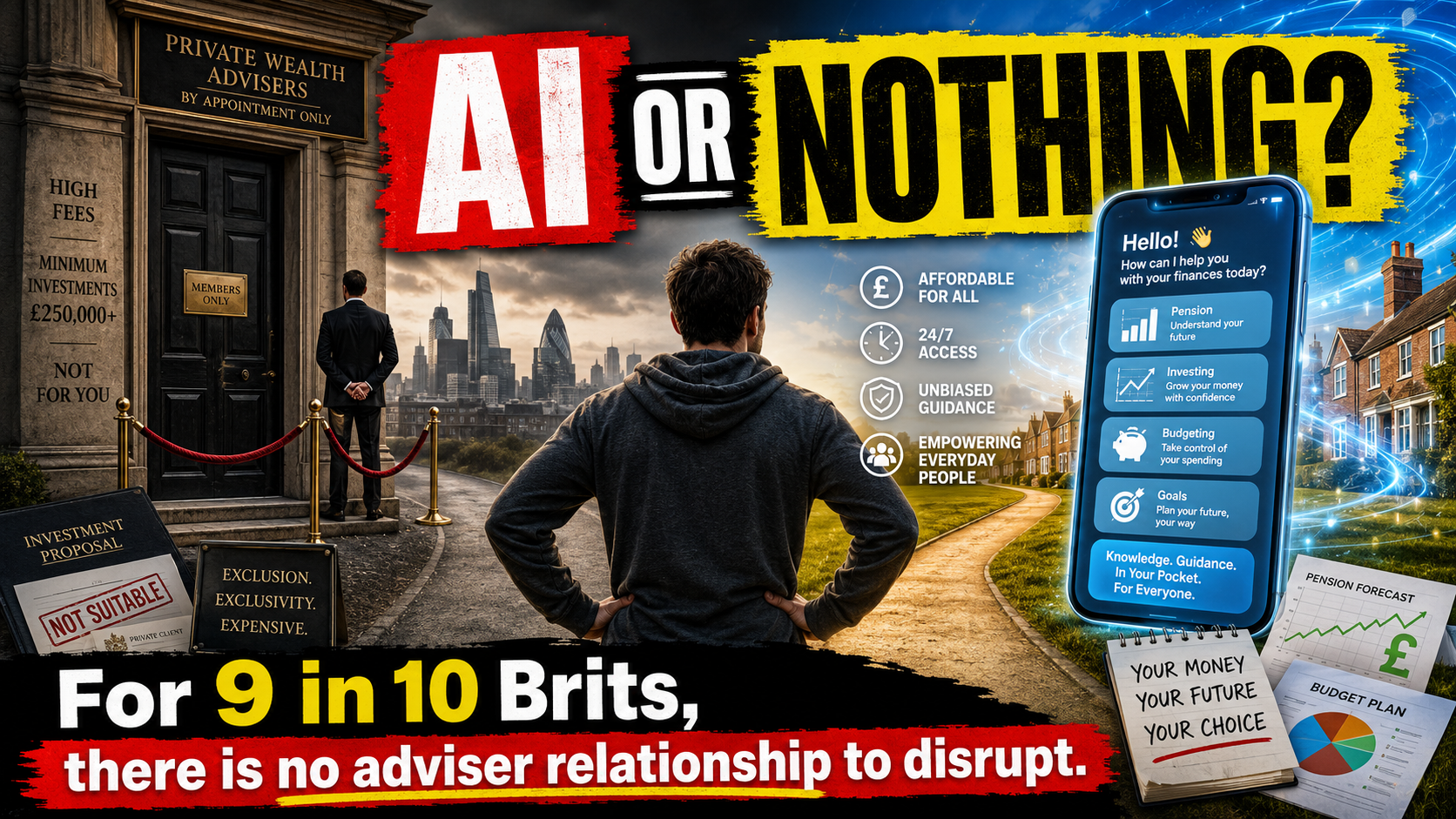
When most people cannot access financial advice, should we be asking whether AI threatens advisers — or whether it finally gives the unsupported majority a first step back to agency?
Source: 9 in 10 advisers expect AI to affect client relationships, Financial Planning Today, 5th June 2026.
The story says 68% of advisers are concerned about clients turning to AI instead of human advisers;
- 89% expect AI to affect the traditional client-adviser relationship;
- 55% think AI will complement their role;
- 20% are already exploring hybrid advice; and
- 16% see an urgent need to adapt.
The survey covered 333 advisers across Openwork and 2plan between 10 April and 4 May 2026.
My view is this: the industry is beginning to recognise AI as a relationship disruptor, but it is mostly interpreting the disruption through the lens of adviser productivity, adviser relevance, and hybrid advice models. That is understandable, but incomplete.
The deeper shift is not “AI helps advisers serve clients better.”
The deeper shift is: “AI helps clients become less dependent on advisers for clarity, preparation, challenge, understanding, and decision support.”
That does not remove the value of good human planners. It changes where their value sits.
The weak adviser response will be defensive: “Clients may misuse AI, so they need us more.”
The stronger response is developmental: “Clients are becoming more capable. How do we help them use AI safely, intelligently, and with more agency?”
This is where AoLP’s positioning is very strong. The Openwork framing still assumes the traditional client-adviser relationship remains the centre of gravity. AoLP can say: the centre of gravity is moving back to the individual.
There is also a consumer-protection angle. Advisers are right to worry about people using AI as if it were regulated personal financial advice. AI can hallucinate, misunderstand tax rules, overstate confidence, or miss emotional and family context. But there is a difference between AI replacing advice and AI restoring agency. The industry often collapses those two ideas into one threat.
That distinction matters.
Used badly, AI becomes unregulated pseudo-advice.
Used well, AI becomes a second brain: helping people organise facts, understand trade-offs, prepare questions, test assumptions, identify missing information, and walk into professional conversations less vulnerable.
For advisers, the uncomfortable truth is that AI may expose how much of “advice” has been charged for as complexity management, document interpretation, education, reassurance, and process navigation. Those are exactly the areas AI can now support at low cost. The remaining human value has to be more relational, ethical, contextual, and genuinely wisdom-led.
So the opportunity is not “AI plus adviser equals better advice.”
It is closer to:
“AI plus human agency equals a better-prepared client. The future planner is not the person who keeps the client dependent. It is the person who helps the client become more sovereign.”
That is a powerful AoLP response to this story. It also gives us a clean line:
The firms that treat AI as a way to protect adviser relevance may miss the point. The firms that treat AI as a way to restore client agency may define the future of planning.
What is the missing sentence in the whole industry conversation?
For the small minority who already have an adviser, the debate may be “AI + adviser.”
But for the overwhelming majority, it is not a choice between human advice and AI-assisted support. It is a choice between:
AI-assisted clarity — or no meaningful support at all.
The latest FCA Financial Lives data puts this sharply: only 8.6% of UK adults received regulated financial advice on investments, pensions or retirement planning in the previous 12 months. The FCA rounds this to 9% in some communications. That means around 91% did not.
That changes the ethics of the debate.
When advisers say, “Clients should not rely on AI,” the obvious response is: what are they supposed to rely on instead?
Most people cannot afford full advice, do not meet asset thresholds, do not trust the industry, or do not know where to begin. For them, banning or discouraging AI use does not protect them. It may simply preserve a capability gap.
The better framing is:
For the advised 9%, AI may enhance the adviser relationship.
For the unsupported 91%, AI may be the first accessible route back to financial agency.
That is not the same as saying AI should give regulated product recommendations. It should not. But it can help people:
understand their situation;
organise their documents;
identify risks and questions;
prepare for conversations;
explore options;
learn the language of money;
avoid signing things they do not understand;
and regain confidence before they are ready, willing, or able to speak to a professional.
So the real public-interest question is not, “Will AI replace advisers?”
It is:
How do we make AI safe, structured, accessible, and agency-restoring for the millions who were never being served by advisers in the first place?
That is where AoLP has a very strong position. The industry is worrying about AI disrupting the client-adviser relationship. But for most citizens, there is no client-adviser relationship to disrupt. There is only silence, complexity, and exclusion.
For the advised minority, AI may be an efficiency tool. For the unsupported majority, AI may be the first step back to agency.

