
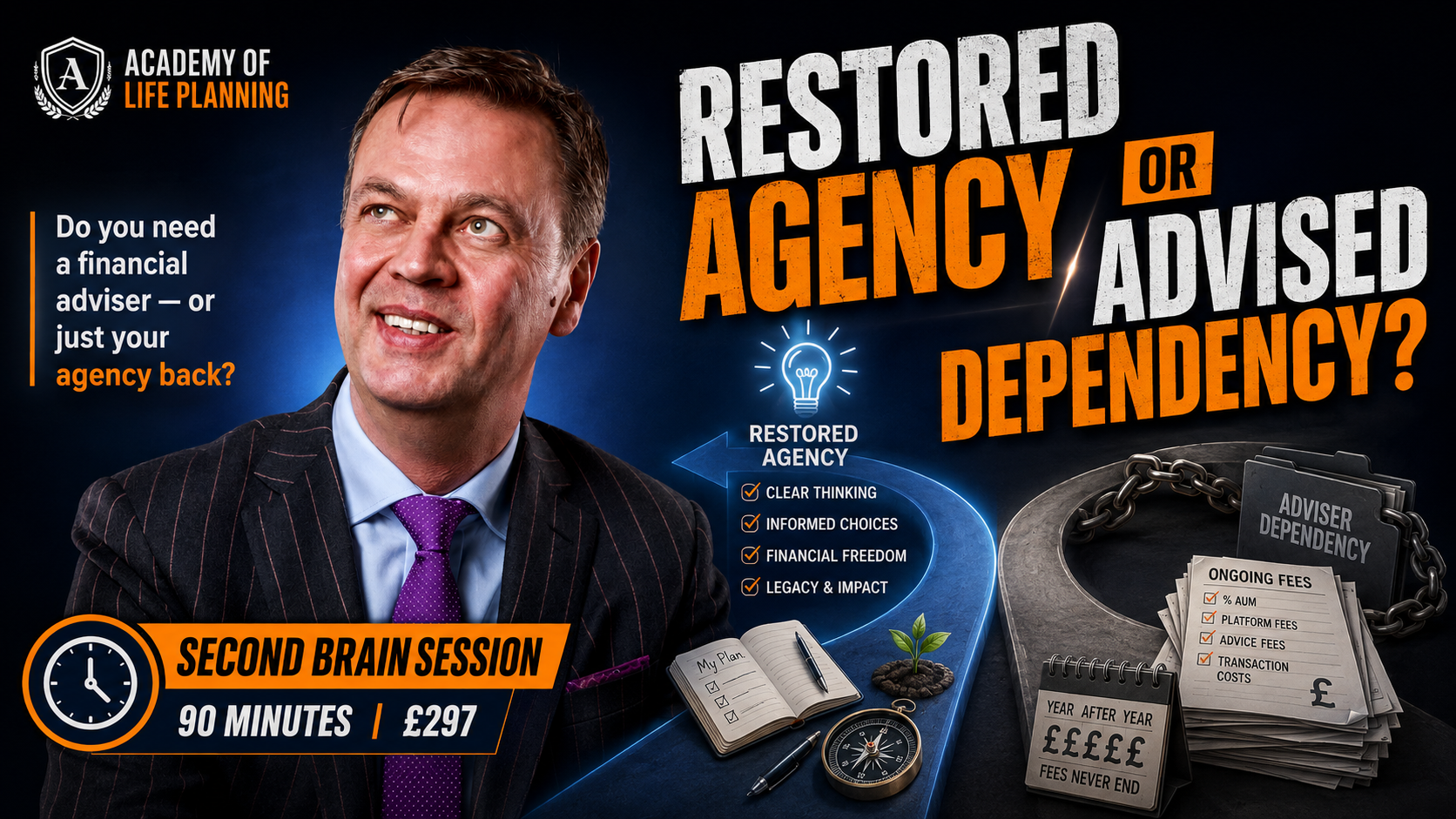
Why a temporary period of complexity should not automatically become a lifetime of advised dependency
Most people do not wake up one morning and decide:
“I would like to outsource my financial judgement for the rest of my life.”
Something usually happens first.
A bereavement.
A divorce.
Retirement.
Redundancy.
An inheritance.
A pension decision.
A tax problem.
A health event.
A business sale.
Or simply the gradual accumulation of enough financial complexity that the person who normally manages perfectly well begins to wonder:
“Have I missed something?”
That is often the point at which people enter the financial advice system.
And it is where an important choice can quietly disappear.
Because there are really two very different kinds of help available.
One is:
“I will assess your situation and tell you what you should do.”
The other is:
“I will help you understand the situation well enough to decide what you want to do.”
Both can have value.
But they are not the same thing.
One is primarily about delegated judgement.
The other is about restored agency.
And before you commit to years of ongoing advice and fees, it may be worth asking which one you actually need.
Temporary complexity can feel like permanent incapacity
Complex financial decisions can make highly capable people feel surprisingly uncertain.
That does not mean they are incapable.
It often means the decision has temporarily exceeded the amount of attention, knowledge or emotional bandwidth they can bring to it.
Bereavement is an obvious example.
Someone who has managed a household, career and finances competently for decades may suddenly struggle to process paperwork.
Brain fog.
Exhaustion.
Fear of making the wrong decision.
The financial system can interpret that moment as:
“This person needs an adviser.”
Perhaps they do.
But a more precise question is:
What kind of help do they need, and for how long?
Because a temporary reduction in confidence should not automatically become a permanent transfer of judgement.
There are two very different responses to capability asymmetry
When the person facing the decision knows far less than the professional or institution on the other side, there is a capability asymmetry.
That asymmetry is real.
The expert may know far more about pensions, tax, investments, regulation, risk and financial products.
The question is what we do with that imbalance.
One response is to preserve it.
The professional continues to know more.
The client continues to depend on the professional.
The professional recommends.
The client accepts.
The relationship continues.
Often the fees continue too.
Another response is to reduce the asymmetry.
Explain the system.
Organise the decision.
Surface the assumptions.
Show the trade-offs.
Identify the risks.
Help the person understand what they do and do not know.
Then let the person decide.
That is the difference between:
substituting judgement
and
supporting judgement.
Sometimes ongoing advice is genuinely right
It would be wrong to pretend everyone should manage everything themselves.
Some people actively prefer delegation.
Some situations are highly technical.
Some people do not want to spend time understanding the detail.
Some regulated decisions require a personal recommendation from an authorised adviser.
Some people simply value having someone continuously involved.
That is perfectly legitimate.
The problem is not ongoing advice.
The problem is treating ongoing advice as the default destination for every period of complexity.
Those are different propositions.
A person should be able to choose:
“I want to delegate this.”
But that is not the same as being led to believe:
“I cannot possibly manage this without permanent professional supervision.”
The better question is: what outcome do you want?
When someone is facing a difficult financial decision, I think there are two possible outcomes.
Outcome one:
“I now have an expert managing this for me.”
Outcome two:
“I now understand this better and feel more capable of managing it myself.”
Neither is automatically superior.
But they create very different futures.
The first may create continuing convenience.
It may also create continuing dependency and continuing fees.
The second requires more participation from you.
But it can leave you with something valuable:
greater decision capability.
That is the Academy model.
The Academy model is built around capability, not dependency
At the Academy of Life Planning, we start from a different assumption.
Most thoughtful people manage their own finances well most of the time.
What they sometimes need is not permanent intermediation.
They need:
clarity,
structure,
challenge,
professional judgement,
and enough cognitive assistance to get through the difficult bit.
Then they can carry on.
That is why we developed the Second Brain Session.
What is a Second Brain Session?
A Second Brain Session is a private 90-minute Zoom conversation designed to help you think clearly about one important financial decision.
It is not product advice.
It is not portfolio management.
It is not an attempt to gather your assets or place you into a permanent advice relationship.
It is simply an opportunity to put an experienced second brain alongside your own.
We work through the question.
We identify what actually matters.
We separate facts from assumptions.
We explore options and trade-offs.
We identify possible blind spots.
We surface what further information you may need.
And we work out what your next step might be.
The objective is not:
“Do what I tell you.”
It is:
“Understand this well enough to make the decision your own.”
Sometimes one good conversation is enough
People often assume complex financial decisions require a complete financial-advice process.
Sometimes they do.
Sometimes they require several planning sessions.
Sometimes they require regulated advice.
But sometimes the missing ingredient is much smaller.
A second perspective.
A structured conversation.
A question you had not considered.
An explanation of how the moving parts connect.
A bit of reassurance that you have not overlooked something obvious.
One good conversation can resolve weeks of uncertainty.
That is very different from committing to an indefinite advice relationship before you know whether you actually need one.
A Second Brain Session helps answer a bigger question
The session is not only about the financial decision itself.
It can also help answer:
What sort of support do I really need?
Perhaps the answer is:
“I can manage this myself now.”
Perhaps:
“I would benefit from a deeper Total Wealth Planning Project.”
Perhaps:
“This issue crosses into regulated product advice and I should speak to an FCA-authorised adviser.”
Perhaps:
“I genuinely want someone to manage this for me on an ongoing basis.”
All of those are valid outcomes.
The important thing is that the decision about the support model should also be yours.
This is what supported decision-making looks like
The Academy’s philosophy is simple.
When somebody is struggling with complexity, do not automatically take their judgement away.
Increase the support.
Increase the clarity.
Increase the capability.
Then see what they can do for themselves.
That is supported decision-making.
And it is very different from assuming that complexity should always result in ongoing professional dependency.
The measure of success is not:
How long can we retain this client?
It is:
Is this person more capable of understanding, choosing and acting than they were before?
That is an Agency Outcome.
The economics matter too
The financial-advice market frequently charges ongoing fees based partly or wholly on the value of assets under advice.
That can make sense for certain services.
But it creates an obvious question.
If the original problem was temporary complexity, why should the solution necessarily involve a fee that continues year after year?
And why should the cost of cognitive assistance automatically rise because the person has more assets?
Sometimes the complexity genuinely rises.
Sometimes it does not.
The Academy model therefore starts elsewhere.
Pay for the support you need.
Use more support when life becomes complicated.
Use less when it becomes simple again.
Return when something important changes.
That is proportional support.
Not permanent dependency by default.
A different model of professional success
Imagine two planners.
Planner A works with someone for 20 years and charges every year.
Planner B helps the same person understand their situation, increase their confidence, make a sound decision, and then says:
“You probably do not need me continuously. Come back when I can add value.”
Which planner has created the better outcome?
The financial-services industry has traditionally been very good at measuring:
assets under advice,
recurring revenue,
client retention,
and funds under management.
The Academy is interested in another measure:
agency gained.
Did the person leave the interaction more capable?
That is the professional outcome we care about.
The Second Brain Session is designed to test that
The Second Brain Session costs £297.
It includes:
a private 90-minute Zoom conversation;
focused exploration of the decision you are facing;
independent thinking support and professional judgement;
written summary notes;
and a view on whether any further planning or specialist help would add value.
No products.
No commissions.
No assumption that you need an ongoing adviser.
No pressure to continue.
Just one question:
What would help you make this decision your own?
Restored agency or advised dependency?
That is the choice worth making consciously.
Sometimes ongoing advice is the right answer.
But it should be the answer because you genuinely want continuing delegation and value the service you receive.
Not simply because you encountered one difficult period and were told that permanent dependence was the natural solution.
So before entering a lifetime advice relationship, ask:
Do I need someone to keep making these judgements for me?
Or:
Do I need enough support to become capable of making them myself?
That distinction could save you far more than fees.
It could preserve something more important.
Your agency.
Your judgement.
Your ability to author your own financial life.
Sometimes you don’t need a financial adviser.
Sometimes you simply need a trusted second brain in the room.
If you are facing an important financial decision and want clarity without handing over control, you can book a Second Brain Session for £297.
Book your Second Brain Session
Understand more. Choose more confidently. Stay in control.
Important information
Total Wealth Planner™ is a trading style of The Academy of Life Planning Limited, registered in England and Wales, Company No. 8016568.
We provide educational financial planning support, not regulated financial advice. We are not authorised or regulated by the Financial Conduct Authority and do not recommend or advise upon specific regulated financial products.
Our services are designed to improve financial understanding, decision-making capability and life-first financial planning.
Where you require a personal recommendation concerning a specific regulated financial product, you should consult an appropriately authorised financial adviser.

