
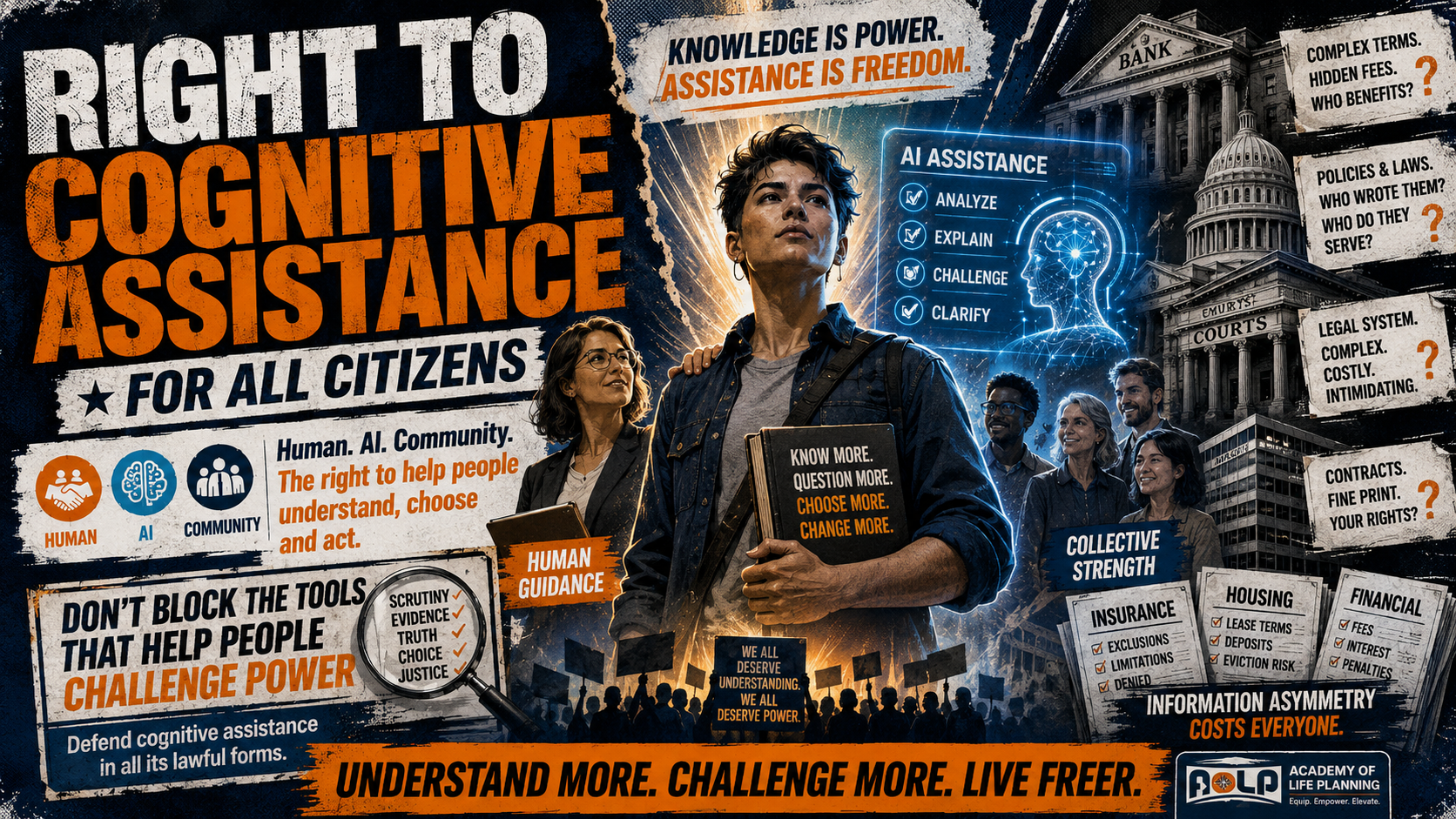
Why the principle of supported decision-making should not stop at disability — or at AI
We already accept a remarkable principle in law.
When somebody may struggle to make an important decision, the first response should not necessarily be:
“Someone else should decide for you.”
It should be:
“What support would help you decide for yourself?”
That distinction — between supported decision-making and substituted decision-making — has developed most clearly in disability and mental-capacity law.
I think its relevance is much wider.
Because people don’t lose practical agency only because of disability.
They lose it when one side of an important decision knows vastly more than the other.
They lose it through complexity.
Through jargon.
Through inaccessible information.
Through professional mystique.
Through asymmetric data.
Through institutional power.
Through stress and vulnerability.
And sometimes because somebody who benefits from their decision understands the system far better than they do.
Artificial intelligence has suddenly given us the technological ability to reduce that asymmetry.
But the principle should be bigger than AI.
I believe every person should have a Right to Cognitive Assistance.
The Right to Cognitive Assistance is the right of every person to access lawful human, technological and collective support that increases their capacity to understand, choose and act, while preserving their autonomy, will and decision authority.
And from that follows a regulatory principle:
No state, regulator, professional body or technology provider should unnecessarily restrict a person’s access to cognitive assistance merely because that assistance makes them more capable of challenging an institution, professional or authority.
That is not a right to have somebody else make your decisions.
It is almost the opposite.
It is a right to become better equipped to make them yourself.
We have already established the principle for vulnerable people
The idea is not radical.
Article 12 of the UN Convention on the Rights of Persons with Disabilities recognises that persons with disabilities enjoy legal capacity on an equal basis with others and requires access to the support they may need in exercising it. The UN Committee’s interpretation has repeatedly emphasised moving away from substituted decision-making towards systems that respect a person’s autonomy, will and preferences.
England and Wales embody a related principle in the Mental Capacity Act 2005.
One of its statutory foundations is that a person should not be treated as unable to make a decision until all practicable steps to help them make it have been taken without success. Someone cannot be deemed incapable simply because other people regard their decision as unwise.
Government guidance explains what this can mean in practice: provide relevant information, explain it differently, use pictures or other forms of communication, find the right environment and involve people who can help the individual express their choice.
Look at the philosophy underneath that.
The objective is not merely:
protect the vulnerable person.
It is:
preserve and support the person’s own capacity to decide wherever possible.
That is human agency.
And once you see the principle, an obvious question follows.
Why should supported decision-making stop at the boundary of disability?
Imagine somebody with full legal capacity trying to understand:
a pension transfer;
a mortgage repossession;
an employment dismissal;
an insurance rejection;
an investment promotion;
a motor-finance agreement;
a benefits decision;
a banking dispute;
a court claim;
or thirty years of correspondence with a financial institution.
Legally, they may possess complete capacity.
Practically, however, they can face an enormous cognitive asymmetry.
The organisation on the other side may have lawyers, algorithms, compliance departments, specialist vocabulary, case-management systems, historic records and institutional knowledge.
The citizen may have a letter.
We normally describe this as an information asymmetry.
But information isn’t quite enough.
Give someone 800 pages of disclosure and you may technically have given them the information while giving them almost no practical capacity to use it.
The deeper problem is a:
Cognitive asymmetry
One party possesses substantially greater capacity to interpret information, recognise significance, model consequences and navigate the system than the other.
That is precisely where cognitive assistance matters.
Cognitive assistance existed long before ChatGPT
We should be careful not to confuse the technology with the principle.
A cognitive assistant can be human.
A lawyer explaining a contract.
An advocate helping someone prepare an appeal.
A teacher making an unfamiliar concept understandable.
An interpreter bridging a language barrier.
A friend helping someone think through a difficult choice.
A financial planner helping someone understand how money fits into their life.
It can be technological.
A calculator.
A search engine.
Accessibility software.
A decision-support tool.
An AI assistant.
It can be collective.
A support group.
A trade union.
A consumer organisation.
A professional community.
Or it can combine all three.
That hybrid model is exactly where the Total Wealth Planner sits.
A Total Wealth Planner is a cognitive assistant
This helps define the profession much more precisely.
A Total Wealth Planner does not need to possess the client’s decision.
They help the client become better able to possess it themselves.
The relationship is:
Citizen = principal.
Total Wealth Planner = human cognitive assistant.
AI = scalable technological cognitive assistant.
Community = collective cognitive assistance.
The purpose of all three is to increase the citizen’s capacity to:
understand → choose → act.
That is fundamentally different from an intermediary whose economic or professional role requires the person to delegate the important judgement to them.
The important distinction isn’t:
human versus AI.
It is:
assistance versus substitution.
A good cognitive assistant can strongly influence somebody’s thinking.
Indeed, that may be precisely why the person sought assistance.
Influence itself is therefore not the problem.
The question is:
Does the assistance increase the person’s ability to exercise their own judgement, or replace their judgement with somebody else’s authority?
That distinction is about to become enormously important.
AI makes cognitive assistance abundant
For most of history, sophisticated cognitive assistance has been scarce and expensive.
You needed access to somebody who knew more than you did.
A solicitor.
An accountant.
A financial adviser.
A doctor.
An academic.
A specialist.
An institution.
AI changes the economics.
Someone can now upload a complicated document and ask:
“Explain this in ordinary English.”
“What assumptions are being made?”
“What does this clause mean?”
“What information is missing?”
“Compare these two accounts.”
“Does the evidence support their conclusion?”
“Show me where the parties disagree.”
“Help me construct a chronology.”
“What questions should I ask?”
“What options haven’t I considered?”
That doesn’t necessarily produce a correct answer.
AI can be wrong.
People can misunderstand it.
Professional expertise will continue to matter.
But those limitations do not erase the extraordinary shift.
Cognitive assistance is becoming abundant.
For somebody whose power historically depended partly upon knowing what the other person did not know, that changes the relationship.
Which brings us to gatekeepers
There is another kind of institution in this story.
The platform.
Imagine a perfectly lawful professional activity being classified by a digital gatekeeper as deceptive simply because it does not conform to the gatekeeper’s expected category.
That isn’t merely a business inconvenience.
It can become an agency issue.
I have experienced this personally with the way Google has classified the Academy’s proposition around financial planning without financial advice.
The distinction matters because UK financial regulation itself recognises it.
The FCA Handbook explicitly states that, for the regulated activity of advising on investments under Article 53(1), generic or general advice is not caught — and gives “financial planning” as its first example of generic advice.
That doesn’t mean anything labelled “financial planning” is automatically outside every aspect of financial-services regulation. Particular recommendations, regulated mortgages, financial promotions and other activities have their own perimeter questions.
But it does mean something important.
Financial planner and regulated financial adviser are not legally synonymous concepts.
If a platform’s automated policy enforcement effectively assumes that they are, a lawful category of cognitive assistance can become harder for citizens to discover.
That deserves scrutiny.
Because search platforms and AI companies increasingly mediate access to knowledge.
If their categorisation systems suppress lawful forms of assistance because those forms do not resemble the established institutional model, they are no longer merely organising information.
They are influencing which forms of help citizens are allowed to find.
The right to assistance must include the right to choose the assistant
There is a subtle danger here.
Institutions may agree enthusiastically that people should receive “support” — provided the institution decides what qualifies as legitimate support.
That isn’t enough.
A pension provider cannot be the sole authority determining which assistance a pension holder may use to scrutinise the pension provider.
A bank cannot determine the limits of the analytical assistance available to someone challenging the bank.
A regulator should be cautious about defining legitimate consumer assistance entirely through professions and categories it already supervises.
And a technology platform should not acquire, through opaque classification and content policies, a de facto power to determine which lawful forms of cognitive assistance citizens can discover.
Otherwise we create permissioned agency:
You may think for yourself, provided you use the people, tools and categories we recognise.
That is not genuine agency.
This is where Article 12 becomes much bigger than Article 12
We should be legally precise.
The UN Convention does not currently say that every person in every information-asymmetric situation possesses a universal legal Right to Cognitive Assistance.
Article 12 specifically concerns persons with disabilities and equal recognition before the law.
So I am not claiming a legal right already exists in the broad form proposed here.
I am making a different argument.
We have already discovered the principle.
Where a person’s ability to exercise their legal agency is impaired, good law increasingly asks whether support can restore their capacity before substituting somebody else’s decision.
Why shouldn’t we develop that principle for the age of artificial intelligence?
Not because every consumer is disabled.
Not because every complex decision involves incapacity.
But because agency can be constrained by environments as well as individuals.
A person can be perfectly intelligent and still be unable to meaningfully interrogate a 200-page financial contract designed by specialists.
A citizen can possess full legal capacity and still face a government bureaucracy they cannot understand.
A litigant can be capable of making every decision in their case while being cognitively overwhelmed by the procedural machinery surrounding it.
A scam victim can be intelligent, educated and competent yet confront sophisticated manipulation, deception and information asymmetry.
Their problem isn’t necessarily deficient capacity.
It is insufficient decision capability relative to the environment they face.
That is the gap cognitive assistance closes.
From vulnerability protection to universal agency
There is a historical progression here.
The older model was paternalistic:
We know what is best for you.
Then came protection:
We will prevent others taking advantage of you.
Supported decision-making introduced something more sophisticated:
We will help you exercise your own will and preferences.
The next step should be:
Everyone should have reasonable access to the capability required to exercise agency in systems that materially affect their lives.
Not because everyone is vulnerable all the time.
But because everyone becomes vulnerable to asymmetry sometimes.
That is a very different conception of consumer protection.
Instead of asking only:
How do we make institutions behave?
ask also:
How do we make citizens harder to exploit?
Not through caveat emptor.
Not by abandoning regulation.
Through capability.
An Agency Principle for high-asymmetry situations
I would therefore propose a public-policy principle:
Where a material information or cognitive asymmetry creates a significant risk of detriment, public policy should protect and, where appropriate, facilitate the individual’s access to lawful cognitive assistance that helps them understand, choose and act for themselves.
That principle could apply across:
financial services;
employment;
healthcare;
education;
housing;
insurance;
public benefits;
consumer contracts;
legal proceedings;
taxation;
migration;
digital services;
and dealings with government.
These are not identical regulatory environments.
But they share a recurring structure:
one party possesses substantially greater informational, technical or institutional capability than another.
That should trigger concern not merely about disclosure.
But about usable understanding.
The Right to Cognitive Assistance therefore has four dimensions
Human assistance. The freedom to obtain help from an appropriate person: planner, lawyer, advocate, mentor, coach, interpreter, specialist or supporter.
Technological assistance. The freedom to use lawful AI and other analytical technologies to understand information and interrogate decisions.
Collective assistance. The freedom to learn from communities, peer networks, consumer organisations and shared knowledge.
Hybrid assistance. The freedom to combine human judgement, technological capability and community knowledge according to the person’s own circumstances.
The citizen chooses.
The assistance supports.
The citizen remains the decision-maker.
And it needs a corollary
Rights become meaningful when we also identify what should not be done.
So:
No state, regulator, professional body or technology provider should unnecessarily restrict a person’s access to cognitive assistance merely because that assistance makes them more capable of challenging an institution, professional or authority.
There will obviously be legitimate boundaries.
Fraud remains fraud.
Harassment remains harassment.
Unauthorised reserved activities remain regulated.
Misrepresentation remains wrong.
AI capable of making consequential decisions about other people can legitimately attract safeguards.
Nothing about cognitive assistance provides immunity from ordinary law.
But there should be a strong presumption against suppressing assistance merely because it makes the recipient more knowledgeable, more questioning or less dependent.
A simple test for regulators and platforms
Before restricting a form of cognitive assistance, ask five questions.
Who is being assisted?
Is the person using the assistance to understand or exercise their own rights and choices?
Who retains the decision?
Does the citizen remain free to accept, reject or question the assistance?
Who is being subjected to power?
Is the system making a consequential determination about another person, or helping the individual respond to a determination about themselves?
What harm is actually being prevented?
Can the regulator identify concrete harm rather than merely the possibility that the individual might reach a different decision?
And finally:
What is the agency cost of restriction?
Will blocking this assistance leave the citizen more dependent upon precisely the institution they are trying to scrutinise?
That last question is almost entirely missing from current regulatory thinking.
Because removing capability also creates risk
We talk endlessly about the risks created by assistance.
Bad advice.
AI hallucination.
Manipulation.
Poor judgement.
Misunderstanding.
Those are genuine risks.
But there is another category:
Capability deprivation risk
The harm that occurs because somebody cannot obtain the assistance they need to understand what is happening.
That can mean:
not recognising an unfair contract;
not questioning an excessive charge;
not spotting a misleading statement;
not understanding a pension option;
not challenging an employment decision;
not pursuing a legitimate complaint;
not assembling evidence;
not accessing justice;
or simply surrendering a decision because the cognitive burden has become overwhelming.
Regulators should have to consider both sides of the ledger.
What is the risk of allowing assistance?
And:
What is the risk of denying it?
This is where Total Wealth Planning belongs
A Total Wealth Planner is not simply a cheaper financial adviser.
That framing misses the professional transition completely.
The Total Wealth Planner is a human cognitive assistant for life and money.
Someone who helps another person:
make complexity visible;
structure the problem;
identify what matters;
understand options;
test assumptions;
model consequences;
recognise where expertise is genuinely required;
and ultimately make their own decision.
AI changes what the planner can do.
But more importantly, it changes what the citizen can do.
The Total Wealth Planner’s job therefore isn’t to defend their informational advantage against AI.
It is to combine human judgement with technological capability so that the client becomes progressively more capable.
That gives us a different measure of professional success.
Not:
How dependent upon me has this client become?
But:
How capable has this person become of navigating their own life?
That is cognitive assistance.
And it may become one of the defining professions of the AI age.
Advice out. Agency in.
Perhaps the deepest mistake we have made in professional services is assuming that expertise must culminate in delegation.
Sometimes it should.
We employ surgeons to operate.
Barristers sometimes represent us.
Investment managers can legitimately be appointed to manage assets.
There are circumstances where delegation is sensible.
But delegation should not be our default model for every complex human decision.
There is another possibility.
Use expertise to build capability.
Use professionals to improve judgement rather than replace it.
Use technology to reduce information asymmetry rather than deepen it.
Use communities to distribute knowledge rather than gatekeep it.
And use AI to give ordinary people access to forms of cognitive assistance previously available mainly to powerful institutions and wealthy individuals.
That is why the emerging debate about AI matters far beyond AI.
The question is not merely:
Who should be permitted to use artificial intelligence?
The bigger question is:
Who has the right to be helped to think?
My answer is:
Everyone.
Not a right to somebody else’s judgement.
Not a right to guaranteed correctness.
Not a right to escape responsibility for our decisions.
A right to obtain lawful assistance that helps us exercise that responsibility more effectively.
That is the Right to Cognitive Assistance.
And perhaps it gives us a useful principle for designing the next generation of regulation:
When somebody exercises power over another citizen, regulate that power.
When somebody helps the citizen understand, choose and act for themselves, protect that capability.
Because in an information-rich, institutionally complex, AI-enabled society, autonomy cannot mean merely being legally free to decide.
Meaningful autonomy requires enough capability to make the decision your own.
And we should be very careful about allowing governments, regulators, professions or technology platforms to take that capability away.
Do not protect citizens from having the capacity to protect themselves.

