
Anthropic, the company behind Claude, has reportedly called for the option of a global pause or slowdown in frontier AI development.
Its argument is stark. If the development of more powerful AI systems could be slowed effectively, the world would have more time to understand and manage the consequences. The concern is not simply that AI is becoming more capable. It is that advanced systems may soon be able to help build even more advanced systems, creating a feedback loop that humans may struggle to control.
This is why Anthropic has compared the issue to an arms-control problem. One company cannot meaningfully pause if others continue. No major laboratory, investor-backed start-up, state actor, or commercial competitor can be expected to stand still alone while others race ahead.
That is the dilemma.
A pause may be desirable.
But a pause without purpose is not enough.
The deeper question is not simply whether AI should slow down. The deeper question is what AI is for.
The problem is not only speed. It is concentration of power.
Most public debate about AI still falls into two camps.
One side says accelerate. Let innovation run. Let markets decide. Let productivity gains flow.
The other side says pause. Slow development. Regulate before harm becomes irreversible. Prevent loss of control.
Both positions contain truth.
But both can miss the more immediate human question.
Who gains capability?
Who loses agency?
Who gets access to tools that help them think, plan, challenge, organise, protect themselves, and make better decisions?
And who is told to wait, trust the experts, stay in their lane, and avoid using the very tools that powerful institutions are already adopting?
This is where the AI debate becomes a human agency debate.
Because the risk is not only that AI becomes too powerful.
The risk is that AI makes already powerful institutions more powerful, while ordinary people are left more dependent, more confused, and less able to act.
Capability asymmetry is the real danger
Capability asymmetry means one side has tools, data, systems, expertise, and processing power that the other side does not.
We already see this across financial services, law, regulation, public administration, employment, insurance, banking, and dispute resolution.
Institutions can automate, analyse, classify, profile, monitor, respond, defend, and optimise.
Individuals often face those systems alone.
They may be dealing with grief, illness, exploitation, debt, redundancy, retirement anxiety, family conflict, legal pressure, or financial harm.
They may have piles of documents but no structure.
They may have questions but no trusted second brain.
They may have instincts but no language.
They may have rights but no practical route to understanding them.
If AI is only deployed by institutions, that imbalance widens.
If AI is available only through expensive, closed, professionalised, or permissioned systems, that imbalance widens.
If regulators and firms tell the public not to use AI while firms use AI internally to reduce costs, manage risk, and strengthen their own position, that imbalance widens.
That is not safety.
That is managed dependency.
A pause does not solve the agency gap
There may be a case for slowing frontier AI development. There may be a case for stronger international governance, testing, licensing, safety standards, compute controls, and accountability.
But none of that answers the agency gap.
The agency gap is the distance between a person’s need to act and their practical ability to do so.
It appears when someone needs to understand a pension decision but cannot afford advice.
It appears when someone receives a settlement agreement but cannot afford legal help.
It appears when someone has suffered financial exploitation but cannot organise the evidence.
It appears when someone is told to take responsibility for their future while being denied the tools, confidence, and support needed to do so.
AI should not be used to deepen that gap.
It should be used to close it.
AI needs a human purpose
At the Academy of Life Planning, our view is simple.
The purpose of AI should be to restore human agency.
Not to replace human judgement.
Not to automate people into passivity.
Not to make institutions more efficient at managing the public.
Not to create a new priesthood of technical experts, platform owners, compliance departments, and proprietary systems.
The purpose should be to help people become more capable in their own lives.
That means helping people:
Understand their situation.
Organise their thoughts.
Clarify their goals.
Identify their options.
Make sense of documents.
Prepare better questions.
Challenge unfairness.
Build income security.
Recover from harm.
Plan across the whole of life, not just the bank account.
AI should act as a ladder, not a leash.
It should help people climb towards clarity, confidence, and self-direction.
Advice out. Agency in.
For years, financial services has framed the public problem as an advice gap.
How do we get more people to take advice?
How do we direct people towards regulated pathways?
How do we encourage consumers to engage with professionals, products, pensions, and investment systems?
But for most people, the deeper issue is not lack of advice.
It is lack of agency.
People do not simply need someone else to tell them what to do.
They need the ability to understand what is already present in their lives, make sense of complexity, and decide what matters.
They need structure before instruction.
They need clarity before commitment.
They need confidence before compliance.
They need tools that make them less dependent, not more.
That is why the Academy’s line is clear:
Advice out. Agency in.
This does not mean expertise has no value. It means genuine expertise should make itself progressively less necessary. It should transfer capability. It should reduce dependency. It should help people become the authority in their own lives.
That principle should guide AI.
The wrong future
The wrong future is easy to imagine.
Large institutions use AI to increase productivity, reduce staff, manage customers, defend complaints, price risk, personalise marketing, and optimise revenue.
Professionals use AI to increase output, reduce labour, and protect margins.
Regulators use AI to monitor markets, detect patterns, and manage systemic risk.
Meanwhile, ordinary people are warned that AI is unreliable, unsafe, or inappropriate for them to use.
They are told to seek advice they cannot afford.
They are told to read documents they cannot understand.
They are told to make decisions in systems designed by people with far more information, far more money, and far more power.
That future does not restore agency.
It entrenches dependency.
The better future
The better future is different.
AI becomes a public capability layer.
People use it to prepare for conversations, not avoid them.
They use it to understand documents, not pretend legal or financial advice is unnecessary.
They use it to organise evidence, not launch reckless campaigns.
They use it to explore human capital, not simply optimise financial capital.
They use it to stabilise themselves during stress, structure their thinking, and surface options.
They become better participants in their own lives.
Better clients.
Better citizens.
Better planners.
Better challengers of unfair systems.
Better stewards of their own future.
That is the promise of AI when its purpose is agency.
This is the work ahead
The debate about AI cannot be left to frontier labs, venture capitalists, governments, regulators, and technology commentators.
It must include ordinary people.
It must include those who are excluded from advice.
It must include people harmed by financial exploitation.
It must include people trying to rebuild income security.
It must include older people facing later-life decisions.
It must include workers under pressure.
It must include young people trying to find a first route back to participation.
It must include anyone who has ever faced a powerful system and thought:
I do not know where to start.
That is where AI can do something profound.
Not by replacing human beings.
But by helping human beings recover their capacity to act.
AI needs governance. But it also needs direction.
Anthropic is right to raise the alarm.
Frontier AI may need stronger governance, greater restraint, and perhaps even coordinated slowdown mechanisms.
But restraint alone is not enough.
A pause asks: how do we stop this getting out of control?
Purpose asks: what kind of future are we trying to create?
For the Academy of Life Planning, the answer is clear.
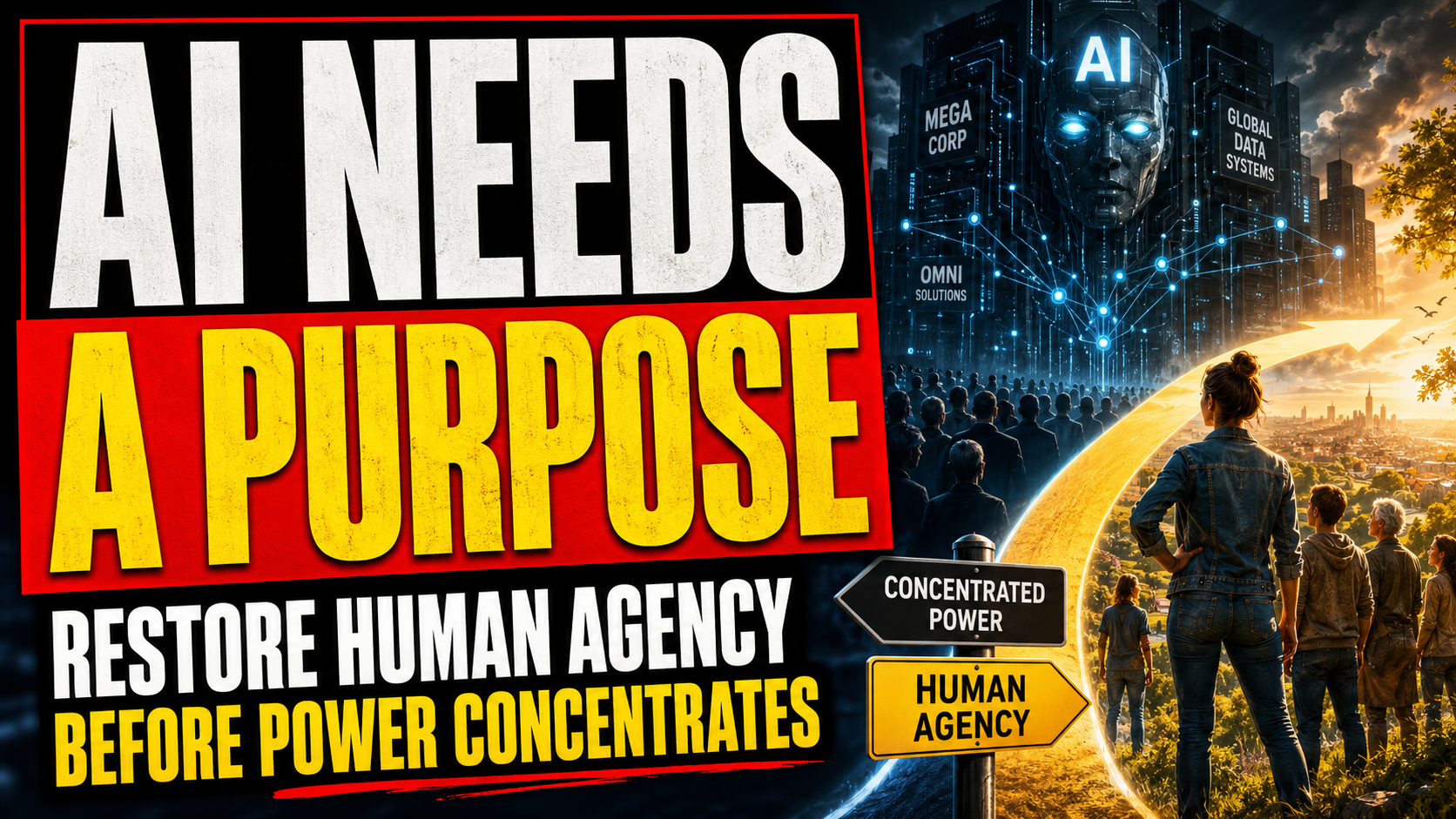
AI should restore human agency before power concentrates beyond reach.
That means building tools, systems, communities, and practices that help people think clearly, act independently, and live more balanced, self-directed lives.
The choice is not simply acceleration or pause.
The choice is concentration or empowerment.
Dependency or agency.
Control by systems or capability for people.
AI does not just need a pause.
It needs a purpose.
And that purpose should be restoring human agency before power concentrates beyond reach.

