
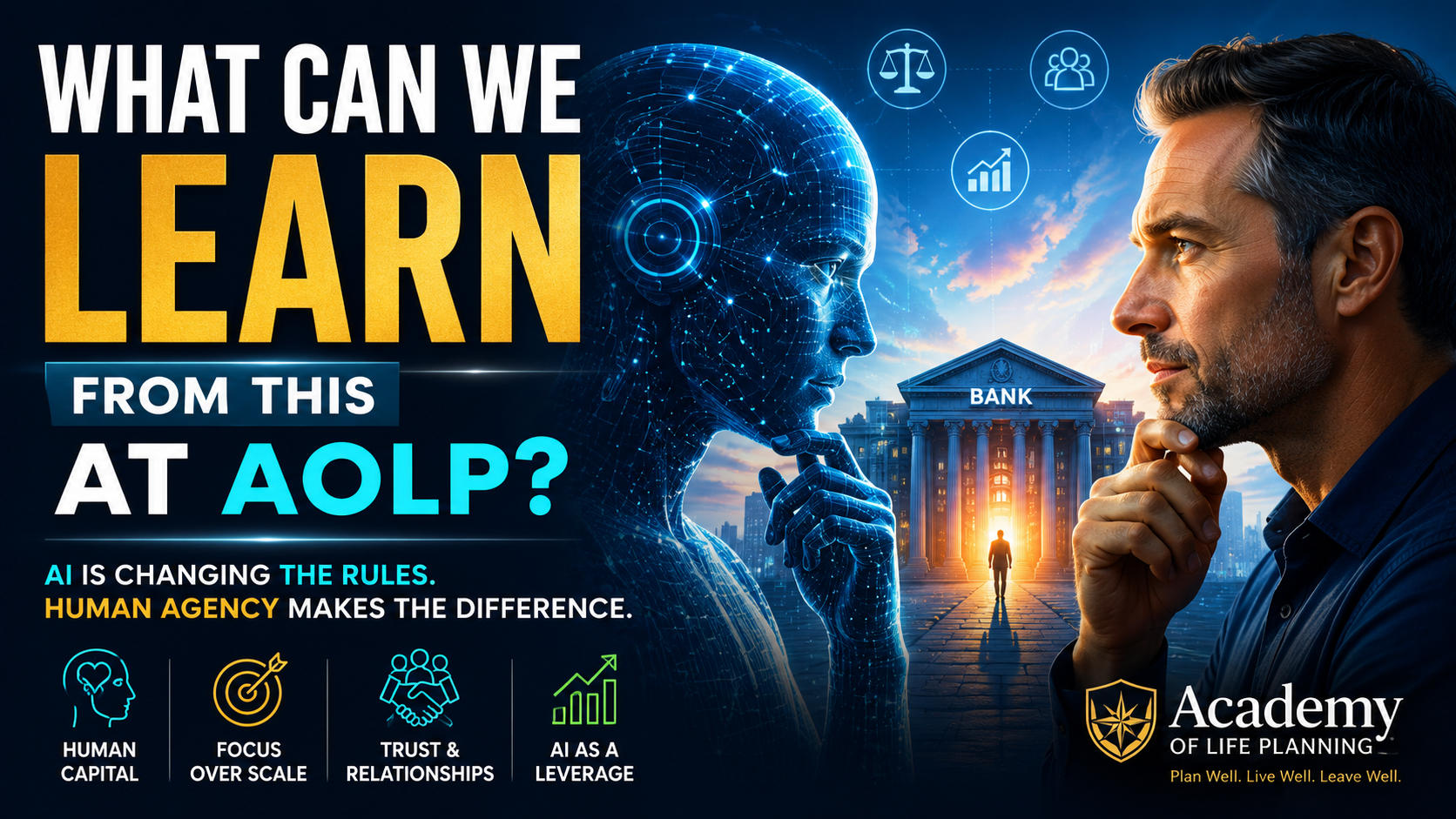
AI is poised to reshape banking not just by cutting costs, but by redistributing profits, redefining customer relationships, and accelerating competition. How should banks respond? Source: McKinsey Report, 29th may 2026.
There is a great deal here that reinforces themes the Academy has been exploring for years, but there are also some important cautions.
At first glance, this looks like a banking story about AI. Underneath, it is really a story about power, capability, and agency.
The biggest lesson for AoLP is this:
Human agency is becoming more valuable, not less.
Many commentators frame AI as a replacement technology. McKinsey is framing it as a leverage technology. The banks that win will not necessarily be the biggest banks. They will be the banks that learn fastest, focus best, and combine human judgement with AI capability most effectively. The report repeatedly emphasises speed of learning, upskilling, focus, and execution rather than simply buying technology.
That aligns closely with the Academy’s long-standing position that:
“Your future wealth will depend less on what you own and more on what you can do.”
Three key lessons stand out.
- Human Capital Is Becoming More Important Than Financial Capital
The report talks about banks deploying 20–30 AI agents per employee. Many people will hear this as a threat.
I hear something different.
An individual equipped with AI may gain access to capabilities previously reserved for large institutions.
A one-person business can now:
- Research like a consultancy
- Market like an agency
- Analyse like a data team
- Build software like a development department
- Create content like a media company
This is exactly why AoLP’s Human Capital Audit becomes increasingly important.
The critical question is no longer:
“What financial assets do you own?”
The more important question becomes:
“What capabilities can you leverage?”
AI multiplies human capital.
For some people, it may increase productive capacity by 5x, 10x, or more.
- Precision Beats Scale
One of the most interesting findings is McKinsey’s conclusion that “precision over heft” matters more than sheer size. Bigger organisations do not automatically win. The winners are those who can identify their niche, deploy resources effectively, and move faster.
This is highly relevant to AoLP members.
For decades, advisers were told:
- Build bigger firms
- Acquire more clients
- Gather more assets
- Scale operations
The AI era may reward a different model:
- Smaller
- More focused
- More specialised
- More personalised
A Total Wealth Planner supported by AI may compete surprisingly effectively against firms many times their size.
- The Real Competition Is Becoming AI-to-AI
This is perhaps the most profound insight.
McKinsey predicts a future where customer AI agents negotiate with bank AI agents. Deposits move automatically. Products are compared continuously. Customers become represented by intelligent digital assistants.
If that happens, many traditional advantages disappear.
Brand weakens.
Advertising weakens.
Distribution weakens.
The winning factor becomes:
“Who is best aligned with the customer’s interests?”
That creates a fascinating opportunity for AoLP.
The Academy has always argued that planning should sit on the client’s side of the table.
In an AI-enabled future, people may increasingly need:
- Personal AI coaches
- Personal AI planners
- Personal AI advocates
- Personal AI educators
Not salespeople.
Not product distributors.
Not asset gatherers.
This could strengthen the case for independent planning rather than weaken it.
The Warning
There is one statement that should concern everyone.
McKinsey discusses banks potentially operating with ratios of 20 virtual employees to every human employee.
That implies significant labour displacement.
The challenge for society is that productivity gains do not automatically become human flourishing.
Historically, technological advances have created both winners and losers.
The key question is:
Will AI primarily concentrate capability inside institutions?
Or will it distribute capability to individuals?
This is where the Academy’s mission becomes particularly relevant.
The real battle is not AI versus humans.
The real battle is whether AI amplifies institutions or amplifies people.
My takeaway for AoLP is that this report strengthens the case for:
- Human Capital Audits
- Ikigai-based planning
- AI literacy
- Personal capability development
- Total Wealth Planning
- Restoring human agency
The individuals who thrive may not be those with the largest pensions, biggest portfolios, or highest incomes.
They may be those who learn how to combine their uniquely human strengths with AI leverage.
That is one of the reasons I keep returning to the theme of human agency.
The future may belong neither to humans alone nor AI alone, but to people who learn how to work alongside intelligent tools to become the most capable version of themselves. Curious how others see this.
 Academy of Life Planning