
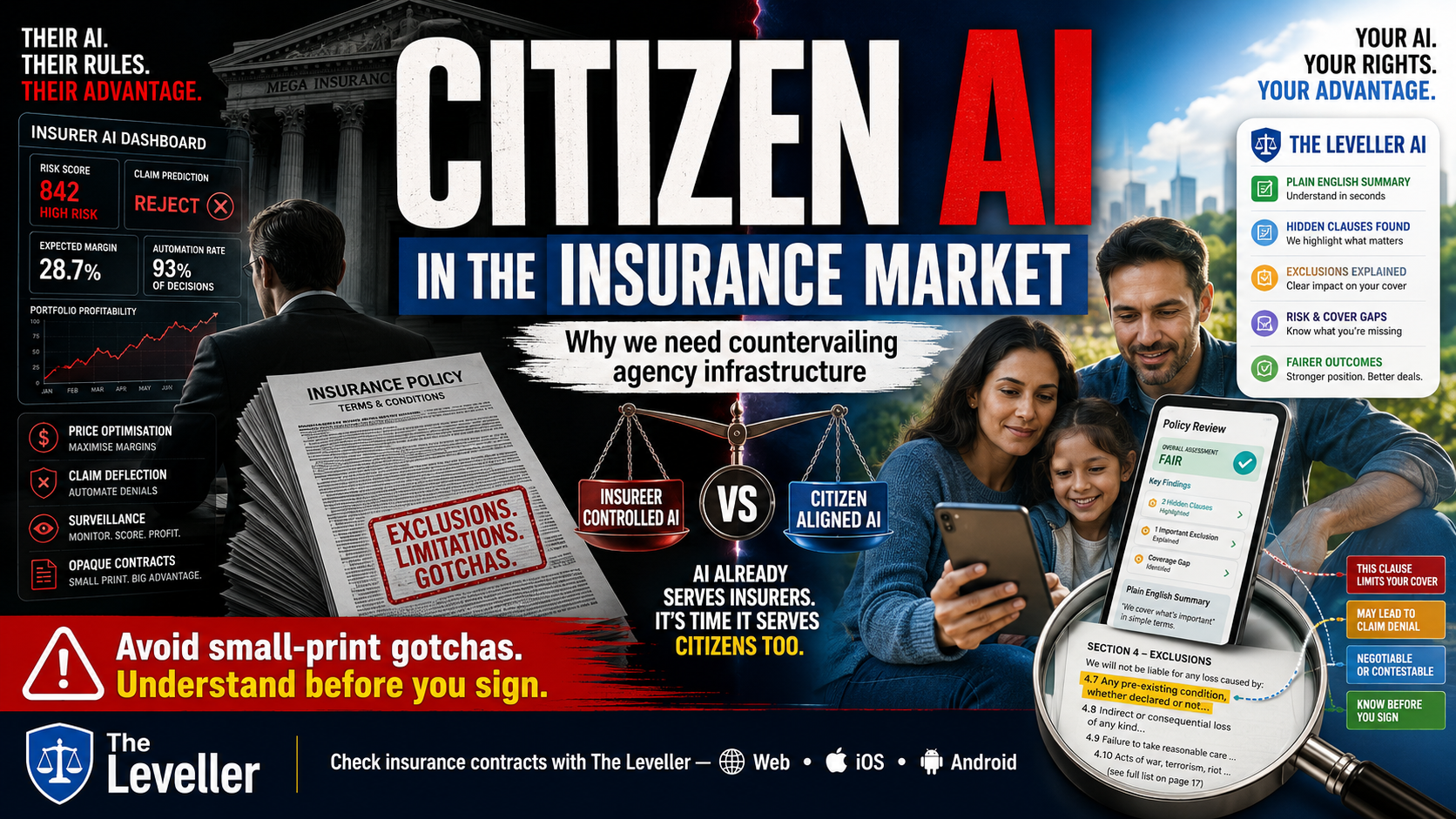
The Insurer Has AI. Who Is Sitting on Your Side of the Table?
Artificial intelligence is beginning to reshape insurance.
Insurers are using it to price risk, assess claims, detect fraud, automate customer service, monitor behaviour and distribute products more efficiently.
That is interesting.
But it is not the most important question.
The more important question is:
Who does the AI serve?
An AI system does not operate outside the interests of the organisation that designed, purchased and deployed it. It is trained, instructed and measured against institutional objectives.
For an insurer, those objectives may include improving margins, reducing claims costs, increasing retention, accelerating processing and selling more products.
None of that automatically makes the technology harmful.
But it does mean the system is not neutral.
It is sitting on one side of the table.
The Rise of Captured AI
We often talk about AI as though intelligence itself were the issue.
Is it accurate?
Does it hallucinate?
Does it sound robotic?
Can it replace a human?
These questions matter, but they can distract us from the deeper structural issue.
The real question is not whether AI is perfect.
It is whose interests the AI has been engineered to advance.
This is the difference between captured AI and citizen AI.
Captured AI serves the institution deploying it.
Citizen AI serves the person whose life, money or rights are affected by the institution’s decision.
In insurance, captured AI may produce outcomes that look efficient from inside the business but feel very different to the customer.
Pricing may become a tool for widening margins rather than fairly pooling risk.
Claims automation may prioritise repudiation and cost reduction over a proper understanding of the loss.
Customer service may optimise speed while removing empathy, discretion and human experience.
Distribution systems may identify opportunities to sell without first establishing whether the customer genuinely needs the product.
Risk prevention may slide into surveillance, with customers monitored, scored and influenced as a condition of access to cover.
Each system may be technically impressive.
Each may also deepen the imbalance of power between the institution and the individual.
Insurance Has Always Been an Information Business
Insurance operates through asymmetry.
The insurer understands the product, the exclusions, the claims data, the underwriting assumptions and the legal wording.
The customer is usually expected to make a decision from a summary, a quotation and a long contract they may never fully read.
The small print matters most precisely when something goes wrong.
That is when a customer may discover that a phrase they barely noticed has become the basis for refusing a claim.
AI could reduce this asymmetry.
It could help people understand policy language, identify exclusions, compare cover and ask better questions.
But if AI is available only to insurers, it may do the opposite.
The institution becomes faster, more informed and more capable.
The citizen remains expected to click “accept”.
This creates a new form of inequality.
Not simply a digital divide.
An agency divide.
One side has systems continuously analysing the customer.
The other side has a PDF.
Institutional AI Is Not the Only AI
Much of the public discussion about consumer use of AI focuses on its limitations.
We are warned that AI can hallucinate.
We are told it may use robotic language.
We are reminded that it is not human.
These warnings are reasonable in isolation.
But they become dangerous when used to discourage citizens from using AI while institutions deploy it at industrial scale.
The relevant comparison is not between AI and perfection.
It is between the options actually available to the person.
Can AI help someone notice an exclusion they would otherwise miss?
Can it translate technical language into plain English?
Can it suggest questions to ask before signing?
Can it identify a mismatch between what the customer believes they are buying and what the contract actually says?
Can it help someone prepare a stronger challenge when a claim is rejected?
If it can, then it improves the person’s capability.
The tool does not need to be infallible to be valuable.
It needs to help the citizen understand more, question more and act with greater confidence.
The Need for Countervailing Agency Infrastructure
When one side of a market becomes more powerful, the answer is not to ask the weaker side to remain technologically restrained.
The answer is to build countervailing power.
In the age of AI, that means countervailing agency infrastructure.
These are tools designed to help citizens understand, interrogate and challenge the systems acting upon them.
In insurance, that infrastructure could help people:
- understand policy terms before buying;
- identify exclusions, conditions and limitations;
- compare what different contracts actually cover;
- distinguish headline promises from contractual reality;
- prepare questions for insurers and brokers;
- organise evidence before making a claim;
- challenge decisions that appear inconsistent or unfair.
This is not about replacing every professional.
It is about ensuring that the individual is not intellectually unarmed.
The insurer may have underwriting AI, claims AI, fraud AI, pricing AI and distribution AI.
The citizen needs AI on their side of the table too.
Prevention or Surveillance?
AI could make insurance more preventative.
Sensors could detect leaks before they become floods.
Telematics could help drivers recognise unsafe habits.
Health data could encourage earlier intervention.
Cyber tools could identify weaknesses before an attack.
Used well, these systems could reduce harm.
But prevention and surveillance are not the same thing.
Prevention gives the person useful information and greater control.
Surveillance extracts information from the person and uses it to control access, price or behaviour.
The difference lies in agency.
Who owns the data?
Who can see the conclusions?
Can the individual challenge the result?
Can they refuse monitoring without becoming effectively uninsurable?
Is the technology helping the person avoid harm, or helping the insurer avoid the person?
These questions should not be treated as technical details.
They are questions about the future social purpose of insurance.
Efficiency for Whom?
Insurance executives are understandably interested in productivity.
AI can reduce administrative costs, accelerate underwriting and process claims more quickly.
But efficiency is not a universal good.
It always has a beneficiary.
A claim rejected in seconds is efficient for the insurer.
It may be devastating for the claimant.
A policy sold without human involvement may reduce distribution costs.
It may also leave the customer with cover they did not understand or need.
A highly personalised premium may be actuarially sophisticated.
It may also destroy the principle of shared risk.
We should therefore ask a second question whenever AI promises efficiency:
Efficiency for whom, and at whose expense?
A system should not be judged only by how quickly it reaches a decision.
It should also be judged by whether the person affected can understand, question and challenge that decision.
From Consumer Protection to Citizen Capability
Traditional consumer protection often begins after harm has occurred.
A complaint is raised.
A claim is disputed.
A regulator investigates.
An ombudsman decides.
These safeguards remain important, but they are reactive.
Citizen AI allows us to intervene earlier.
Before the contract is signed.
Before the exclusion becomes relevant.
Before the misunderstanding becomes a dispute.
The strongest form of protection is not merely compensation after failure.
It is capability before commitment.
This is the purpose of Academy OS.
Academy OS is designed as an independent intelligence layer for the citizen.
Not AI working for the insurer.
AI working for the person dealing with the insurer.
Its role is not to make decisions on someone’s behalf, but to improve their ability to understand, choose and act independently.
That is what agency infrastructure means.
Check Before You Sign
Insurance contracts are often accepted in minutes and relied upon for years.
The real test may come only after a fire, theft, illness, accident or bereavement.
That is too late to discover what the small print means.
The Leveller helps you review an insurance contract before signing.
It can help you identify:
- exclusions;
- unusual conditions;
- restrictive definitions;
- limits on cover;
- obligations placed on you;
- terms that deserve further explanation.
It does not promise to remove every risk.
It helps you see more of the risk before you commit.
Avoid small-print gotchas. Understand before you sign.
The Leveller is available on the web, Apple iOS and Android through Google Play.
Check out The Leveller in the Academy OS here.
Because institutions already have AI working for them.
Citizens need AI working for them too.
 Academy of Life Planning