
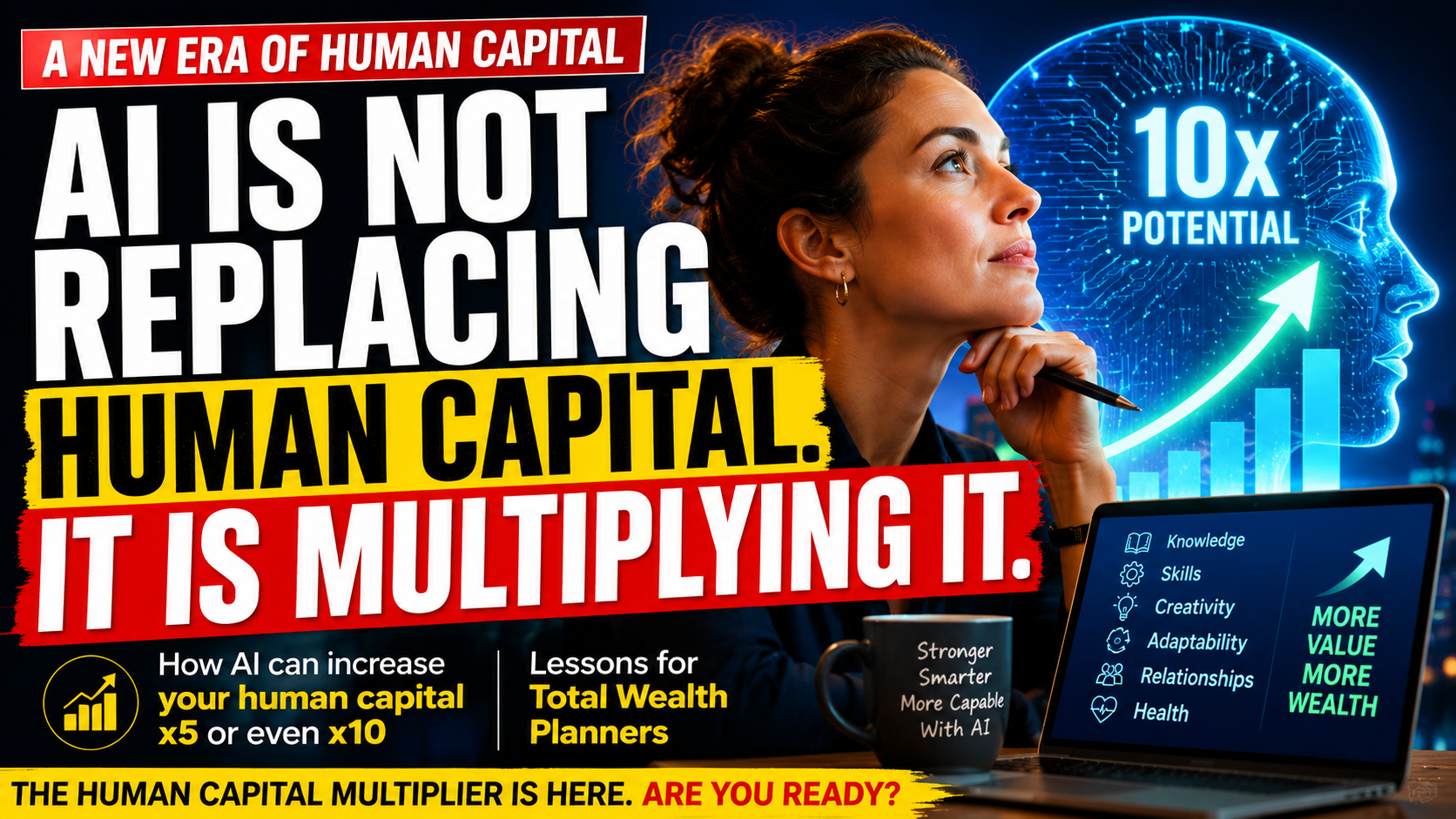
AI Is Not Replacing Human Capital. It Is Multiplying It.
For decades, economists have argued that human capital is one of the most important sources of wealth creation.
The term “human capital” refers to the knowledge, skills, experience, health, creativity, motivation, relationships, and capabilities that allow people to create value in the world. It is what enables an individual to earn an income, solve problems, help others, build organisations, and contribute to society.
Yet something remarkable is happening.
Artificial Intelligence may be about to become the greatest human capital amplifier in history.
The conversation around AI is often dominated by fear.
Will jobs disappear?
Will machines replace professionals?
Will algorithms make human expertise obsolete?
These are understandable concerns.
But they may also be causing many people to miss the bigger opportunity.
The real story may not be AI versus humans.
The real story may be AI multiplied by humans.
What the Human Capital Researchers Taught Us
Long before anyone imagined ChatGPT, economists such as Theodore Schultz and Gary Becker argued that investments in education, training, health, information, and knowledge increase a person’s future productive capacity. Human capital was viewed as a form of capital because it could generate future income and future value.
The more capable the individual became, the more value they could create.
This principle remains true today.
The difference is that AI appears capable of dramatically increasing the output generated from existing human capital.
A person with modest technical skills can now access expertise that previously required a large organisation.
A sole trader can perform tasks once requiring an entire support team.
A citizen investigator can analyse thousands of pages of evidence.
A financial planner can create educational content, conduct research, model scenarios, and build client resources at a speed that would have been unimaginable only a few years ago.
The underlying human capital remains important.
But the productivity of that capital changes dramatically.
The Total Wealth Equation Has Changed
Traditionally, wealth accumulation depended heavily upon access to financial capital.
If you wanted to compete with large institutions, you needed:
- Large budgets
- Specialist staff
- Expensive technology
- Significant infrastructure
Today, much of that leverage is becoming accessible to individuals.
A capable individual equipped with AI can increasingly perform work that previously required an entire department.
This matters enormously for Total Wealth Planners.
Why?
Because human capital has always been the most underappreciated asset on the personal balance sheet.
Most people understand how to value a pension.
They understand how to value a house.
They understand how to value an ISA.
Few understand how to value themselves.
Yet for most people, their future earning capacity, adaptability, creativity, relationships, and problem-solving abilities represent their greatest asset by far.
AI increases the return on those assets.
Human Capital Is No Longer Limited By Geography
One of the most interesting observations in the research is that human capital naturally becomes more valuable when it can connect with wider networks of knowledge and information.
AI accelerates this process.
Knowledge that was once trapped inside universities, corporations, consultancies, or professional networks is increasingly becoming accessible to anyone with curiosity and internet access.
This does not eliminate expertise.
It changes access to expertise.
The individual who knows how to ask good questions, think critically, and apply judgement gains enormous advantages.
In many ways, AI rewards agency.
What Should Total Wealth Planners Do?
The traditional financial planning question was:
“How do I invest my money?”
The emerging question may be:
“How do I invest in myself?”
That means helping people assess:
- Their knowledge
- Their skills
- Their experience
- Their health
- Their relationships
- Their adaptability
- Their creativity
- Their use of technology
- Their ability to leverage AI
A Human Capital Audit may become as important as a financial review.
After all, if AI can increase a person’s productive capability fivefold or tenfold, then understanding and developing human capital becomes one of the highest-return investments available.
The New Human Capital Gap
The greatest divide of the next decade may not be rich versus poor.
It may be augmented versus unaugmented.
Those who learn how to combine human judgement, wisdom, values, purpose, and creativity with AI may experience unprecedented opportunities.
Those who ignore these tools may find themselves competing against individuals and organisations operating at a completely different level of capability.
This is why the Academy of Life Planning continues to focus on restoring human agency.
Agency is the ability to make conscious choices about your future.
AI does not remove that responsibility.
It amplifies it.
The question is not whether AI will change the world.
The question is whether you will use it to become more fully yourself.
Because in the age of AI, your greatest asset may not be your money.
It may be your capacity to grow.

