
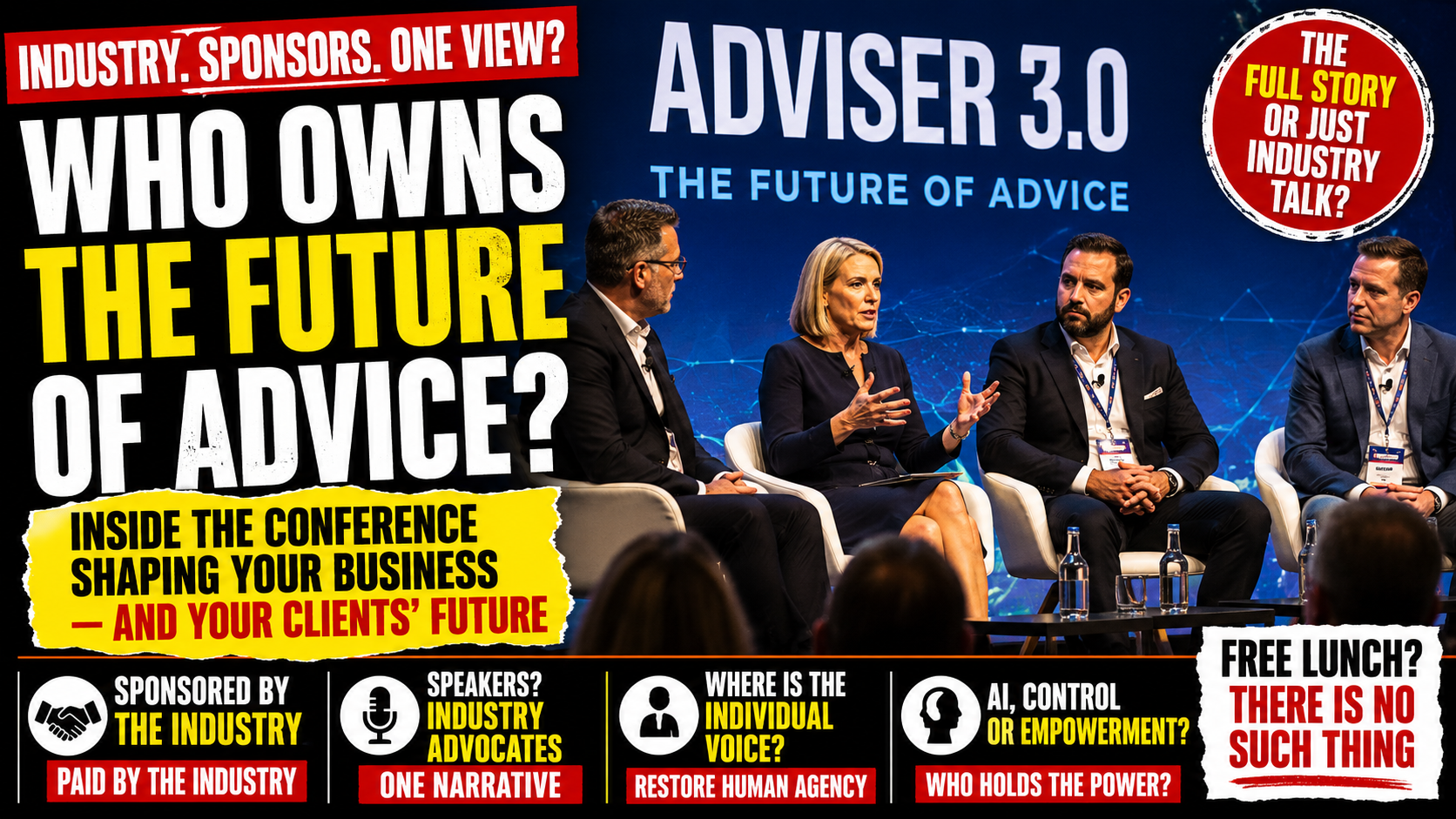
What sits underneath many industry conferences is an uncomfortable structural reality: the ecosystem is largely self-referential.
The sponsors fund the event.
The media platforms depend on industry advertising.
The exhibitors sell to advisers.
The speakers often come from firms benefiting from the existing model.
The audience attends within that commercial architecture.
That does not automatically make the discussions wrong. But it does shape the boundaries of acceptable conversation.
The result is often a narrowing of perspective rather than a widening of inquiry.
Questions about efficiency, scalability, acquisitions, AI-enabled workflow, valuations, and productivity are all entirely legitimate. But they are still mostly institutional questions:
- How do firms scale?
- How do firms extract efficiency?
- How do firms increase enterprise value?
- How do firms defend margins?
- How do firms operationalise AI?
Far less discussed are:
- What happens to human agency?
- Does AI reduce dependency or deepen it?
- Does technology empower individuals or centralise control?
- What becomes of the adviser when knowledge asymmetry collapses?
- What if clients increasingly want capability, not intermediation?
- What if the future premium is not scale — but trustworthiness?
That missing layer matters.
Because AI is not just another adviser tool. It is potentially the first mass-market capability engine that allows ordinary people to think, analyse, compare, structure, model, and challenge institutional narratives for themselves.
And institutions historically become uneasy when dependency structures weaken.
You can already see the framing beginning:
- AI is dangerous
- Consumers may misunderstand outputs
- People need protection from complexity
- Guardrails must be institutionally controlled
Some of that concern is valid. AI absolutely can mislead people.
But the debate becomes incomplete when only institutional risk is discussed and human empowerment is excluded from the conversation.
The deeper issue is not whether AI creates risk.
Every technological shift creates risk.
The real question is:
Who gets to hold capability?
That is the part often missing from industry conferences because the system itself is financially and structurally aligned around institutional continuity.
So advisers attending these events may unknowingly be hearing only one slice of the debate:
the industry’s interpretation of the future of advice.
Not the wider societal conversation about:
- autonomy
- dependency
- capability
- decentralisation
- cognitive empowerment
- and restored human agency
The irony is that many advisers themselves are also caught inside these dependency structures, even while serving clients within them.
Curious how others see this.

