
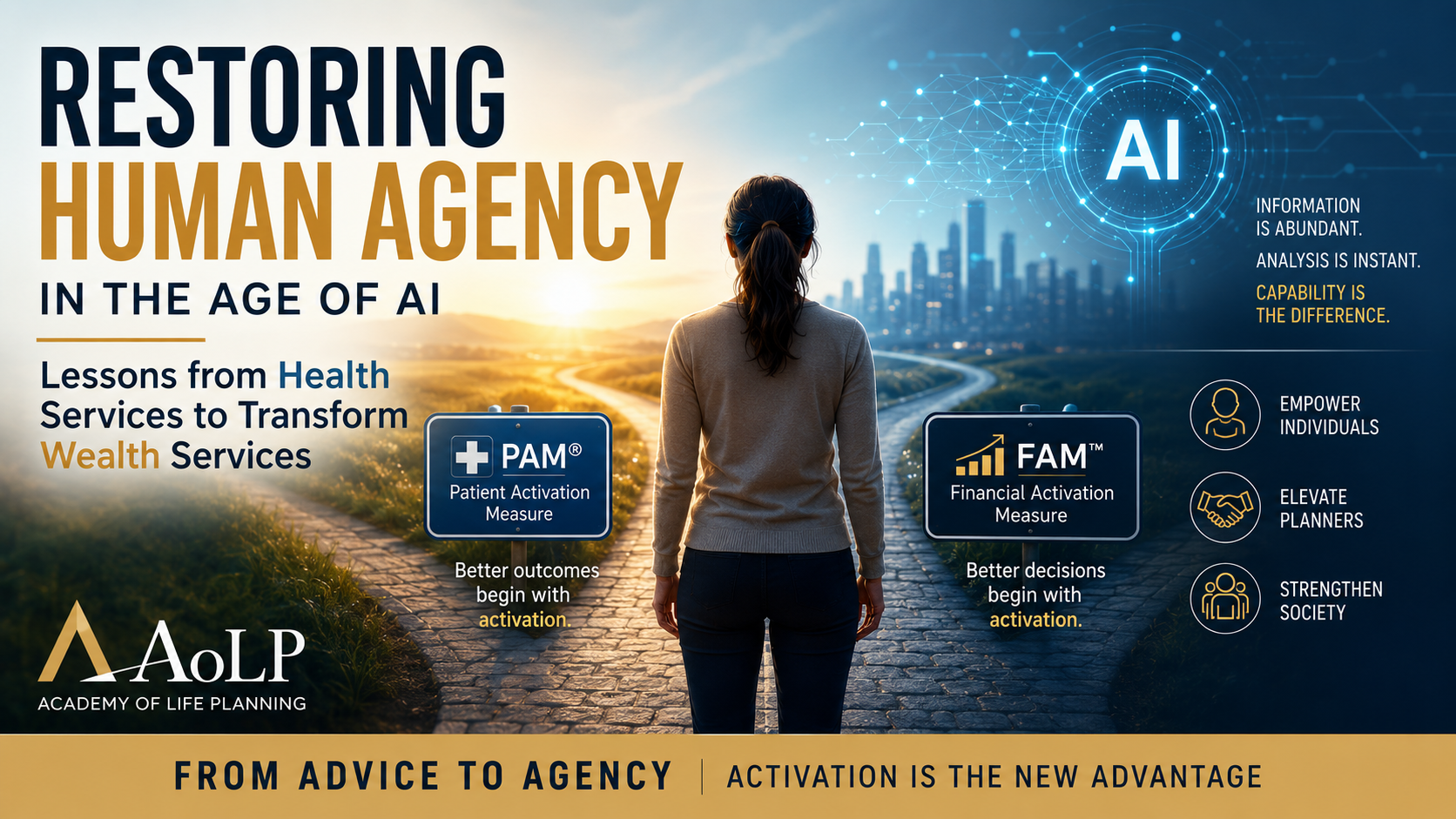
What Health Services Can Teach Financial Planning About the Future of Human Capability
For decades, both healthcare and financial services have operated around a remarkably similar assumption:
The expert knows best.
In healthcare, the doctor diagnoses, prescribes, and directs.
In financial services, the adviser recommends, structures, and manages.
The individual — patient or client — often becomes a participant in a system they only partially understand.
That model made sense in an industrial age.
Information was scarce.
Expertise was concentrated.
Systems were opaque.
Technology was expensive.
But artificial intelligence is beginning to dismantle those assumptions at extraordinary speed.
Today, information is abundant. Analysis is instant. Guidance is increasingly accessible. Large language models can explain pensions, medication interactions, investment concepts, tax structures, and behavioural patterns in seconds.
This changes something profound.
The central question of the future is no longer:
“Can people access expertise?”
It is:
“Can people think, decide, and act effectively for themselves?”
That is a very different problem.
And it may become the defining challenge of the AI era.
The NHS Already Saw This Coming
Long before generative AI entered public consciousness, parts of the NHS had already recognised a critical structural reality:
Better outcomes do not come solely from more intervention.
They come from greater activation.
This led to the development and adoption of the Patient Activation Measure (PAM®), a framework designed to assess a person’s:
- knowledge
- confidence
- skills
- ability to self-manage
The NHS definition is simple but powerful:
Patient activation is “a person’s knowledge, skills and confidence to manage their own health and wellbeing.”
That insight fundamentally changed the framing of care.
Because clinicians began to recognise something important:
Two patients with the same medical condition could have entirely different outcomes depending on their level of activation.
Some patients:
- asked questions
- understood treatment pathways
- followed through consistently
- adapted behaviours
- participated actively in decisions
Others felt:
- overwhelmed
- passive
- avoidant
- dependent
- disconnected from their own care
The issue was not simply medical complexity.
It was capability and confidence.
The NHS increasingly recognised that if activation levels remained low, even excellent clinical interventions often failed.
Patients missed appointments.
Medication adherence dropped.
Behaviour change collapsed under stress.
Systems became reactive and expensive.
This represented a major philosophical shift.
Healthcare was no longer simply about treating illness.
It became increasingly about helping people develop the capability to manage themselves.
Financial Services Faces the Same Structural Problem
Financial planning now stands at a remarkably similar crossroads.
For decades, the industry has largely been built around:
- information asymmetry
- product complexity
- delegated decision-making
- institutional dependency
Consumers were conditioned to believe:
- finance is too complex
- experts must decide
- systems cannot be understood independently
- confidence belongs to professionals
But AI changes this equation dramatically.
The cost of intelligence is collapsing.
Explanations are becoming accessible.
Analysis is becoming commoditised.
Planning tools are becoming widely available.
This does not mean expertise disappears.
But it does mean the value proposition changes.
The future competitive advantage is unlikely to be:
“having access to information.”
It will increasingly be:
“having the capability to use it wisely.”
That is where the concept of Financial Activation Measure (FAM™) begins.
What Is Financial Activation?
FAM™ applies the activation logic of healthcare to financial life.
It asks a fundamentally different question from traditional financial planning.
Not:
“How wealthy are you?”
Not:
“How sophisticated is your portfolio?”
But:
“How capable are you of participating in your own financial life?”
This is a behavioural and developmental framework.
It measures:
- confidence
- engagement
- self-management
- decision capability
- agency under uncertainty
In simple terms:
FAM™ measures how activated someone is financially.
The Four Levels of Financial Activation
Like PAM®, the FAM framework recognises stages of activation.
Level 1 — Disengaged & Overwhelmed
At this level:
- confidence is low
- avoidance is common
- systems feel intimidating
- financial life is outsourced psychologically
The mindset becomes:
“Someone else will take care of this.”
This is where many vulnerable consumers exist today.
Not because they lack intelligence.
But because complexity, stress, shame, trauma, or institutional dependency have reduced their ability to engage.
Level 2 — Aware but Struggling
At this stage:
- some knowledge exists
- intentions are positive
- consistency is weak
- people often feel behind
The mindset becomes:
“I know I should be doing more.”
This is where many people remain trapped:
aware enough to worry,
but not yet confident enough to act consistently.
Level 3 — Taking Action
Here, people begin:
- building habits
- participating in decisions
- asking better questions
- developing planning capability
The mindset becomes:
“I am part of my financial planning.”
This is where true collaborative planning begins.
Level 4 — Self-Activated
At the highest activation level:
- independent thinking strengthens
- decision capability improves
- behaviour becomes sustainable
- resilience increases
The mindset becomes:
“I am my own advocate.”
Importantly, this does not mean rejecting professional support.
It means engaging with professionals from a position of agency rather than dependency.
Complexity Is Not the Same as Activation
One of the most important insights from the NHS PAM framework is that activation and complexity are separate variables.
This is equally true financially.
A person can have:
- high wealth but low activation
- low wealth but high activation
- high complexity but strong capability
- relatively simple finances but complete disengagement
This creates four very different planning realities.
Low Complexity + Low Activation
This is not primarily an investment problem.
It is a confidence and engagement problem.
The solution is:
- education
- simplification
- behavioural support
- psychological safety
Not sophisticated optimisation.
High Complexity + Low Activation
This is where risk becomes greatest.
People become vulnerable to:
- exploitation
- poor decisions
- dependency
- paralysis
- inappropriate products
- manipulation
The answer here is not “more complexity.”
It is:
stabilisation before optimisation.
Support before strategy.
Agency before advice.
Low Complexity + High Activation
This group often needs less intervention than the industry historically assumed.
Over-servicing can actually reduce agency.
Sometimes the highest-value service is:
- reassurance
- education
- occasional guidance
- maintaining confidence
Not creating dependency.
High Complexity + High Activation
This is where planning becomes genuinely collaborative.
The individual remains the decision owner.
Professionals contribute:
- expertise
- modelling
- challenge
- structure
- specialist insight
But not control.
This may ultimately represent the future of ethical financial planning.
AI Is Increasing Activation
This is the critical point many institutions still misunderstand.
AI is not simply automating advice.
It is redistributing capability.
For the first time in history:
- ordinary individuals can interrogate complex systems directly
- ask unlimited questions without embarrassment
- explore scenarios safely
- learn iteratively
- test assumptions
- improve confidence privately
This matters enormously.
Because activation grows through participation.
Not passive consumption.
AI lowers:
- intimidation
- friction
- information asymmetry
- dependence on gatekeepers
That is why both healthcare and financial services are likely entering the same structural transition.
Industrial-age systems were built around professional scarcity.
AI creates an environment of capability abundance.
The challenge now becomes helping humans use that capability wisely.
The Future Is Not “AI Replacing Humans”
This is where much public debate becomes simplistic.
The real future is unlikely to be:
- humans only
or - AI only
It is more likely to become:
AI + human judgement + activation frameworks.
In this model:
AI becomes:
- an explainer
- simulator
- educator
- execution engine
- reflective thinking tool
Professionals become:
- guides
- coaches
- interpreters
- stabilisers
- thinking partners
And individuals become:
- active participants
- decision owners
- increasingly capable agents
This is a fundamentally different architecture from the traditional advice model.
From Advice to Agency
The traditional model often looked like this:
Adviser = decision-maker
Client = passenger
The activation model looks more like this:
Individual = decision owner
Planner = thinking partner
AI = capability amplifier
This shift matters because dependency does not scale well socially.
Not financially.
Not psychologically.
Not systemically.
There are not enough advisers, clinicians, or institutions to centrally manage every major life decision for millions of people indefinitely.
And increasingly:
people do not want that model anyway.
They want:
- participation
- transparency
- understanding
- capability
- dignity
- autonomy
Not abandonment.
Not isolation.
But agency.
Why This Matters Beyond Financial Services
The deeper implication here is societal.
Many modern systems were built during periods when:
- expertise was centralised
- information moved slowly
- institutional trust was relatively high
That world is changing rapidly.
AI is exposing a difficult truth:
Many systems quietly relied on public dependency.
Healthcare.
Finance.
Education.
Law.
Even media.
The next era may increasingly reward systems that:
- increase human capability
- build judgement
- improve participation
- restore autonomy
- support informed decision-making
This does not weaken professionals.
It transforms their role.
The highest-value professionals of the future may not be those who make decisions for people.
But those who help people develop the ability to participate wisely in their own lives.
The Foundation of Total Wealth Planning
At the Academy of Life Planning, we increasingly see activation as foundational.
Before wealth optimisation comes:
- awareness
- capability
- confidence
- clarity
- readiness
Because all planning begins with what is already present.
Human capital.
Decision capital.
Behavioural capability.
Psychological resilience.
Financial activation.
Without those foundations:
even excellent technical advice can fail in practice.
With them:
people become more adaptable, resilient, and capable of navigating uncertainty.
That may ultimately become the real purpose of planning in the AI era.
Not replacing human judgement.
But restoring it.
Final Thought
Artificial intelligence may become one of the greatest capability-expanding technologies in human history.
But capability alone is not enough.
People must also develop:
- confidence
- judgement
- participation
- self-trust
- activation
Because in an age where AI can increasingly do almost everything…
The most valuable human skill may become:
The ability to choose.
And act on those choices.

