
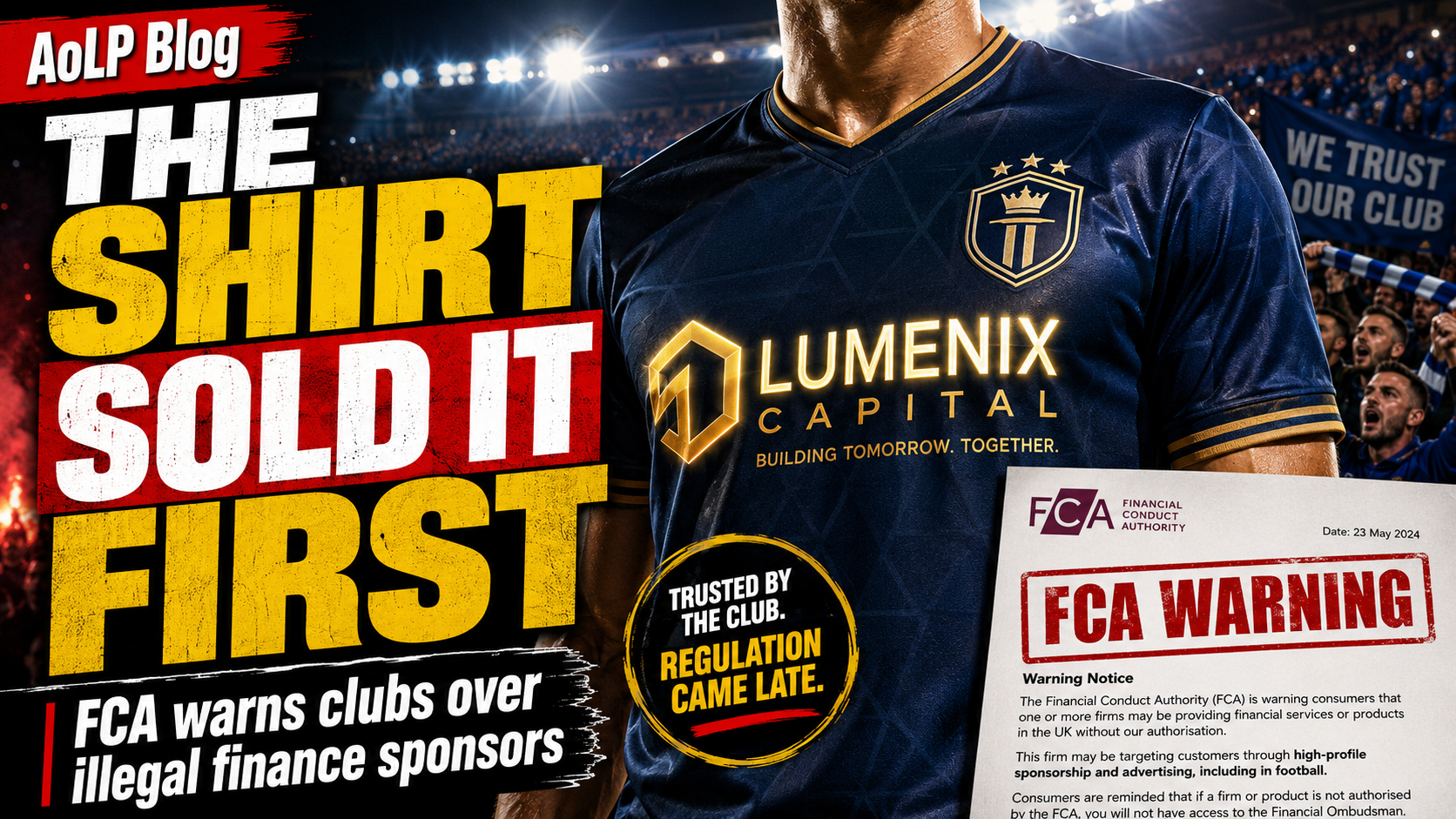
By the Time the FCA Writes the Warning Letter, the Shirt Has Already Done the Selling
The Financial Conduct Authority’s warning to football clubs over sponsorship deals with unauthorised financial firms raises a much bigger question than football sponsorship.
It asks us to look at how trust is created, transferred and monetised before most people even realise a financial decision is being shaped.
According to reports, the FCA has written to a number of football clubs, primarily in the Premier League, warning them about sponsorship arrangements with unauthorised financial firms, including cryptoasset businesses and trading platforms. The regulator’s concern is that these firms may be using club sponsorships to gain credibility and visibility with UK supporters, despite not being authorised to operate in the UK market.
The FCA’s warning is important. But it also reveals a familiar problem.
By the time the regulator writes the warning letter, the shirt has already done the selling.
The club badge is not neutral space
A football shirt is not just fabric.
It carries identity, loyalty, belonging, memory and emotion. For many supporters, the club badge is intergenerational. It is family, place, history and community. It is Saturday afternoons, childhood rituals, shared grief, shared joy and collective hope.
So when a financial brand appears on that shirt, it is not simply buying advertising space.
It is borrowing trust.
The supporter may never read the firm’s terms and conditions. They may never check the FCA register. They may not understand the difference between an authorised firm, an unauthorised firm, a financial promotion, a cryptoasset exchange, a trading platform or an approved communication.
But they may recognise one thing immediately:
“My club is associated with this firm.”
That association does a great deal of work.
It softens scepticism. It reduces perceived risk. It gives the appearance of legitimacy. It allows a commercial brand to stand inside a trusted emotional environment and benefit from loyalty it did not earn.
That is the real issue.
Financial harm often begins before the transaction
In financial services, harm is often discussed as though it begins at the point of purchase.
Someone invested. Someone transferred money. Someone opened an account. Someone clicked the button. Someone bought the product.
But the conditions for that decision are often created much earlier.
They are created through repetition, visibility, endorsement, social proof and emotional association. A sponsor on a shirt, a logo on a stadium board, an advert beside a club interview, a trading platform promoted through match-day content — these can all help move a firm from unfamiliar to familiar.
And familiarity is powerful.
For ordinary people, especially those without specialist financial knowledge, familiarity can feel like safety. Visibility can feel like legitimacy. Association with a trusted institution can feel like endorsement.
This is where agency begins to erode.
Not because people are foolish.
But because the environment around them has been designed to make a risky decision feel normal.
Regulation arrives after credibility has already been granted
The FCA is right to warn clubs that they may expose supporters to financial harm. It is right to highlight legal, reputational and money laundering risks. It is right to expect due diligence before sponsorship deals are signed and ongoing monitoring afterwards.
But the timing matters.
Once the shirts are printed, the hoardings are installed, the digital campaigns are live and the sponsor has appeared beside the club badge, a trust transfer has already taken place.
The commercial benefit to the sponsor is immediate.
The regulatory warning comes later.
This is a recurring pattern in financial harm. The promotional machinery moves quickly. The emotional association is formed quickly. The public exposure happens quickly. But the regulatory response, even when well-intentioned, often appears downstream.
By then, the public has already seen the signal.
The sponsor has already gained credibility.
The fan has already absorbed the association.
The damage may not yet be visible, but the conditions for harm may already have been created.
Football clubs are not passive advertising hosts
There is a temptation to say that clubs are merely selling commercial inventory.
That argument is too weak.
A football club is not the same as a billboard beside a motorway. It is a civic and emotional institution. It has a privileged place in the lives of supporters. It benefits from loyalty that often survives poor performance, bad ownership, rising ticket prices and repeated disappointment.
That loyalty has commercial value. Clubs know this. Sponsors know this. Agencies know this. Leagues know this.
The question is whether the duty attached to that trust has been taken seriously enough.
When a club accepts money from a financial firm, especially one operating in a complex or high-risk area such as cryptoassets or retail trading, it is doing more than accepting a sponsor. It is allowing that firm to stand inside the club’s trust architecture.
That should carry responsibility.
Clubs cannot claim the commercial value of supporter loyalty while ignoring the consumer risk created when that loyalty is monetised.
The deeper problem is capability asymmetry
This case also illustrates a wider problem in modern financial life: capability asymmetry.
Capability asymmetry exists when one side has the tools, knowledge, data, behavioural insight, legal advice, marketing expertise and commercial incentives to shape a decision, while the other side is expected to protect themselves with limited time, limited knowledge and limited emotional distance.
The football fan is not approaching the sponsorship as a compliance officer.
They are not thinking: Is this firm authorised? Is this promotion approved? What jurisdiction applies? What happens if the platform collapses? Are there Financial Services Compensation Scheme protections? Is this a regulated activity? What are the withdrawal risks? What are the conflicts of interest?
They are watching their team.
That is precisely why the sponsorship is valuable.
The supporter’s attention is not neutral. It is emotionally open. It is already committed. And that makes the placement powerful.
The financial firm is not merely buying visibility. It is buying reduced resistance.
Restoring agency means questioning the trust transfer
At the Academy of Life Planning, we argue that financial planning should restore human agency, not increase dependency.
That means helping people ask better questions before trust is handed over.
Who is asking for my money?
Who benefits if I believe this is safe?
Is this firm authorised in the UK?
What protection would I have if things went wrong?
Is the club endorsing this firm, or merely being paid by it?
What does the sponsor gain from being seen beside something I already trust?
These are not anti-football questions. They are pro-supporter questions.
Nor are they anti-business questions. Ethical sponsorship has a legitimate role in sport. Clubs need revenue. Commercial partnerships can support growth, facilities, women’s football, youth development and community work.
But when financial firms are involved, especially unauthorised or high-risk firms, the standard must be higher.
Because the product being promoted is not a soft drink, a car or a local restaurant.
It may be a route into financial loss.
The warning should come before the shirt
The lesson from this story is not simply that clubs need better due diligence.
They do.
But the deeper lesson is that regulation needs to recognise how trust is manufactured before the formal financial promotion is even examined.
A logo on a shirt can be a financial signal.
A stadium partnership can be a credibility device.
A club announcement can function as a trust transfer.
A sponsor does not need to make a detailed investment case if the emotional context has already lowered the supporter’s guard.
That is why the warning must come before the shirt.
Before the contract is signed.
Before the campaign goes live.
Before the sponsor gains access to supporters through the badge.
Before borrowed trust becomes financial harm.
From consumer protection to agency protection
Consumer protection usually asks whether a rule has been broken.
Agency protection asks whether a person’s ability to make a clear, independent decision has been strengthened or weakened.
That distinction matters.
A supporter should not need to become a financial promotions lawyer to avoid being harmed by a club sponsor.
A pension saver should not need to become an investment analyst to avoid being misled.
A vulnerable person should not need to become a forensic investigator to protect themselves from a firm using borrowed credibility.
The burden should not always fall on the individual after the trust environment has already been engineered around them.
This is why we need a broader conversation about financial promotion, institutional endorsement and the commercial use of loyalty.
It is not enough to ask whether people were warned.
We must ask whether they were first made to feel safe by something they already trusted.
The real question for clubs
Football clubs often describe supporters as the lifeblood of the game.
If that is true, supporter trust should not be treated as a monetisable asset without ethical limits.
The real question for clubs is simple:
Would you be comfortable explaining this sponsor to a lifelong supporter who lost money because your badge made the firm feel safe?
If the answer is no, the deal should not be signed.
And if the answer is “we did not know”, then the due diligence was not good enough.
The FCA’s warning is welcome. But the broader lesson is clear.
In financial services, harm does not always begin when money changes hands.
Sometimes it begins when trust changes hands.
And by the time the warning letter arrives, the shirt may already have done the selling.

