
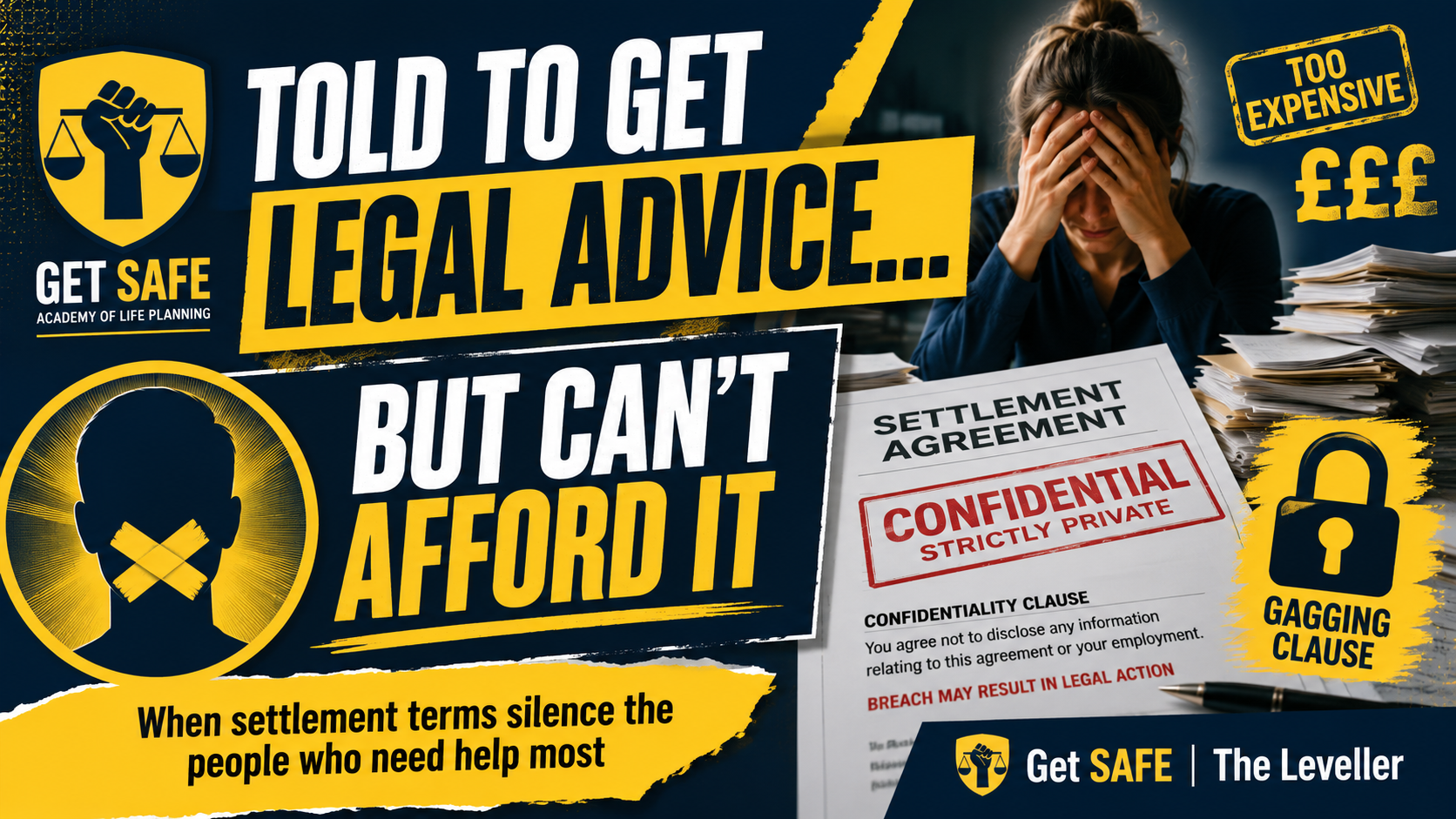
When You’re Told to Get Legal Advice — But Can’t Afford It
Some of the people who need legal advice most are the very people least able to get it.
A settlement arrives.
There is a confidentiality clause.
You are told you cannot discuss it. You cannot share it. You cannot talk openly about what has happened.
The document may even say you have been advised to seek independent legal advice before signing.
But there is no funded route to that advice.
You cannot afford a solicitor.
The deadline is close.
The pressure is real.
So you sign.
Because what else do you do?
This is one of the quietest access-to-justice gaps in the system. And it affects people at precisely the moment when clear thinking matters most.
The moment after harm
Much of the public conversation around contracts focuses on the point before people sign.
That matters. People should understand what they are agreeing to before they enter into a financial product, service, employment arrangement, settlement, or redress process.
But there is another moment that receives far less attention.
The moment after harm has already occurred.
The moment when someone is exhausted, frightened, financially stretched, and presented with a document that asks them to close the matter.
That document may ask them to:
waive future claims;
accept capped redress;
surrender rights;
agree not to disclose information;
give up access to further routes of complaint;
release another party from liability;
or accept wording they do not fully understand.
Sometimes the person is told to take independent legal advice. But being told to get advice is not the same as being able to access it.
A right that exists only for those who can afford to use it is not meaningful protection.
The confidentiality trap
Confidentiality clauses can serve legitimate purposes. But in practice, they can also create fear.
People may worry that even asking for help could put them in breach of an agreement. They may feel unable to show the document to a friend, advocate, support worker, or family member. They may not know what they are allowed to say, or to whom.
This creates a chilling effect.
The person is isolated at the very point when they most need perspective.
They may be asked to make a legally significant decision without the confidence, money, or support needed to understand the consequences.
This is not empowerment.
It is pressure disguised as process.
Why The Leveller™ exists
The Leveller™ was built for this gap.
Not only for pre-signature contract analysis, although it does that too.
It was also built for the person sitting at the kitchen table with a settlement agreement, redress letter, waiver, or set of terms they do not understand — knowing the document matters, but not knowing what questions to ask.
The Leveller™ does not replace a lawyer.
It does not give legal advice.
It does not tell you whether to sign.
What it does is help you understand, in plain English, what the document appears to be asking you to agree to.
It can help identify:
what rights you may be giving up;
what obligations you may be accepting;
what clauses deserve closer attention;
what practical consequences may follow if you sign;
what questions you may wish to ask before agreeing;
and where the balance of power may sit in the document.
For someone with no funded access to legal support, that can make a real difference.
Not because it solves everything.
But because it gives them something to stand on when they have nothing else.
Using AI without breaching trust
Using The Leveller™ does not require you to publish your situation, discuss the matter publicly, or involve another person.
You remain in control of the document and the decision.
That matters.
Many people harmed by financial exploitation, institutional failure, poor complaints handling, or unfair settlement processes are already carrying stress, shame, confusion, and fear.
They do not need another system taking over.
They need a clear first step that helps restore agency.
The Leveller™ is designed to support that first step.
It gives structure where there is overwhelm.
It gives plain English where there is legal or contractual complexity.
It gives questions where there is silence.
And it gives the person a way to pause before signing something they may later regret.
A small tool for a large gap
The deeper issue here is not simply one app.
It is the wider imbalance between institutions and individuals.
Organisations can draft documents, retain lawyers, manage risk, control wording, impose deadlines, and frame settlement terms in their own interests.
Individuals often face the same process alone.
That is not a level playing field.
The Academy of Life Planning exists to restore human agency in financial and life decisions. That means helping people become less dependent on systems that benefit from their confusion, fear, or lack of access.
The Leveller™ is one practical contribution to that mission.
It is not a substitute for professional legal advice where legal advice is available and affordable.
But where it is not, it can help someone understand what is in front of them before they give something important away.
Share it with someone who needs it
If you know someone in this position right now — a settlement on the table, a confidentiality clause, no money for advice, and no clear idea what to do next — please share this with them.
Not as pressure.
Not as a sales pitch.
As a small act of protection.
Because sometimes the difference between surrendering rights and asking the right question is simply understanding what the document is really saying.
The Leveller™ is available at:
£4.99 one-off cost.
Available on iOS and Android.


One thought on “When You’re Told to Get Legal Advice — But Can’t Afford It”