
Why the AI era may not simply eliminate jobs — but fundamentally redefine what productive human value looks like
For more than two centuries, industrial society has organised human beings primarily around employment.
You study.
You train.
You specialise.
You obtain a role inside an institution.
You exchange labour for income.
That model shaped modern economies.
And for much of the industrial age, it worked reasonably well because institutions held the productive infrastructure:
- factories,
- distribution,
- information,
- software,
- media,
- finance,
- and organisational capability.
Individuals largely needed institutions in order to participate economically.
But AI may represent the first major technological shift where not only labour — but intelligence itself — becomes increasingly automated, accelerated, and distributed.
That changes the equation profoundly.
And once again, the deeper issue is not simply technology.
It is agency.
The real question may not be:
“Will AI replace jobs?”
But rather:
“What happens when individuals gain access to productive capability that once belonged almost exclusively to institutions?”
That question sits at the centre of the emerging conversation around ecosystems, entrepreneurship, human capital, and the future of work.
Part 1
Why Ecosystems Matter More in the Age of AI
When people hear the word “ecosystem,” they often think about technology platforms or corporate partnerships.
But ecosystems are much deeper than that.
An ecosystem is a connected environment in which:
- people,
- tools,
- resources,
- relationships,
- processes,
- and flows of information
work together to create outcomes that isolated parts cannot achieve alone.
Nature operates through ecosystems.
Human life operates through ecosystems.
Communities operate through ecosystems.
And increasingly, economic life will too.
Historically, employment itself acted as a form of ecosystem.
Large institutions provided:
- structure,
- income,
- training,
- progression,
- administration,
- networks,
- and identity.
The individual contributed labour in exchange for stability.
But AI increasingly changes the economics of labour.
Tasks become:
- automated,
- accelerated,
- fragmented,
- recombined,
- or eliminated altogether.
This does not necessarily mean “no work.”
But it likely means:
- less linear careers,
- less dependence on single employers,
- more fluid economic participation,
- more entrepreneurial activity,
- and greater importance placed on adaptability and self-direction.
The challenge is that many people are still psychologically and structurally organised for the old model.
A model where:
- institutions carry responsibility,
- career ladders are relatively stable,
- and productive value is tied mainly to formal employment.
But the AI era increasingly rewards something different:
- initiative,
- adaptability,
- creativity,
- systems thinking,
- relationship-building,
- and the ability to identify and leverage opportunities independently.
This is where ecosystems become critically important.
Because individuals navigating a more decentralised, AI-driven world will increasingly need:
- support structures,
- decision tools,
- collaborative communities,
- adaptive learning systems,
- and frameworks for identifying productive value beyond traditional employment.
In other words:
they will need ecosystems that help them develop agency.
Part 2
The Age of Restored Human Agency
One of the defining features of the industrial era was delegation.
Institutions specialised.
Individuals relied upon them.
You delegated:
- financial decisions,
- legal understanding,
- career pathways,
- administrative systems,
- information processing,
- and increasingly even thinking itself.
This was understandable in a world where complexity exceeded individual capability.
But AI changes that balance.
For the first time in history, ordinary people increasingly have access to:
- advanced analytical capability,
- idea generation,
- educational support,
- strategic thinking assistance,
- research capability,
- modelling tools,
- and operational leverage.
A single individual with AI can now perform activities that previously required:
- departments,
- teams,
- agencies,
- analysts,
- or large organisations.
That changes what individuals are capable of building.
It also changes what “work” means.
Historically, much human work involved:
- processing information,
- repeating procedures,
- administrative coordination,
- or executing predictable cognitive tasks.
AI increasingly performs many of those functions more efficiently.
But human value does not disappear.
It shifts.
The future may place greater value on:
- interpretation,
- judgement,
- trust,
- meaning,
- creativity,
- emotional intelligence,
- relationship capital,
- systems design,
- entrepreneurial thinking,
- and adaptive problem-solving.
This is why entrepreneurship is likely to rise significantly in the AI era.
Not necessarily entrepreneurship in the Silicon Valley sense.
But entrepreneurial behaviour in the broader human sense:
- identifying opportunities,
- organising resources,
- creating value,
- solving problems,
- and developing sustainable livelihoods independently or collaboratively.
In many ways, individuals may increasingly become micro-enterprises operating inside connected ecosystems.
That transition will not be easy.
Many current professional roles may structurally flatten in economic value as AI reduces scarcity around certain forms of expertise.
Some highly paid cognitive tasks may become rapidly commoditised.
Entire industries may reorganise around smaller, AI-enabled teams.
And many people may experience significant identity disruption as old career assumptions weaken.
This is not merely an economic transition.
It is a psychological transition.
A transition from dependency toward agency.
And ecosystems that help people navigate that transition may become enormously important.
Part 3
Human Capital Development and the GAME Plan
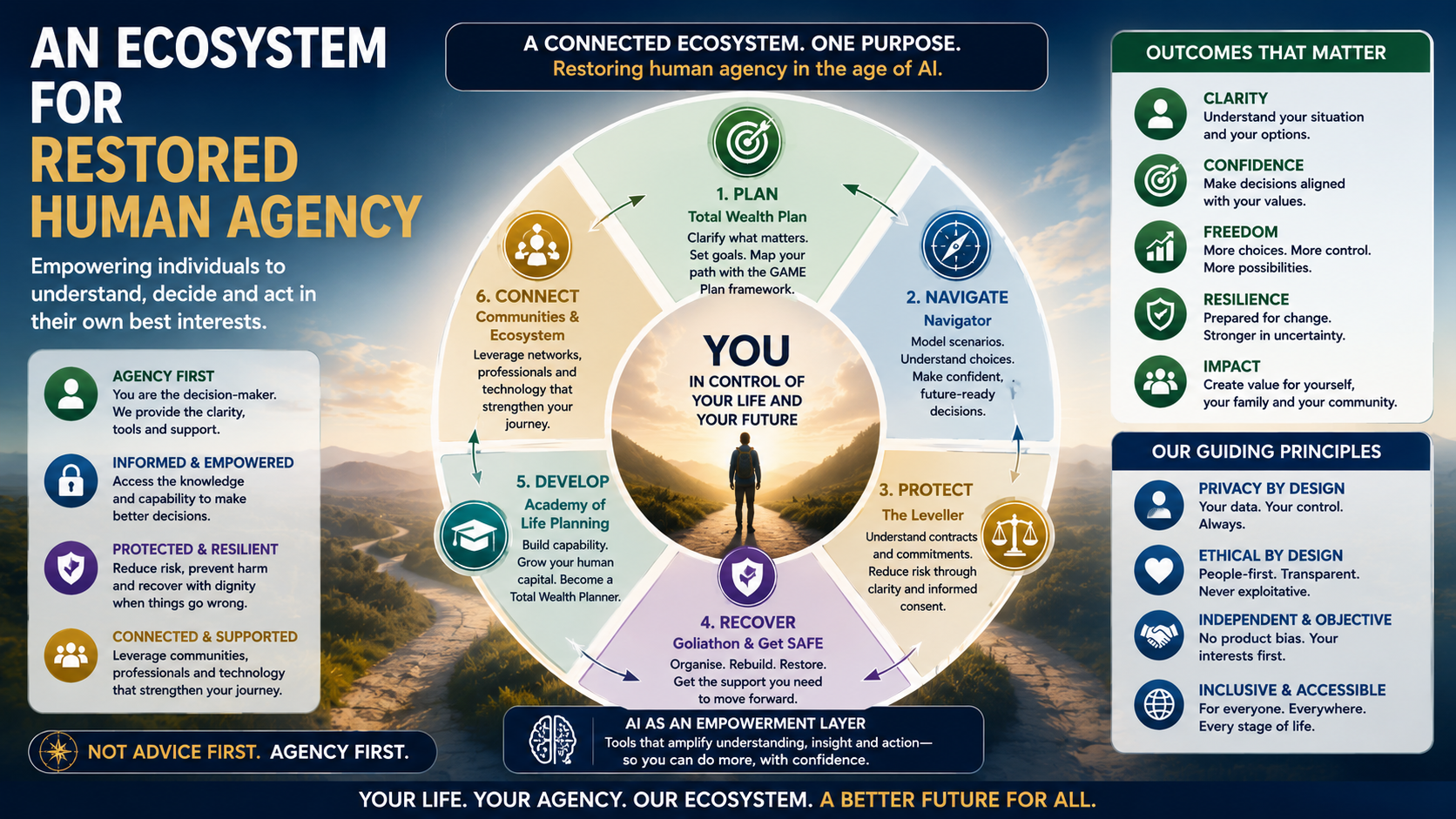
At the Academy of Life Planning, this transition increasingly sits within what we describe as Total Wealth Planning and human capital development.
Traditional financial planning often focused heavily on financial capital:
- pensions,
- investments,
- savings,
- insurance,
- and accumulation.
But financial capital is only one form of capital.
Human beings also possess:
- skills,
- knowledge,
- creativity,
- relationships,
- networks,
- adaptability,
- reputation,
- practical capability,
- health,
- and life experience.
Together, these form human capital.
And in an AI-driven world, human capital may become more important than ever.
Because sustainable livelihoods increasingly depend not simply on:
“Which job do you have?”
But on:
“What productive assets do you possess?”
“What opportunities can you identify?”
“What value can you create?”
“How adaptable are you?”
“How quickly can you learn?”
“What ecosystems support you?”
This is one reason the GAME Plan framework begins with life before money.
The GAME Plan:
- Goals,
- Actions,
- Means,
- Execution
is fundamentally about helping individuals identify and mobilise productive capability.
Not simply optimise financial products.
In practical terms, this increasingly means helping people:
- identify latent assets,
- recognise emerging opportunities,
- build multiple income pathways,
- leverage AI productively,
- develop entrepreneurial confidence,
- strengthen resilience,
- and create sustainable livelihood ecosystems around themselves.
For some people, that may mean:
- launching micro-businesses,
- building community enterprises,
- creating educational content,
- monetising expertise,
- developing AI-supported services,
- participating in collaborative networks,
- or transforming practical skills into independent income streams.
Others may remain employed but increasingly operate with:
- portfolio careers,
- hybrid work models,
- side ventures,
- or AI-enhanced productivity.
The important point is this:
The future may increasingly reward individuals who can organise productive ecosystems around themselves.
Not simply individuals who fit into institutional structures.
The Rise of Ecosystem Thinking
This is why the Academy of Life Planning increasingly frames the future not around isolated advice or transactional services — but around ecosystems.
An ecosystem for restored human agency includes:
- tools,
- frameworks,
- support structures,
- learning environments,
- collaborative networks,
- entrepreneurial capability,
- and human-centred technology.
Its purpose is not dependency.
Its purpose is empowerment.
The long-term direction is not:
“Do everything for people.”
It is:
“Help people become increasingly capable of directing their own lives.”
That does not mean abandoning support.
In fact, the opposite may be true.
As complexity rises, people may need:
- guides,
- mentors,
- communities,
- second brains,
- and trusted ecosystems
more than ever.
But the relationship changes.
The individual remains the agent.
The ecosystem exists to strengthen capability, not replace it.
And perhaps that is the deeper opportunity emerging beneath the AI revolution.
Not simply smarter institutions.
But more capable human beings.
Not simply more automation.
But a reorganisation of society around restored human agency, human capital development, and connected ecosystems that help people thrive in a rapidly changing world.
The transition may be uncomfortable.
But it may also open the door to a very different kind of economy:
one where productive value is more distributed,
entrepreneurship is more accessible,
and individuals are supported not merely as workers —
but as whole human beings capable of growth, contribution, adaptation, and creation.

