
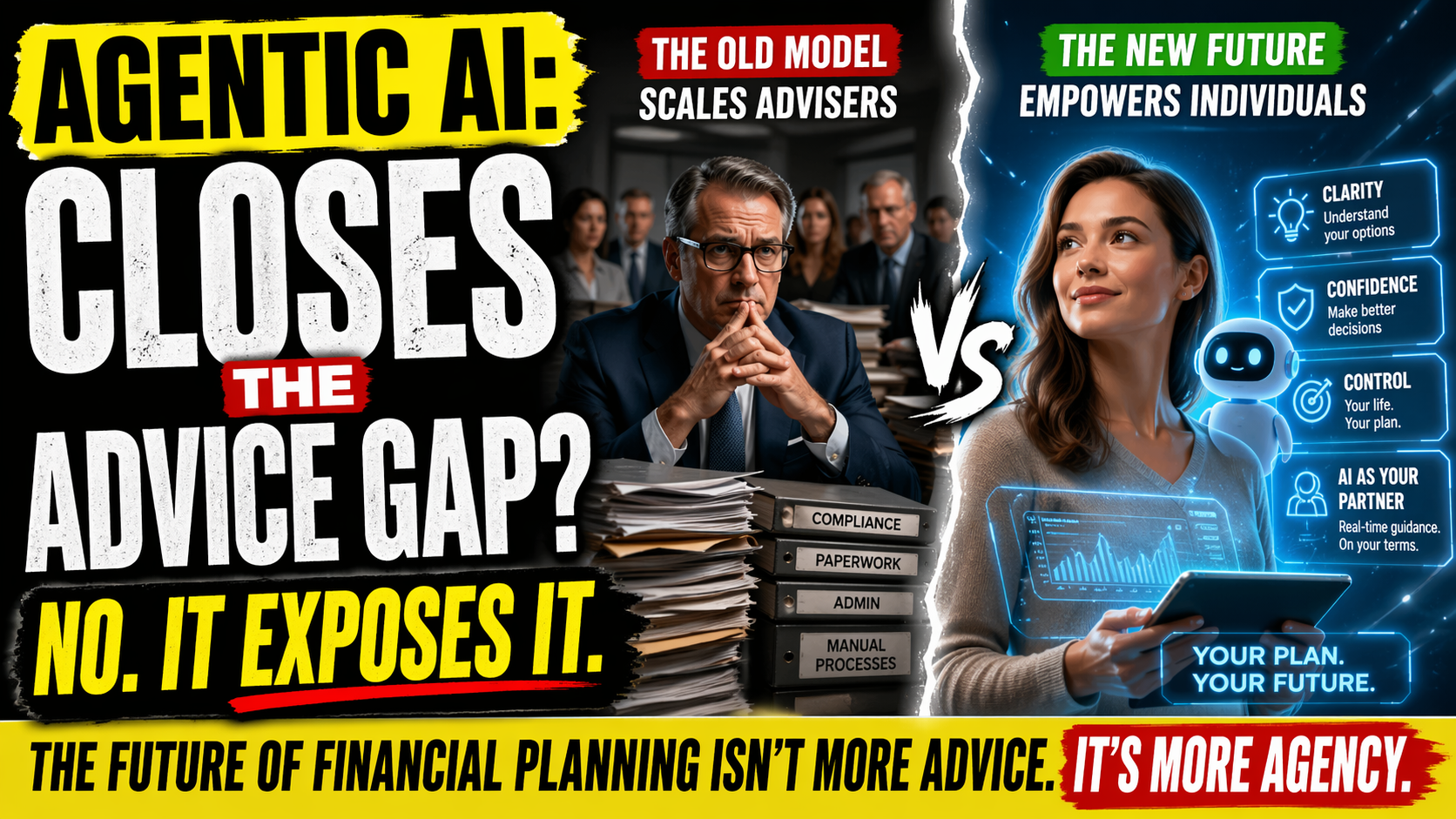
There’s a quiet shift happening in financial services.
AI firms are now building what they call “agentic operating systems”—platforms designed to automate workflows, increase adviser capacity, and scale advice delivery.
On the surface, it sounds like progress.
And to be fair—technically—it is.
But strategically?
It may be solving the wrong problem entirely.
The Industry’s Framing: A Capacity Problem
We’re told there’s an “advice gap.”
Too many people need advice.
Not enough advisers to deliver it.
So the solution becomes obvious:
- Automate the back office
- Streamline workflows
- Increase adviser capacity
- Serve more clients
This is exactly what the new wave of AI platforms is designed to do.
And they will succeed—on their own terms.
But What If the Premise Is Wrong?
The assumption underpinning all of this is rarely questioned:
That people need advisers in order to make financial decisions.
But that assumption was built in a world of:
- Information asymmetry
- Product opacity
- Technical complexity
- Institutional dependence
AI is removing all four.
The Real Shift: From Advice to Agency
What people actually need is not “advice” in the traditional sense.
They need:
- Clarity
- Understanding
- Confidence in their decisions
- The ability to act
In other words:
They need agency.
And AI doesn’t just help advisers deliver more advice…
It enables individuals to make their own decisions—with support, not dependency.
Two Futures Are Now Emerging
We’re beginning to see a clear divide.
1. The Industry Evolution Path
- Advisers remain central
- AI augments the firm
- Capacity increases
- The model scales
2. The Agency Revolution Path
- The individual becomes central
- AI augments the person
- Dependency reduces
- The model transforms
Both will grow.
But only one fundamentally changes outcomes.
The Hidden Risk
If AI is used purely to scale the existing model:
- Product distribution becomes more efficient
- Personalisation becomes more targeted
- Influence becomes more sophisticated
But the underlying structure remains:
- The client still depends
- The system still intermediates
- The incentives remain unchanged
Efficiency improves.
Trust does not.
A Different Question
Instead of asking:
“How do we help advisers serve more clients?”
We should be asking:
“How do we help people make better decisions for themselves?”
That’s a very different starting point.
And it leads to a very different system design.
The Next 2–3 Years
The prediction that this industry will look very different in a few years is absolutely correct.
But not for the reasons many think.
It won’t just be:
- Faster firms
- Smarter workflows
- Better segmentation
It will be:
- Individuals with their own planning systems
- AI acting as a real-time thinking partner
- Human experts stepping in only when needed
From 90/10… to 99/1.
The Bottom Line
Agentic AI won’t close the advice gap.
It will expose it.
Because the real gap was never about access to advisers.
It was about access to:
- understanding
- confidence
- control
And those are now becoming universally available.
Where This Leaves Us
The question is no longer whether AI will transform financial planning.
It already is.
The real question is:
Who will it empower?
- The institutions?
- Or the individual?
The Academy of Life Planning exists for one reason:
To ensure the answer is the individual.
If you’re exploring what this shift means for your future as a planner—or as a person navigating your own financial life—there’s a different path emerging.
One built on agency, not dependency.

