
Only 20% of people feel on track financially.
That is the headline finding from a recent industry survey on financial resilience.
At first glance, it is concerning.
Look closer, and it becomes something else entirely:
A reflection not just of financial anxiety—but of a flawed way of measuring it.
Because embedded within the survey is an assumption that quietly shapes the entire narrative:
That financial resilience is primarily about the size of your savings pot.
A Measurement Problem, Not Just a Money Problem
The research points to generational differences:
- Younger people feel less “on track”
- Older generations feel more confident
- The explanation? Lower savings, weaker pensions, rising costs
From this, a familiar conclusion emerges:
People are struggling because they are not saving enough.
It sounds reasonable.
It is also incomplete.
Because the survey never meaningfully asks:
- What is this person capable of earning in the future?
- How adaptable are they in a changing economy?
- Do they have the confidence and clarity to make good decisions?
- Can they recover from shocks—or are they dependent on static assets?
In other words:
It measures what people have—but not what they can do.
The Missing Dimension: Human Capital
Financial capital matters. Of course it does.
But it is only one part of a broader system of personal resilience.
Alongside it sits something far more dynamic:
Human capital.
This includes:
- Skills and earning potential
- Health and energy
- Adaptability and learning capacity
- Networks and opportunities
- The ability to generate income in multiple ways
A younger individual with modest savings but strong human capital may be highly resilient.
An older individual with a fixed pension pot—but limited flexibility—may be far more exposed than the numbers suggest.
Yet the current measurement system often reverses that reality.
Why Younger Generations Feel Behind
Millennials and Gen Z are not simply pessimistic.
They are responding to a different landscape:
- Less predictable career paths
- Greater economic volatility
- Housing and cost pressures
- A transfer of responsibility from institutions to individuals
They are being assessed against benchmarks designed for a previous era:
- Defined benefit pensions
- Linear career progression
- Stable economic conditions
That world no longer exists.
So when younger people say they are “not on track,” the question is not just:
Are they behind?
But rather:
Behind what—and according to whose model?
The Real Gap: Financial Activation
There is a deeper issue beneath the surface.
It is not simply a savings gap.
It is an activation gap.
Many people:
- Do not know where they stand
- Do not feel in control
- Do not know what to do next
- Or lack confidence in the decisions they are making
The survey itself reveals this:
- 21% are unsure where they stand
- 31% say they are making progress but need support
This is not just about money.
This is about capability.
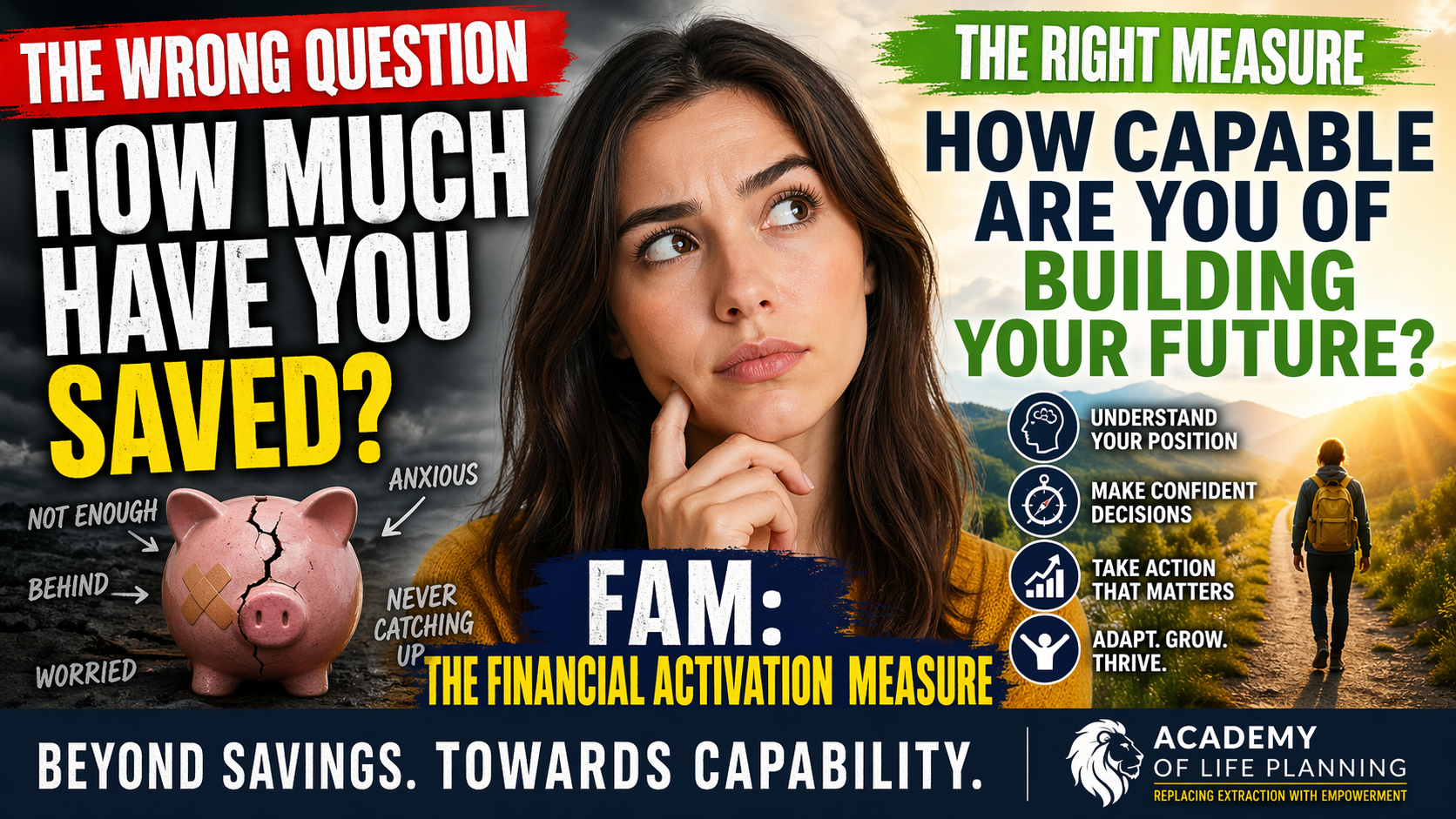
Introducing a Better Measure: The Financial Activation Measure (FAM)
At the Academy of Life Planning, we approach this differently.
Inspired by the NHS’s Patient Activation Measure (PAM)—which recognises that most people can manage their own health with the right support—we developed the Financial Activation Measure (FAM).
The premise is simple, but powerful:
Most people can manage their financial lives—if they are properly supported and activated.
FAM does not ask:
- “How much have you saved?”
It asks:
- Do you understand your financial position?
- Do you feel confident making decisions?
- Do you know what actions to take next?
- Can you adapt when circumstances change?
It measures capability, confidence, and readiness.
Not just outcomes.
Take your free 5-minute FAM test here.
From Outcomes to Agency
This shift matters.
Because when you measure only financial capital:
- You reinforce dependency
- You overlook potential
- You define people by what they lack
But when you measure activation:
- You unlock agency
- You identify where support is needed
- You enable people to move forward with clarity
It changes the role of financial planning itself.
From:
Managing money on behalf of people
To:
Equipping people to manage their own lives—effectively and confidently
A More Complete Definition of Financial Resilience
A more accurate model of resilience would include three components:
1. Financial Capital
What you have accumulated
2. Human Capital
What you are capable of generating
3. Decision Capital
How well you make choices under uncertainty
When these three are aligned, something powerful happens:
People stop feeling behind—and start feeling in control.
A Shift the Industry Cannot Ignore
The current narrative tells people:
- Save more
- Contribute more
- Catch up
But without addressing capability, this risks:
- Increasing anxiety
- Reinforcing dependence
- Missing the real drivers of long-term resilience
The opportunity is clear.
We need to stop asking how much people have…
and start understanding how capable they are.
The Way Forward
Financial resilience is not a number.
It is a state.
A state of:
- Clarity
- Confidence
- Capability
- Control
The Financial Activation Measure is designed to help people reach that state.
Because in a world of increasing complexity, uncertainty, and choice:
The most valuable asset any person has… is their ability to navigate their own life.
The Academy of Life Planning
Replacing extraction with empowerment

