
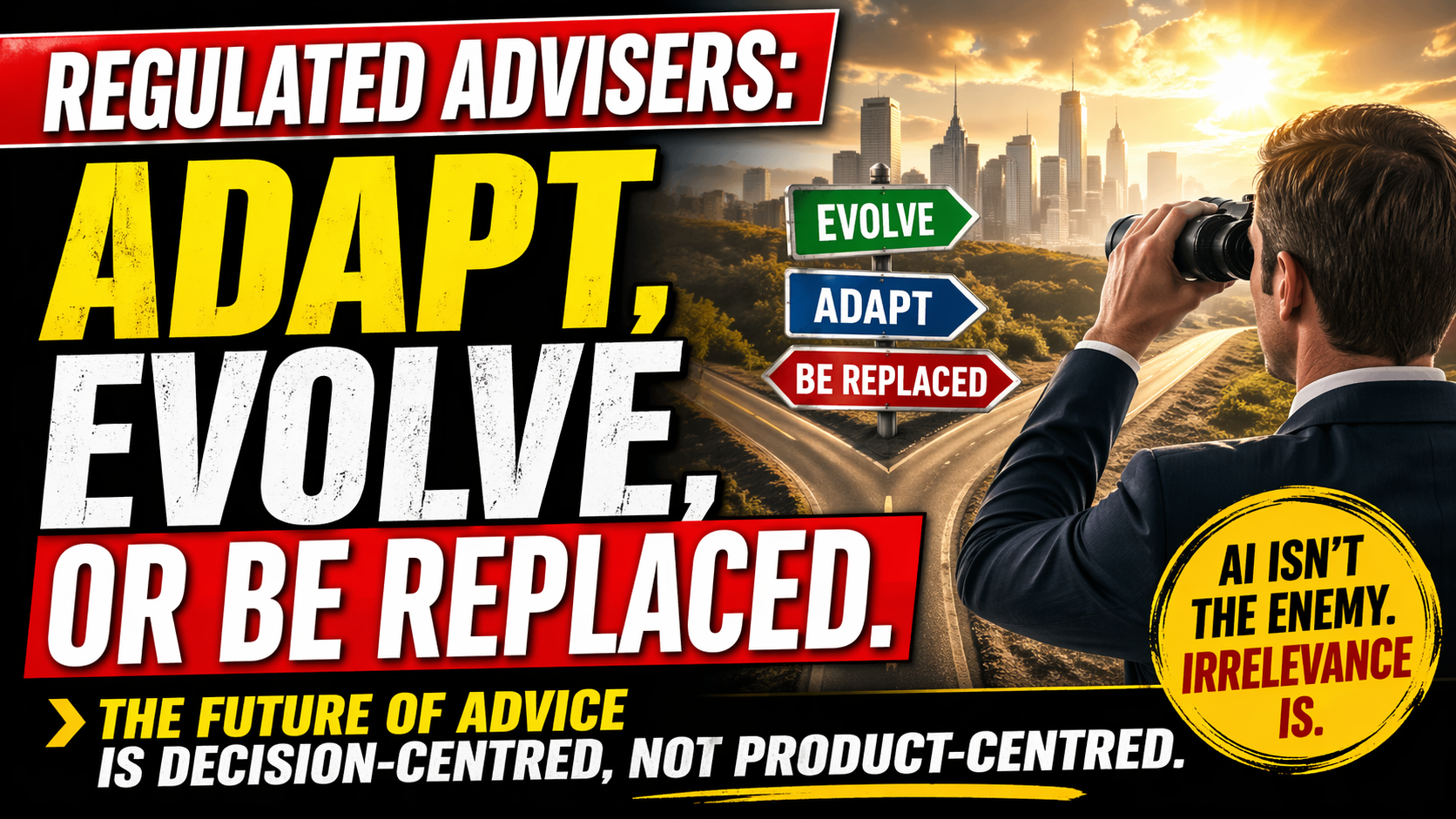
There is a quiet shift underway in financial services.
Not a dramatic collapse. Not a sudden disruption.
But something more consequential.
A slow, structural unravelling of the traditional advice model.
And most advisers haven’t fully clocked it yet.
A Model Under Pressure
Regulated advisers today are operating within a tightening vice.
On one side, regulatory change.
On the other, technological transformation.
And beneath both, a shifting expectation from consumers.
The old model—annual reviews, product-centric advice, process-driven delivery—is becoming harder to justify.
Not just commercially.
But conceptually.
The FCA’s direction of travel is clear.
Move toward proportionality.
Focus on outcomes.
Support different levels of client need.
At the same time, the regulator is becoming more data-led, more technology-enabled, and more explicit about efficiency and growth.
This is not a stable environment.
It is a transition phase.
The Real Challenge Isn’t Compliance
Many advisers believe their biggest challenge is regulatory burden.
It isn’t.
The real challenge is relevance.
Too many firms are still positioned around:
- products
- wrappers
- transactions
- periodic reviews
But clients don’t wake up thinking about pensions, ISAs, or asset allocation.
They think about:
- whether they can stop working
- how to support their family
- what choices they can afford to make
- what risks they’re unknowingly carrying
This is not a product problem.
It is a decision problem.
And the firms that fail to recognise this are already drifting out of alignment with client need.
AI Is Not the Threat You Think It Is
AI is widely being framed as the existential threat to advisers.
That framing is wrong.
AI is not replacing advisers.
AI is exposing them.
It is removing the historical advantage of information asymmetry.
For decades, advisers held value because:
- information was scarce
- analysis was complex
- comparison was difficult
That advantage is gone.
Today, a client can:
- interrogate a product in seconds
- surface hidden costs instantly
- generate alternative strategies independently
So the question becomes:
If information is no longer scarce… what are clients actually paying for?
The uncomfortable answer for many firms is:
Not what they think.
The Blind Spots Holding Firms Back
There are five critical blind spots I see consistently across the profession.
1. Confusing regulation with value
Being regulated does not make a service valuable.
It makes it accountable.
2. Protecting the model instead of redesigning it
Too many firms are trying to defend margins instead of rethinking relevance.
3. Misreading AI
AI is being treated as either:
- a threat to be resisted
- or a tool for internal efficiency
Instead of what it really is:
A client empowerment engine.
4. Over-reliance on product intermediation
When the value chain shifts, intermediaries are the first to be questioned.
5. One-size-fits-all service models
Annual reviews for all clients are not sustainable, necessary, or aligned with actual need.
Where the Real Opportunity Lies
Despite the pressure, this is not a story of decline.
It is a story of repositioning.
The advisers who thrive will not be those who optimise the old system.
They will be those who step outside it.
Five priorities stand out:
1. Move from Product Advice to Decision Support
The future adviser does not sell solutions.
They help clients make better decisions.
That means:
- clarifying trade-offs
- navigating uncertainty
- aligning money with life
- supporting follow-through
2. Use AI to Enhance Client Agency
The winning firms will not just automate admin.
They will use AI to:
- improve client understanding
- increase engagement
- enable better questions
- support informed choice
AI should not replace the client.
It should strengthen them.
3. Segment Service Intelligently
Not every client needs:
- the same process
- the same frequency
- the same level of support
Proportionate service is no longer operational.
It is strategic.
4. Make Value Visible
Transparency is no longer optional.
Clients need to clearly see:
- what they are paying for
- what they are receiving
- where conflicts may exist
- how decisions are being shaped
Trust is built through clarity.
5. Expand Beyond the Regulated Perimeter
This is the most uncomfortable shift—but also the most important.
The future does not sit purely within regulated advice.
It sits across:
- planning
- coaching
- education
- decision support
- behavioural guidance
The firms that recognise this will have far more flexibility, scalability, and resilience.
The Shift That Matters Most
The real transition is this:
From product-centred adviser
To decision-centred planner
To trusted thinking partner
This is not semantics.
It is a complete redefinition of value.
A Final Thought
The greatest danger to regulated advisers is not AI.
It is clinging to a model that AI makes easier for clients to question.
And the greatest opportunity?
To rebuild the profession around something far more enduring:
- clarity
- judgement
- trust
- and human agency
Where the Academy of Life Planning Fits
At the Academy of Life Planning, this is exactly the transition we support.
Not by replacing advisers.
But by helping them evolve into Total Wealth Planners:
- product-free in thinking
- client-first in design
- AI-enabled in delivery
- and grounded in human outcomes
Because in a world where information is abundant…
The real value is no longer knowing more.
It is helping people choose better.
Curious how others see this.

