
The concept of time buckets in Bill Perkins’ book Die with Zero: Getting All You Can from Your Money and Your Life (2020) is particularly relevant to whole-person financial planning.
The central premise is that we should stop treating wealth accumulation as the ultimate objective and start thinking about how we convert our resources into meaningful life experiences at the appropriate time.
Traditional financial planning tends to organise life around money. Perkins suggests organising money around life.
What are time buckets?
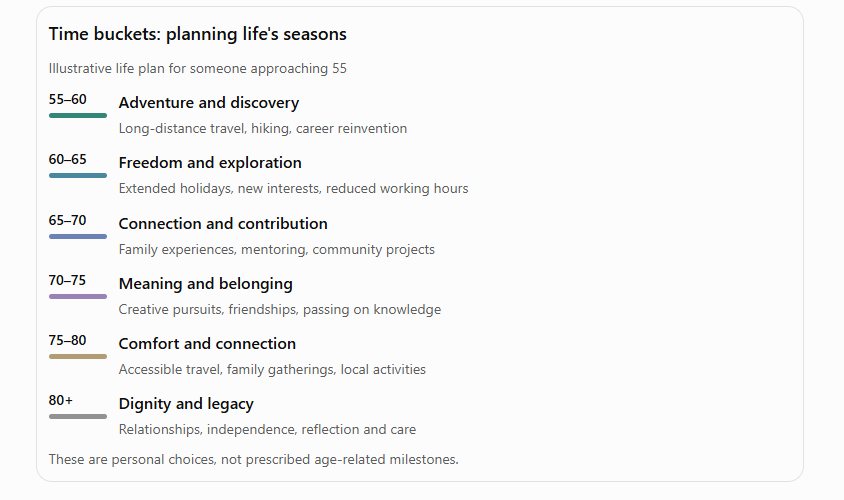
Rather than creating a conventional bucket list of things you would like to do before you die, Perkins suggests dividing your remaining life into periods, typically five or ten years, and allocating desired experiences to each period.
The distinction is important because many life experiences have an expiry date. You may still have the money to undertake them later, but no longer have the health, energy, relationships or opportunity.
Perkins describes this in Rule 7 of the book: Think of Your Life as Distinct Seasons.
An illustrative example might look like this:
Three particularly powerful concepts
1. Memory dividends
Perkins argues that an experience generates value not only when it happens but throughout the subsequent years in which we remember it, share its stories and draw meaning from it.
An experience at 40 can potentially generate 40 years of memory dividends. The same experience at 75 might generate considerably fewer.
Financial capital compounds, but so can experiential wealth.
2. The three resources of life
Our ability to enjoy particular experiences depends on the availability of three resources: money, time and health.
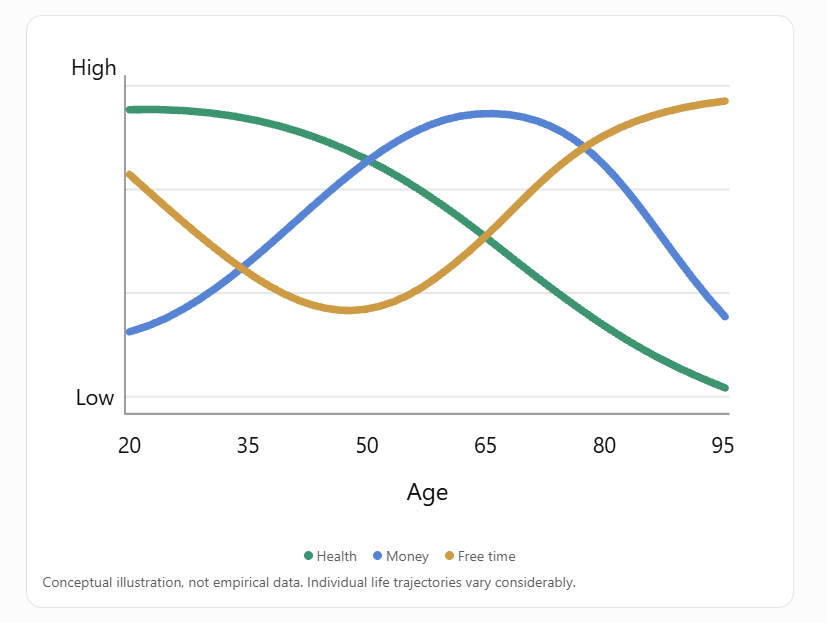
The challenge is that these resources are rarely at their maximum simultaneously.
When we are young, we may have health but insufficient money. During our working years, we may have money but insufficient time. In later life, we may have money and time but diminishing health.
Good life planning seeks to bring these resources into alignment.
3. Mini-deaths
Perkins recognises that we experience numerous endings throughout our lives, not just one at the end.
The opportunity to holiday with your young children disappears as they grow up. The opportunity to spend time with your parents disappears when they die. Certain versions of ourselves cease to exist.
This introduces a neglected dimension of financial planning: the opportunity cost of postponing life.
How this fits the Academy’s GAME Plan
I see time buckets as an excellent practical exercise within the Academy’s existing methodology.
| GAME Plan | Application |
|---|---|
| Goals | Identify meaningful experiences across life’s remaining seasons. |
| Actions | Determine what needs to happen and when. |
| Means | Identify the financial, human and social capital required. |
| Execution | Act while the window of opportunity remains open. |
The time buckets could feed directly into Navigator’s cashflow modelling, translating meaningful life goals into chapters and timed financial requirements.
Rather than beginning with the question, “When can I afford to retire?”, the client begins with, “What do I want my remaining years to contain?”
The financial plan becomes the means rather than the end.
Where I would take Perkins’ thinking further
Perkins largely focuses on converting financial wealth into life experiences. Total Wealth Planning can extend this to the creation and deployment of all forms of wealth.
Not every meaningful experience requires spending money. Some require developing capabilities, building relationships, finding purpose, improving health or contributing to others.
Nor should dying with zero be a literal financial target. Financial resilience, longevity uncertainty, care costs, dependants and personal legacy intentions all matter.
I would introduce a complementary concept:
The Life Opportunity Window.
Every meaningful life goal has three dimensions:
- Desirability: How much does it matter to me?
- Feasibility: What resources and capabilities do I need?
- Time sensitivity: What happens if I leave it until later?
That third dimension is often absent from conventional financial planning.
A potential Academy OS application
I could see Navigator operating as a My Life Season tool working alongside My Life Record, and the Total Wealth Wheel.
Clients could independently map their desired experiences across their financial, social, environmental and spiritual well-being, identify closing opportunity windows, estimate resource requirements and develop an actionable plan.
The human planner could then help interrogate assumptions and explore trade-offs without taking ownership of the decisions.
Perkins already provides a Time Buckets application through his official website, which is worth exploring.
The distinction I would make between his philosophy and ours is this:
Perkins asks how we can avoid dying with unused money.
The Academy might ask how we can avoid dying with unused potential.
Don’t just plan how long your money needs to last. Plan what you want your life to contain while it lasts.
From Time Buckets to Life Chapters
The Academy of Life Planning has already incorporated this thinking into Navigator™, through its built-in My Life Seasons chapter planning facility.
Rather than treating life as a single financial projection stretching from today until death, Navigator enables individuals to think about their lives in distinct chapters, each with its own priorities, opportunities and resource requirements.
This complements Bill Perkins’ time buckets concept but extends it beyond spending accumulated financial wealth.
Each chapter presents opportunities to develop and deploy human capital, strengthen relationships, pursue meaningful experiences and contribute to the world around us.
The objective is not simply to optimise the consumption of financial capital, but to realise our potential across all four dimensions of well-being: financial, social, environmental and spiritual.
Perkins asks how we can avoid dying with unused money.
The Academy asks how we can avoid dying with unused potential.
Don’t just plan how long your money needs to last. Plan what you want your life to contain while it lasts.

