
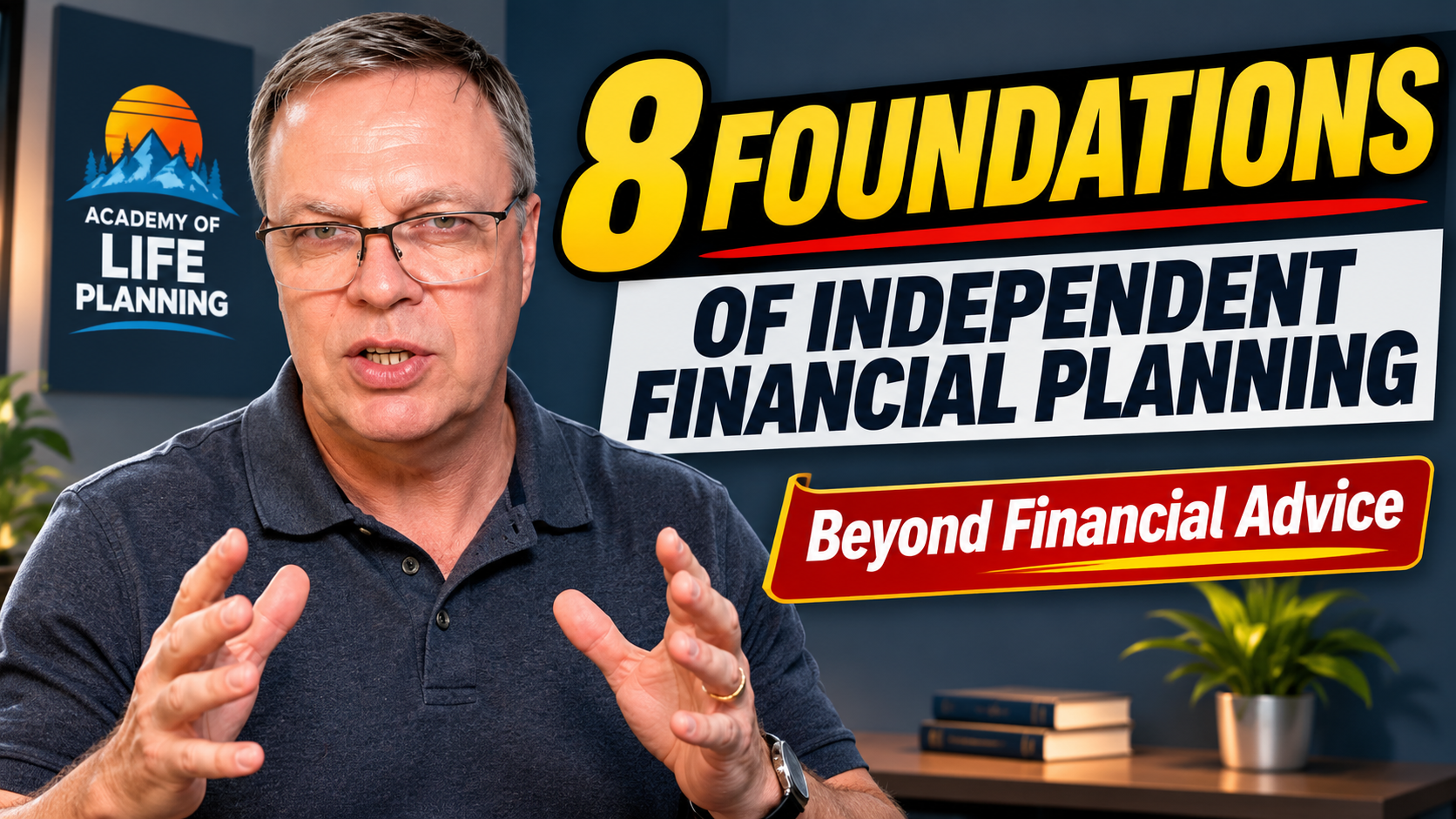
What does a genuinely independent financial planning proposition look like when its purpose is to develop human capability rather than acquire assets under management?
A growing number of financial planners are recognising an underserved market.
These are people who want help with their financial and life decisions but do not necessarily want to change their investment arrangements.
They may be DIY investors. They may already have an investment manager. They may be approaching retirement, considering a career change, navigating a family transition or simply trying to make sense of their financial future.
They want professional expertise without surrendering control.
Increasingly, practitioners are responding by developing financial planning-only services.
That is an encouraging development. But it also invites a more fundamental question.
What would financial planning look like if we designed the entire profession around the needs of the person, rather than the management of their money?
At the Academy of Life Planning, we believe the answer requires more than separating financial planning from investment management.
It requires a different professional philosophy, methodology, commercial model and relationship with technology.
Here are the eight foundations of that proposition.
1. Plan the person before the money
Traditional financial services frequently begin with what a person owns.
We begin with who they are.
What matters to them? What are their talents? What gives their life meaning? What would they like their future to look like? What constitutes enough?
Until we understand the life someone wants to live, it is difficult to establish what their money needs to achieve.
Financial planning should begin with a life conversation, not an investment conversation.
Money is a resource. Life is the purpose.
2. Recognise human capital alongside financial capital
Imagine two people, both aged 40, with identical pension pots and investment portfolios.
One has a fulfilling career, adaptable skills, strong professional relationships and considerable future earning potential.
The other is approaching redundancy, has limited opportunities for retraining and faces an uncertain working future.
Are they equally wealthy?
Conventional financial planning may not fully capture the difference.
At the Academy, we use a broader organising framework:
Total Wealth = Financial Capital + Human Capital − Liabilities
Human capital includes our knowledge, skills, experience, capabilities and future earning potential.
For many working-age households, developing human capital may have a far greater impact on their financial future than optimising an investment portfolio.
Yet how often does a financial planning meeting devote more time to career development than investment performance?
Independent financial planning should direct attention towards the resources and decisions that matter most, irrespective of whether they generate financial product revenue.
3. Adopt a whole-person planning methodology
Financial wealth is only one dimension of a wealthy life.
Our methodology considers four interconnected dimensions of well-being:
- Financial: Having sufficient resources, resilience and financial security.
- Social: Developing meaningful relationships, belonging and contribution.
- Environmental: Living and working in surroundings that support well-being.
- Spiritual: Finding meaning, purpose and alignment with personal values, understood inclusively.
These dimensions are interconnected.
A decision to retire earlier might reduce financial wealth while improving health, relationships and quality of life.
A career change might temporarily reduce income while increasing long-term fulfilment and earning potential.
The purpose of financial planning is not to maximise one dimension at the expense of all the others.
It is to help people achieve enough across the different dimensions of their lives, according to their own values.
Our GAME Plan methodology brings these considerations together with practical financial sustainability modelling.
We plan the life. We then establish how to fund it.
4. Build capability rather than dependency
There is an important distinction between helping someone make a decision and making that decision for them.
At the Academy, we provide neutral information, education, balanced advantages and disadvantages, scenario modelling and explanations of risks and uncertainties.
We help people understand the options available and explore their potential consequences.
We do not make personal recommendations concerning specific regulated investments or select investment products on someone’s behalf.
Our governing distinction is simple:
The professional is accountable for the quality of the explanation. The individual retains authority over the decision.
This is not an abdication of professional responsibility. It requires considerable expertise, care, accuracy, balance and an appreciation of the limitations of our knowledge.
But the intended outcome is different.
Rather than demonstrating how much the client needs the planner, we seek to demonstrate how much more capable the client becomes through working with the planner.
That is human agency.
5. Establish structural independence
We often talk about trust in financial services as a personal characteristic.
Is the practitioner trustworthy? Are they ethical? Will they put the client’s interests first?
These are important questions. But there is another question we should ask.
How trustworthy is the structure within which the practitioner operates?
Consider a planner whose income depends on the amount of money a client places under management.
What happens when the client’s best option is to repay debt, invest in their own education, start a business, spend more time with their family or retain their existing investment arrangements?
The practitioner may act with complete integrity. Nevertheless, a commercial tension exists.
The Academy’s own professional practice is designed around different conditions:
- Zero assets under management.
- No investment product commissions.
- No asset-based remuneration.
- No investment transaction remuneration.
- No discretionary control of client assets.
- No mandatory ongoing professional relationship.
- Transparent fees for professional services and support.
- Freedom for clients to implement their own decisions.
No commercial model eliminates every potential conflict of interest. But we can remove many unnecessary conflicts by design and disclose those that remain.
We call this structural trustworthiness.
Doing what serves the client should not require overcoming financial incentives to do otherwise.
When we say independent, we mean independent of wealth management intermediation.
6. Prioritise materiality before complexity
Financial services can become extraordinarily complicated.
Sophisticated investment strategies, elaborate tax arrangements, complex products and detailed portfolio analysis can consume considerable professional time.
But complexity does not necessarily translate into better outcomes.
For one household, the most consequential decision might be when to retire.
For another, it might be whether to invest in retraining, reduce housing costs, repay expensive debt or change working arrangements.
For someone else, it might simply be understanding whether they already have enough.
Our investment education favours simplicity, diversification, low costs and long-term discipline.
For appropriate long-term retail investment capital, low-cost, globally diversified and automatically rebalanced portfolios provide a useful educational benchmark against which the additional costs and claims of managed alternatives can be evaluated.
That is a benchmark for understanding, not a personal investment recommendation.
The independent financial planner can possess considerable investment expertise without becoming an investment intermediary.
The question is not how sophisticated we can make the financial solution.
It is how much difference we can make to the person’s life.
Materiality before complexity.
7. Combine sovereign AI with episodic human expertise
Artificial intelligence invites us to reconsider the relationship between individuals and professional expertise.
Historically, access to financial information, modelling tools and analytical capability has often been mediated by professionals.
AI creates an opportunity to make these capabilities more directly accessible to individuals.
But there are two fundamentally different ways to deploy this technology.
Institutional AI primarily helps organisations complete processes, reduce costs and deliver services more efficiently.
Sovereign AI helps individuals develop and preserve their ability to understand, choose and act independently.
At the Academy, we are building towards the latter.
Through Total Wealth Plans and the Academy OS, individuals can access AI-supported planning tools, explore scenarios and maintain greater ownership and control of their financial and life information.
Appropriate verification of AI outputs remains essential, particularly where calculations and consequential decisions are involved.
Human planners provide education, experience, challenge, contextual understanding and professional support when it matters.
The technology does not make the planner redundant.
It changes the nature of the relationship.
We describe this professional architecture as:
Continuous agency. Episodic expertise.
The individual remains in control throughout their life. Professional expertise is available whenever it adds genuine value.
Self-directed by default. Supported when it matters.
8. Make financial planning inclusive
One of the limitations of an asset-based commercial model is that people without substantial investable assets may struggle to access professional financial planning.
Yet these are often the people who could benefit most from it.
Consider someone who has lost their life savings through financial exploitation.
Someone facing redundancy at 55.
A parent returning to employment after raising a family.
A household struggling with the rising cost of living.
A young person trying to establish a financially sustainable future.
Their financial planning needs may be considerable, even if their investment portfolios are not.
Through our Get SAFE initiative, we see the importance of helping people rebuild understanding, confidence and capability following financial exploitation.
Financial vulnerability requires care, appropriate safeguarding, professional boundaries and, where necessary, specialist referral.
But vulnerability should not automatically become a reason for exclusion.
Safeguarding should be the architecture of inclusion, not the justification for exclusion.
A profession built around solving people’s problems can serve a much broader population than an industry built around acquiring their portfolios.
A different measure of professional success
What happens when we bring these eight foundations together?
We begin to see an intentionally different professional proposition.
| Dimension | Agency-led independent financial planning |
|---|---|
| Starting point | The person and the life they want to live |
| Resources considered | Human and financial capital |
| Objective | Financial sustainability and whole-person well-being |
| Decision-making authority | Retained by the individual |
| Commercial model | Transparent fees for expertise and support |
| Technology | Develops individual capability |
| Professional relationship | Available when genuinely useful |
| Client eligibility | Based on planning needs, not investable assets |
| Measure of success | Greater understanding, capability and independence |
The important distinction is not simply whether a financial planner offers a standalone planning service.
It is whether the entire proposition is designed to increase the client’s agency.
A financial planning-only service can be a valuable starting point.
An agency-led professional model takes the opportunity further.
The opportunity for financial planners in the age of AI
As access to financial information and analytical tools becomes increasingly democratised, the traditional advantages associated with controlling access to information may diminish.
But people will continue to face difficult decisions.
They will still need help understanding uncertainty, resolving competing priorities, recognising their capabilities and connecting financial resources with the lives they want to live.
That is where human expertise can make an enduring contribution.
The commercial opportunity is to build a profession whose value resides in the problems it helps people solve, rather than the assets it acquires or retains.
A profession that earns its fees through the value of its work, not through continued control of its clients’ wealth.
A profession that welcomes increasingly capable clients rather than perceiving them as a commercial threat.
Building the foundations of a different profession
Through Academy Foundations, we are supporting practitioners who want to explore and develop this alternative professional model.
We bring together whole-person planning methodology, human capital development, AI-supported technology, structural independence and agency-led professional practice.
We are also interested in learning from practitioners who have already developed financial planning-only services and are exploring how these might evolve.
The Academy has trained 81 other practitioners, although their individual commercial models and adoption of our philosophy vary. Our own practice provides the working implementation of the foundational proposition described here.
We are not suggesting that every practitioner must follow an identical path.
We are inviting a conversation about what financial planning could become when the person’s interests, capabilities and decision-making authority are placed at the centre of its design.
The Academy is not advice with something missing.
It is an intentionally different professional model, designed to restore human agency.
We don’t want your assets under management.
We want your decisions under your control.
Bring us the problem, not the portfolio.
Steve Conley is a Chartered Financial Planner and founder of the Academy of Life Planning, established in 2012. The Academy exists to restore human agency through independent, values-led, whole-person financial planning.
Explore Academy Foundations and the wider Academy ecosystem:
- Academy of Life Planning — Professional education, methodology and movement.
- Academy OS — AI-supported tools for independent financial and life planning.
- Total Wealth Planner — Human expertise and professional support when it matters.
This article describes the Academy’s professional philosophy and service model. It provides general educational information, not personal investment recommendations.

