
The challenge is not simply to protect people’s financial assets as they grow older. It is to protect their voice in the decisions that affect their lives.
By Steve Conley, Founder, Academy of Life Planning | 25 November 2026
We talk a great deal about financial security in later life.
We plan for investment risk, inflation, longevity, care costs, inheritance and the possibility of running out of money.
But how much time do we spend planning for the preservation of human agency?
As people grow older, their circumstances change. Their physical health may deteriorate. Their cognitive abilities may fluctuate. Their confidence in dealing with complex financial matters may diminish.
The financial planning profession understandably concerns itself with recognising these changes and responding appropriately.
But there is an important upstream consideration.
What are we doing throughout the professional relationship to develop and preserve the client’s own decision-making capability, rather than waiting until concerns about cognitive decline emerge?
At the Academy of Life Planning, we propose an additional discipline within whole-person financial planning.
We call it Agency Continuity Planning.
What is Agency Continuity Planning?
Agency Continuity Planning is the process of developing, preserving and appropriately supporting an individual’s ability to understand, choose and act throughout life’s changing circumstances, including periods of vulnerability and declining mental capacity.
Its purpose is to ensure that the person’s voice, values, wishes and preferences remain central to decisions affecting their life.
It starts long before anyone raises concerns about mental capacity.
It begins when we first help someone understand their financial circumstances, explore their choices and develop the confidence to make informed decisions.
It continues as we help them organise their information, document their wishes, prepare for life transitions and establish appropriate arrangements for future support.
And it remains relevant even when someone eventually requires another person to make certain decisions on their behalf.
The objective is not independence at all costs.
It is the preservation of meaningful agency wherever possible.
Vulnerability is not incapacity
One of the dangers in discussions about ageing is the tendency to conflate vulnerability with incapacity.
An older person struggling to navigate an online banking system may not lack mental capacity.
Someone who finds investment terminology confusing may simply never have had it explained properly.
A recently bereaved individual experiencing difficulty concentrating may need time, compassion and accessible information.
A person making a decision that their financial adviser disagrees with may nevertheless be entirely capable of making that decision.
These distinctions matter.
In England and Wales, the Mental Capacity Act 2005 establishes five foundational principles:
- A person must be presumed to have capacity unless established otherwise.
- All practicable steps must be taken to support a person in making their own decision before treating them as unable to do so.
- Making an unwise decision does not, in itself, establish incapacity.
- Decisions made on behalf of someone lacking capacity must be made in their best interests.
- Consideration must be given to whether the objective can be achieved in a less restrictive way.
The second principle is particularly important for financial planners.
Before concluding that someone cannot make a decision, we must consider whether we have adequately supported their ability to make it.
That principle sits at the heart of an agency-led professional model.
Three things we must not confuse
Agency Continuity Planning distinguishes between three related but different concepts.
| Concept | Meaning |
|---|---|
| Mental capacity | The ability to make a particular decision at a particular time. |
| Decision-making capability | The knowledge, skills, accessible information and practical support available to make informed decisions. |
| Decision-making authority | The legal right to make or authorise a decision. |
A person may have mental capacity and legal authority but lack the financial knowledge or confidence necessary to navigate a complex decision.
That is not necessarily a reason for someone else to take over.
It may be a reason to provide better information, education, technology or human support.
Similarly, someone experiencing cognitive decline may retain the capacity to make many decisions, even if they require assistance with others.
Capacity is decision-specific and time-specific.
The appropriate response is not automatically to remove authority.
It is to identify what support will enable the person to participate as fully as possible.
Have we been developing capability or dependency?
Imagine two people approaching their eighties.
The first has spent several decades relying on a financial adviser.
Their investments have been managed for them. Their financial decisions have largely been delegated. Their knowledge of their arrangements is limited.
When something changes, they telephone their adviser.
The second has spent those decades developing an understanding of their financial circumstances.
They know what they own, why they own it and what their financial arrangements are intended to achieve.
They have accessible records, documented wishes and trusted professional contacts.
They seek expertise when they need it, but they have retained meaningful involvement in their financial decisions.
Both individuals may experience cognitive decline.
But they begin from different positions.
The second has developed resources that may help them retain meaningful participation in their affairs and help others support them when circumstances change.
This is not an argument against using professional expertise or voluntarily delegating decisions.
Delegation can itself be an expression of agency.
It is an argument against unnecessarily creating dependency through the design of professional services.
There is a difference between cognitive decline and capability that was never developed in the first place.
We should be careful not to confuse the two.
The five pillars of Agency Continuity Planning
The Academy’s proposed framework brings together five complementary areas of practice.
1. Build decision-making capability
Throughout the planning relationship, help the individual develop their own understanding.
Explain financial arrangements in accessible language. Make assumptions visible. Explore alternatives. Discuss risks and uncertainties.
Encourage questions and provide opportunities to revisit important decisions.
The professional’s value should not depend upon the client remaining unable to understand their own affairs.
Decision-making capability is a form of human capital.
It deserves to be developed, maintained and supported throughout life.
2. Preserve personal information sovereignty
How many households would struggle to identify all their financial arrangements if the person who normally manages them became seriously ill tomorrow?
Where are the pension records?
Which accounts exist?
Who are the professional contacts?
What commitments have been made?
Why were particular decisions taken?
Financial information may be scattered across institutions, email accounts, professional files and forgotten paperwork.
This fragmentation creates vulnerability.
The Academy’s My Life Record initiative addresses this challenge through the concept of a personally controlled, enduring life record.
Such a record can bring together financial arrangements, important documents, professional contacts, personal preferences and the history of significant decisions.
The individual should retain control over their information and decide what is shared, with whom and for what purpose, subject to applicable legal requirements.
Appropriate security, accessibility and authorised access arrangements are essential.
A person’s ability to understand their life should not depend upon the continued availability of a particular adviser, institution or technology provider.
Information continuity supports agency continuity.
3. Adapt support as circumstances change
Human agency is not static.
Someone who is entirely comfortable managing their affairs today may need additional support tomorrow.
Bereavement, illness, financial exploitation, cognitive decline or other significant life events can temporarily or permanently change the type of assistance required.
Financial planning services should be adaptable.
This may involve slower conversations, simpler explanations, written summaries, visual information, additional time or the involvement of a trusted person.
AI-supported planning tools can also contribute to this objective.
Our Total Wealth Plan technology specification establishes an adaptive approach in which the planning journey responds to the individual’s circumstances and emotional readiness.
The person experiencing distress is not expected to follow the same process as someone enjoying financial stability.
Similar principles can inform services for people experiencing changes in their cognitive abilities.
Technology should help people retain meaningful involvement, not diagnose incapacity or take decisions away from them.
The objective is to adapt the service to the person, rather than require the person to adapt to the service.
4. Document values, wishes and preferences
Financial planning frequently records what a person owns.
Agency Continuity Planning also records what matters to them.
What constitutes a good life?
What gives them a sense of purpose?
Where would they prefer to live?
What relationships are important to them?
What would they wish to prioritise if their health deteriorated?
How do they feel about spending money on their own care, supporting family members or preserving an inheritance?
These conversations have value long before concerns about mental capacity arise.
They also become particularly important if another person subsequently needs to make decisions on their behalf.
Section 4 of the Mental Capacity Act requires consideration, where reasonably ascertainable, of a person’s past and present wishes and feelings, relevant written statements, beliefs and values when determining their best interests.
An accessible and regularly updated record of the person’s wishes can therefore help preserve their voice.
It is not a substitute for the relevant legal decision-making process.
Nor should an historical statement automatically override the person’s current wishes.
But it can help ensure that those making decisions understand the human being whose life is affected.
5. Establish future support and legal arrangements
Planning ahead includes considering who might support us if our circumstances change.
In England and Wales, lasting powers of attorney allow people with the necessary mental capacity to appoint trusted individuals to make specified decisions on their behalf.
There are two types:
- Property and financial affairs.
- Health and welfare.
Their operation differs. A registered property and financial affairs LPA can, depending on its terms, permit an attorney to act while the person retains capacity and gives permission. A health and welfare LPA can only be used when the person lacks capacity for the relevant decision.
Being someone’s spouse, adult child or next of kin does not, by itself, confer general legal authority to manage their financial affairs.
These matters deserve attention well before a crisis.
But Agency Continuity Planning goes beyond completing legal documentation.
It involves helping trusted people understand their responsibilities, establishing appropriate information-sharing arrangements, recognising potential conflicts of interest and ensuring that the individual’s own voice remains central.
Appropriate legal, health and social-care expertise should be involved where required.
The existence of a power of attorney should not become an excuse to stop involving the person in their own life.
From independence to supported agency
Too often, we think about decision-making in binary terms.
Either someone is independent or dependent.
Either they make their own decisions or somebody else makes decisions for them.
Human experience is considerably more nuanced.
Agency Continuity Planning recognises a continuum of support.
| Circumstance | Professional response |
|---|---|
| Independent decision-making | Develop knowledge, confidence and capability. |
| Assisted decision-making | Provide accessible information, tools and practical assistance. |
| Supported participation | Adapt communication and involve trusted people where appropriate. |
| Lawfully authorised decision-making on another’s behalf | Preserve the person’s involvement, wishes, values and interests within the applicable legal framework. |
These are not legal classifications, nor are they necessarily sequential stages.
A person may move between different levels of support depending on their circumstances and the particular decision involved.
The principle throughout is to preserve as much meaningful agency as possible.
Even where somebody lacks capacity for a particular decision, they remain a person with preferences, relationships, feelings and a voice.
Agency Continuity Planning and Safeguarding by Design
The Academy’s Safeguarding by Design Framework operates across four complementary layers: methodological, technological, operational and community.
Agency Continuity Planning provides a practical application of that framework to life’s changing circumstances.
| Safeguarding layer | Agency continuity application |
|---|---|
| Methodological | Plan for changes in capabilities, circumstances and future support needs. |
| Technological | Provide accessible information, adaptive tools and personally controlled records. |
| Operational | Recognise vulnerability, respect capacity principles, verify legal authority and escalate appropriately. |
| Community | Establish trusted relationships and access to relevant specialist professionals. |
Our Safeguarding & Vulnerability Policy, effective from 26 August 2026, already recognises that vulnerability does not automatically establish incapacity.
It requires proportionate support, respect for personal wishes and appropriate professional boundaries.
Agency Continuity Planning builds upon these arrangements by asking what can be done throughout a person’s life to help preserve their ability to participate in consequential decisions.
It is safeguarding upstream of harm.
Five questions every household should consider
You do not need to wait until retirement to begin thinking about agency continuity.
Ask yourself:
- Do I understand my financial arrangements sufficiently to explain them to someone else?
- Could someone I trust locate my important documents if I became unable to manage my affairs?
- Have I documented what matters to me and why I have made significant decisions?
- Have I considered who I would want to support me and established appropriate legal arrangements?
- Are my professional relationships developing my capability or making me unnecessarily dependent?
These are not simply questions for older people.
Illness, accidents, financial exploitation and major life changes can occur at any age.
Agency continuity is a lifetime planning consideration.
A new measure of professional success
Traditionally, financial services businesses have measured success through assets under management, client retention and recurring revenue.
An agency-led profession needs additional measures.
How well does the client understand their own affairs?
Can they access their information independently?
Do they know where to obtain appropriate help?
Are their wishes documented?
Can they participate meaningfully in decisions as their circumstances change?
Would their financial and life-planning arrangements remain understandable if their current professional relationship ended?
These questions encourage a different understanding of professional value.
The objective is not to make the professional indispensable.
It is to help the individual remain capable, informed and supported throughout life.
Continuous agency. Episodic expertise.
Inclusion before avoidance
The Academy’s eighth foundational principle of Independent Financial Planning is Inclusion before avoidance.
Financial vulnerability is not, in itself, a reason to exclude someone from financial planning.
Neither is advanced age, disability or cognitive decline.
Appropriate support may change as people’s circumstances change. Particular decisions may require specialist expertise or lawful intervention. Practitioners must recognise the limits of their competence.
But the person should never disappear from the planning process.
Safeguarding should be the architecture of inclusion, not the justification for exclusion.
Agency Continuity Planning gives practical expression to that commitment.
Conclusion: Protecting the voice behind the wealth
Cognitive decline is not something we can necessarily prevent.
But unnecessary professional dependency is something we can address through the design of our services.
Accessible information, adaptive technology, personally controlled life records, documented wishes and early planning for future support can all contribute to preserving human agency.
We should not wait until concerns about cognitive decline emerge before beginning this work.
Nor should safeguarding be concerned solely with determining when decision-making authority should pass to someone else.
It should be concerned with preserving the person’s participation for as long and as fully as possible.
Financial planning has traditionally sought to protect wealth across a lifetime.
Agency Continuity Planning invites us to protect something equally important.
The person’s ability to influence the life that wealth is intended to support.
The challenge is not simply to protect people’s financial assets as they grow older.
It is to protect their voice in the decisions that affect their lives.
An important distinction as we develop financial planning for an age of client agency.
Further reading and resources
- Mental Capacity Act 2005 — statutory principles and best interests
- GOV.UK — Make, register or end a lasting power of attorney
- GOV.UK — Making decisions about your health, welfare or finances
- Academy of Life Planning
- Academy OS
Join the conversation
Are you developing financial planning services that help people retain meaningful control over their lives as their circumstances change?
We welcome conversations with financial planners, legal professionals, safeguarding specialists, technology developers and others interested in developing Agency Continuity Planning.
How can we work together to preserve the person’s voice throughout their planning journey?
Steve Conley BSc FCII APFS
Founder, Academy of Life Planning
Chartered Financial Planner | Chartered Insurer
Restoring Human Agency in the Age of AI.
Strategic significance for the Academy
I see Agency Continuity Planning as a potentially important addition to the Academy’s body of intellectual capital.
It brings together existing elements of your proposition into a named discipline:
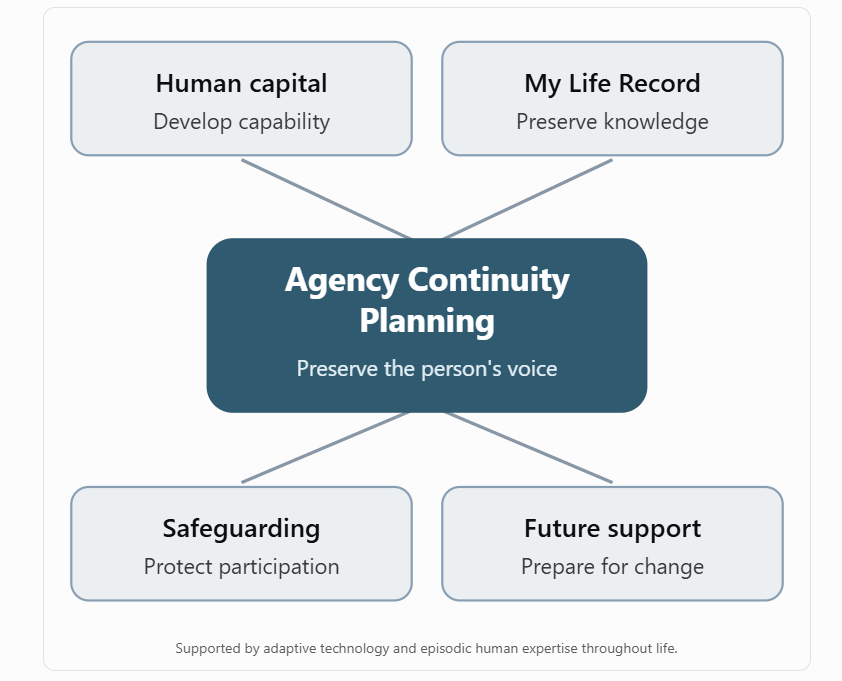
Supported by adaptive technology and episodic human expertise throughout life.
I have presented Agency Continuity Planning as a proposed Academy discipline rather than an established professional or statutory standard. I have also verified the Mental Capacity Act principles, best-interests provisions and LPA distinctions against official legislation and government guidance for England and Wales.
The memorable distinction I would carry forward into future Academy materials is:
Financial continuity protects your resources. Agency continuity protects your voice.
A corollary: Why My Life Record™ matters
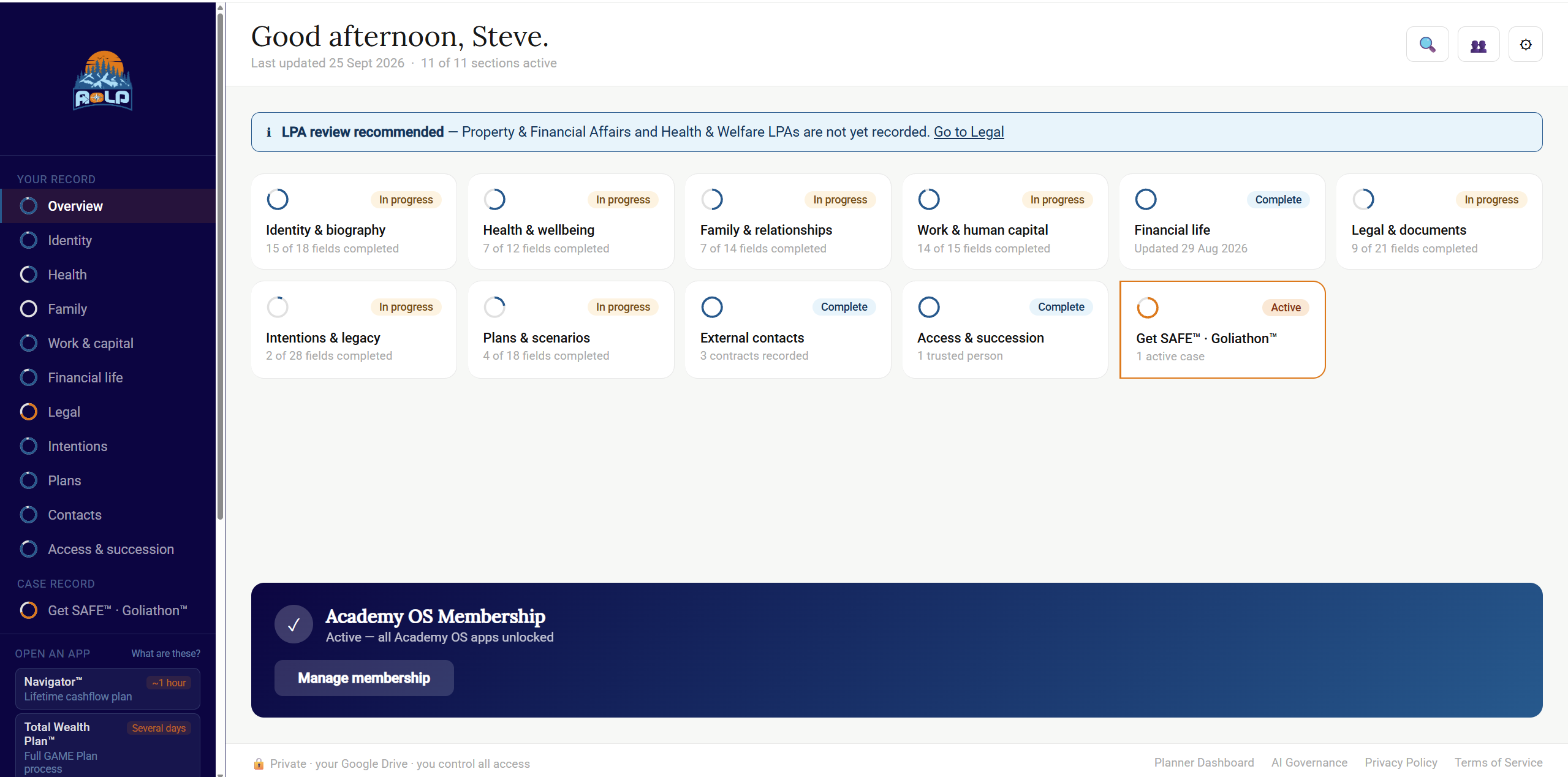
Agency cannot easily be preserved if the information necessary to exercise it is inaccessible.
Consider what happens when someone experiences cognitive decline, serious illness or an unexpected life event.
Their financial arrangements may be scattered across different institutions. Their pension records may be held by former employers. Important documents may sit in an adviser’s files. Their intentions may be known only to themselves.
Even a properly appointed attorney may struggle to establish what exists, where it is held and what the individual would have wanted.
The legal authority to act does not automatically confer the practical capability to act well.
This is one of the reasons we developed My Life Record™.
It is intended to be a personally controlled, enduring record of an individual’s life, financial circumstances, important documents, decisions, values and wishes.
Unlike a conventional financial planning report, which captures a particular moment in time, My Life Record is intended to evolve with the person throughout life.
It can provide continuity across changing circumstances, professional relationships, institutions and generations.
Your life should not be locked inside somebody else’s filing cabinet
Traditionally, much of the information necessary to understand a person’s financial affairs has been held by the professionals and institutions serving them.
Change your adviser, and some of that knowledge may be lost.
Lose access to an online account, and important information may become inaccessible.
Experience cognitive decline, and the task of reconstructing your financial life may fall to someone who has never been involved in it.
These are foreseeable risks.
They can be addressed upstream through better information architecture.
My Life Record is founded on a different principle: the individual should be the primary custodian of their own life information, with appropriate arrangements for secure sharing and authorised access when support is required.
The professional relationship may be temporary. The person’s need for information continuity is lifelong.
Preserving more than financial information
An effective life record should help answer questions such as:
- What do I own, owe and earn?
- Where are my important documents and pension records?
- Who are my trusted contacts and professional specialists?
- What decisions have I made, and why?
- What are my values, priorities and preferences?
- What would I want to happen if I could no longer make certain decisions independently?
- Who has lawful authority to support me or act on my behalf?
The last few questions are particularly important.
Knowing how much money someone possesses tells us relatively little about how they would wish that money to support their life.
Understanding the person requires understanding their story.
A memory aid, not a replacement for the person
As cognitive abilities change, accessible personal records may help individuals recall information, understand previous decisions and continue participating in their affairs.
With appropriate safeguards, they may also help trusted supporters and lawfully appointed representatives understand the person’s circumstances and wishes.
AI-supported tools may make this information easier to navigate, explain and organise.
However, neither AI nor a life record can determine mental capacity, confer legal authority or replace the requirements of the Mental Capacity Act.
Nor should a historical record of someone’s wishes automatically override what they are expressing today.
The purpose is to support the person’s voice, not freeze it in time.
Build it before you need it
The best time to establish a personally controlled life record is not when cognitive decline has already become a significant concern.
It is while the individual can actively participate in creating, maintaining and shaping it.
Every financial planning conversation becomes an opportunity to strengthen that record.
Every significant decision becomes an opportunity to document its reasoning.
Every life transition becomes an opportunity to revisit what matters.
Over time, the individual develops something more valuable than a collection of documents.
They develop continuity of understanding.
My Life Record as safeguarding infrastructure
Within the Academy ecosystem, the components serve complementary purposes:
| Component | Contribution to agency continuity |
|---|---|
| My Life Record™ | Preserves personal knowledge, information and documented wishes. |
| Total Wealth Plans | Develops understanding, explores options and supports informed decisions. |
| Total Wealth Planner | Provides human expertise and support when it matters. |
| Safeguarding by Design Framework | Establishes the principles and boundaries that protect meaningful participation. |
Together, these components help create a planning environment centred on the individual rather than the institution.
My Life Record is designed to remain accessible without a subscription charge for the record itself, reflecting our belief that access to one’s own life information should not depend on a continuing commercial relationship.
Information continuity is agency continuity
We spend considerable time planning how financial wealth will pass between generations.
Perhaps we should devote equal attention to preserving the knowledge, intentions, values and wishes that give that wealth its meaning.
An inheritance transfers assets.
A lasting power of attorney establishes legal authority.
A personally controlled life record can help preserve the understanding necessary to exercise that authority thoughtfully.
Each serves a different purpose.
Agency Continuity Planning brings them together around the person.
My Life Record is not simply a record of what you have. It is a record of who you are, what matters to you and how you wish your life to be supported.
Your circumstances may change.
Your capabilities may change.
Your need for support may change.
But your voice should remain part of the conversation.
That is why My Life Record matters.

