
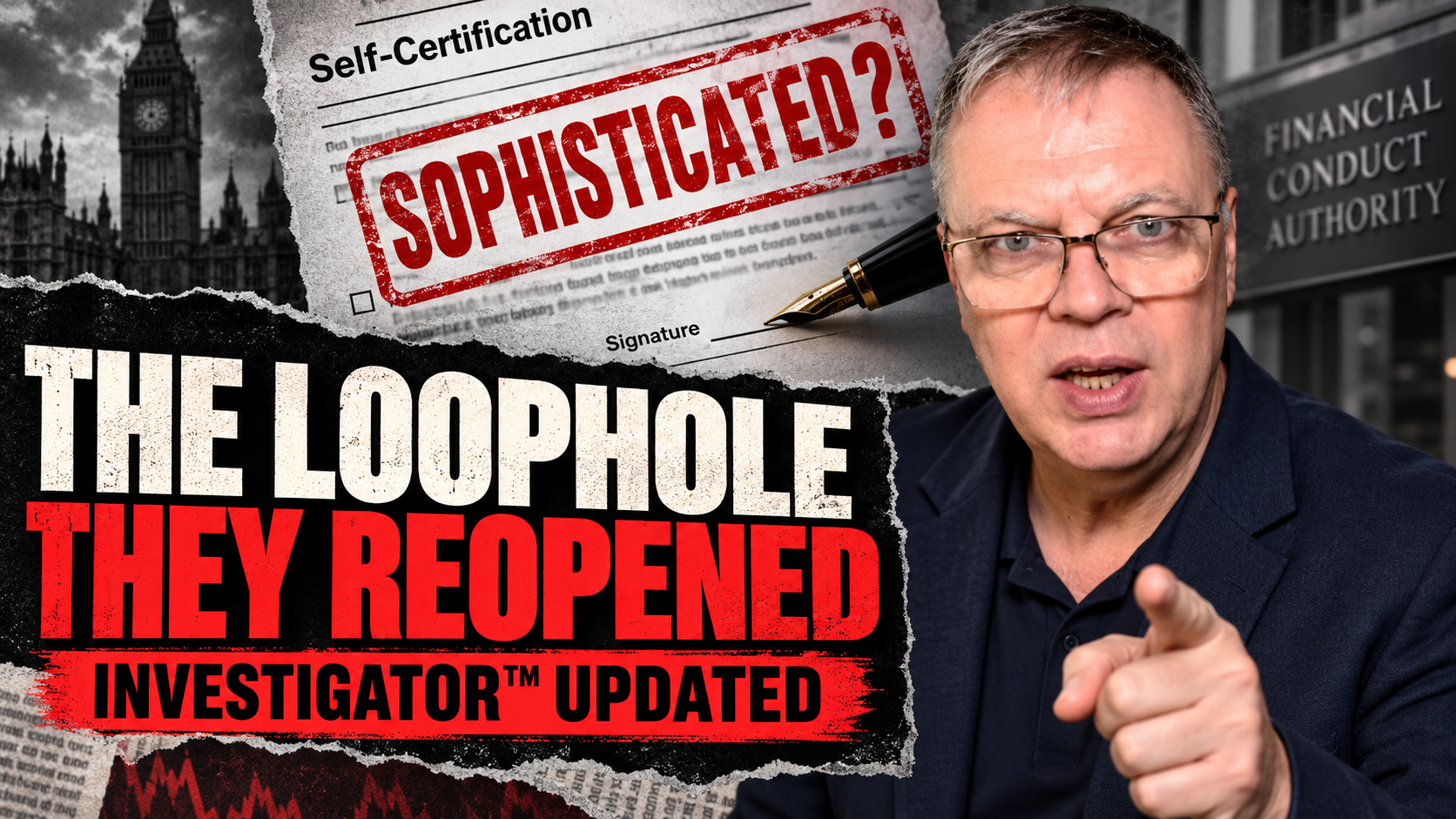
In response to the collapse of Woodville Consultants and a challenge from The Times, we have updated Investigator™—because government should close the loophole, but people need protection while it remains open
A form is placed in front of an investor.
It asks them to confirm that they are “high net worth” or a “sophisticated investor”.
The language sounds reassuring. Sophisticated. Experienced. Wealthy enough to know what they are doing.
Perhaps the person selling the investment helps them complete it. They explain that it is merely an administrative requirement—something necessary before the investor can access an opportunity unavailable to the general public.
The investor signs.
But they may not realise what else they have signed away.
The Woodville warning
In August 2026, The Times published an important commentary by Alistair Osborne: “How to stop making scams so easy”.
The article followed the collapse of Woodville Consultants, an unregulated litigation funder that raised more than £300 million from individual investors through high-risk loan notes.
Woodville entered administration in July 2026. Its affairs—and allegations concerning how investor money was used—remain under investigation. It would therefore be wrong to prejudge those findings.
But the regulatory weakness exposed by the case is already clear.
The Financial Conduct Authority banned the mass marketing of speculative mini-bonds and similar loan notes to ordinary retail investors from January 2021. Yet high-risk investments can still be promoted under exemptions for people classified as high-net-worth or sophisticated investors.
The most troubling route is self-certification.
The consumer signs a statement. The promoter gains access to them. Normal retail safeguards may fall away.
The FCA says consumers are sometimes encouraged to certify themselves as experienced or wealthy specifically so that investments can be promoted to them. It has called for self-certification to be removed, high-net-worth thresholds to be raised, and firms to become responsible for verifying eligibility.
But closing the statutory exemption requires government action.
And the loophole remains open.
Regulation was tightened. Then the lobbyists arrived.
The present thresholds are not the result of regulatory inaction alone.
In January 2024, the government raised the high-net-worth thresholds from £100,000 to £170,000 of annual income and from £250,000 to £430,000 of net assets.
The reform lasted only weeks.
Following lobbying from the venture-capital, angel-investment and start-up community, the government reversed it. The argument was that tighter eligibility rules would reduce the number of people able to fund young businesses and restrict access to growth capital.
That concern was not imaginary. Early-stage businesses need funding.
But the government responded by restoring a broad exemption applying far beyond genuine angel investment. The same doorway used to finance promising start-ups could continue to be used to promote speculative loan notes and other opaque investments to individual consumers.
This was deregulation by reversal.
A protection had been introduced. Influential commercial interests objected to its effect on their market. The protection was withdrawn, while the foreseeable risk was transferred back to consumers.
The incentives were asymmetrical:
- promoters retained access to a larger pool of potential investors;
- introducers retained opportunities to earn commissions;
- businesses retained a cheaper route to raising capital;
- consumers retained the risk of total loss.
Woodville should not be presented as the proven consequence of one political decision; its affairs remain under investigation. But the wider consumer detriment is precisely what the FCA warned the exemption could facilitate.
The lesson is uncomfortable:
When consumer protection depends on whether the protected industry finds it convenient, protection becomes negotiable.
The real choice was never simply between consumer protection and economic growth. It was whether legitimate angel investment required the continued existence of a much broader protection-waiver funnel.
Instead of designing a narrower, verified route for knowledgeable investors funding genuine enterprises, the government restored a classification system in which consumers could still be encouraged to declare themselves outside ordinary safeguards.
That is not agency.
Agency means being able to make an informed choice while retaining control over the decision. It does not mean allowing the seller to define the buyer as sophisticated, explain away the protections and then rely upon the buyer’s signature when things go wrong.
When a safeguard becomes part of the sale
The classification form is ostensibly a consumer safeguard.
In the wrong hands, it becomes part of the sales process.
The sequence looks like this:
Attract. Restrict. Coach. Certify. Blame.
First, attract the person with a compelling proposition: an apparently secure investment, an impressive return or an opportunity normally reserved for insiders.
Then introduce a restriction. Explain that the investment is not available to ordinary retail investors.
Next, coach the person through the classification. Present it as routine paperwork rather than a decision carrying serious regulatory consequences.
Once they certify, the investment can be promoted outside safeguards that would otherwise apply.
If it fails, responsibility moves backwards. The consumer declared themselves sophisticated. They signed the warning. They accepted the risk.
This is the protection-waiver funnel.
It manufactures the appearance of informed consent without necessarily providing the conditions required for an informed decision.
Wealth is not sophistication
One of the deepest problems is the collapse of several different ideas into a single impression of competence.
Having money does not prove that someone understands an opaque investment.
Being a company director does not mean someone understands litigation funding, mini-bonds or the financial structure behind a particular loan note.
Having made one investment many years ago does not necessarily provide relevant experience today.
Three separate questions need to be kept apart:
- Wealth: Could you financially absorb a complete loss?
- Sophistication: Do you possess the relevant experience to evaluate this investment?
- Consent: Were the risks, conflicts and consequences explained clearly before you agreed?
None proves either of the others.
Yet a sales process can use one to imply all three.
Our response: Investigator™ Version 1.1
We cannot legislate.
But we can help people recognise what is happening before they surrender protections they may not fully understand.
In direct response to Woodville, the FCA’s analysis and the challenge raised by The Times, we have updated Investigator™, the Academy’s free investment investigation tool.
The changes focus on three parts of the architecture of consent.
1. Are you genuinely eligible?
Investigator™ now distinguishes between high-net-worth and sophisticated-investor classifications rather than treating them as variations of the same claim.
If someone is being asked to declare themselves high net worth, the app explains both the present legal thresholds and the higher thresholds briefly introduced in 2024 before being reversed following lobbying.
The current thresholds are:
- annual income of at least £100,000; or
- net assets of at least £250,000, subject to the statutory exclusions.
The temporarily higher thresholds were:
- annual income of at least £170,000; or
- net assets of at least £430,000.
Users falling between those bands now receive an immediate amber warning. The FCA continues to argue that thresholds should be raised, self-certification removed and eligibility verified by firms.
If someone is being asked to self-certify as sophisticated, Investigator™ tests the applicable criteria separately.
It makes clear, for example, that the unlisted-company criterion requires more than one such investment during the preceding two years. One historic investment does not qualify.
It also explains that the director criterion concerns being a director of a company with annual turnover of at least £1 million during the relevant period. The £1 million refers to company turnover—not the director’s income and not the company’s assets.
These may sound like technical distinctions.
They are not.
They are the difference between genuinely meeting a statutory criterion and being guided into over-certifying in good faith.
2. Who is being paid to bring you in?
Investigator™ now asks whether the investment was introduced by a third party and what the investor was told about payment or commission.
It distinguishes between:
- no intermediary being involved;
- the amount and basis of commission being clearly disclosed;
- an intermediary saying they were not being paid; and
- payment or commission not being clearly disclosed.
This matters because nominal disclosure is not necessarily meaningful disclosure.
“There may be an introducer fee” is very different from:
“The person recommending this investment will receive 12 per cent of everything you invest.”
Commission is normally funded, directly or indirectly, from the money raised. It may reduce the amount available for the underlying activity and creates an obvious conflict of interest.
The existence of commission does not prove fraud.
Its concealment—or deliberate vagueness about its scale—may prevent properly informed consent.
3. Whose credibility are you being asked to borrow?
A solicitor may prepare documents.
An accountant may audit accounts.
An insurer may underwrite a particular policy.
A regulated business may perform one limited function somewhere within the wider arrangement.
None of this necessarily means that the investment itself is regulated, approved or safe.
Investigator™ now asks whether lawyers, accountants, insurers or other professionals have been associated with the investment—and whether their involvement has been used to reassure the investor.
This is borrowed credibility: using another organisation’s professional standing to create a wider impression of safety than its actual responsibility justifies.
The new question prompts the investor to ask:
- What precisely is each professional responsible for?
- What have they independently verified?
- Are they regulated in relation to this particular activity?
- What happens if the investment fails?
- Who, if anyone, is responsible for the resulting loss?
The right professional names can make a proposition feel safe without making anyone responsible for its safety.
Investigating the decision—not merely the product
Traditional investment checks often concentrate on the proposition:
- What return is being offered?
- What assets support it?
- Is the issuing company regulated?
- What are the risks?
Those questions remain essential.
But Woodville demonstrates why we must also investigate the process that brought someone to the point of agreement.
Not only: “What did you buy?”
But: “How were you brought to the point of saying yes?”
Was urgency introduced?
Were protections explained—or treated as paperwork?
Was the investor coached into a classification?
Were commissions disclosed meaningfully?
Was credibility borrowed from professionals whose responsibilities were far narrower than the reassurance suggested?
An investment can carry a prominent risk warning and still be sold through a process that undermines informed consent.
Agency while the loophole remains open
The government should listen to the FCA.
A system that allows sellers to coach consumers into signing away their own protections is not placing responsibility with the consumer. It is placing power with the party controlling the explanation, the paperwork and the commercial incentive.
But consumer protection cannot consist solely of waiting for legislation—or investigating failures after the money has disappeared.
People also need practical tools that help them pause, inspect the narrative and ask better questions before acting.
Investigator™ cannot determine whether an investment is safe.
It cannot replace regulated investment advice, legal advice, law enforcement or regulatory investigation.
It does something deliberately different.
It helps people examine the investment, the people surrounding it and the process through which their consent is being obtained.
The statutory certificate asks the consumer to make a declaration.
Investigator™ helps them understand the declaration before accepting its consequences.
Government should close the loophole.
Until it does, we should stop leaving people to face the protection-waiver funnel alone.
Investigate before you invest
Investigator™ is available free online at myinvestigator.app.
You can also access the Academy’s complete collection of free web-based tools through Academy OS.

