
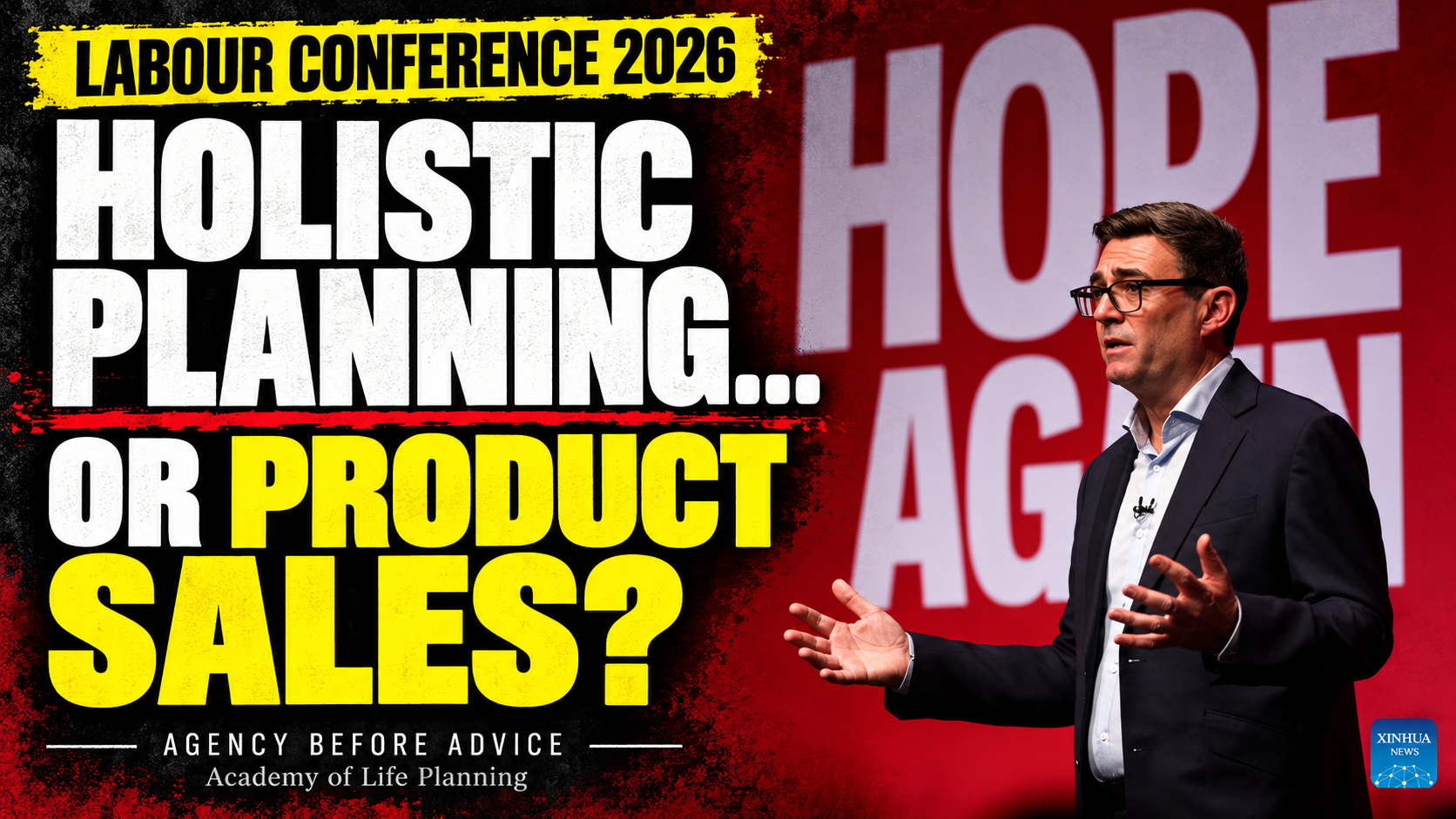
Bringing back bancassurance will not, by itself, rebalance power towards ordinary people. Banks should be judged by the agency they build, not just the assets they gather.
By Steve Conley, Founder, Academy of Life Planning
30 September 2026
A bank announces that it wants to return to advice in a “massive way”. Its executive tells Labour Conference attendees that it wants to offer holistic planning to as many people as possible.
It sounds like a public service.
But before welcoming it, we should ask a basic question: what is being expanded—people’s ability to plan their lives, or the bank’s ability to distribute products?
Citywire’s report on Barclays raises precisely that question.[1]
I ask it as someone who headed bancassurance product marketing for three of the UK’s five biggest banks. I know how easily the language of helping people can become entangled with the machinery of selling to them.
Labour should recognise the echo
In Head North, Andy Burnham writes:
“We believe we need to rebalance this country in favour of ordinary people and away from a powerful establishment.”
— Page 127
On page 230, he warns of the devastating consequences of Britain’s political class absorbing the market-driven mantra of the 1980s and developing an aversion to safeguards dismissed as “red tape”.
That warning should travel with Labour into its own conference halls.
Conference fringe events bring businesses, organisations and policymakers together. Labour openly provides opportunities for organisations to host discussions and reach decision-makers.[2] Business participation is understandable. The responsibility of the political audience is to interrogate the proposition.
A commercial expansion does not become a public service because it is described as closing a gap.
And a powerful institution does not rebalance power towards ordinary people merely by offering to manage more of their money.
A whole product range is not a whole person
“Holistic” is a powerful word. It suggests that someone sees the whole picture.
But which picture?
In the bancassurance model I know, the process can begin with product areas: investments, pensions, protection and borrowing. Assumptions establish what a customer supposedly needs. Existing provision is measured against those assumptions. A shortfall emerges. A product is recommended to fill it.
Where sales targets influence those assumptions, the process risks becoming a route to optimum product penetration.
That is needs and shortfall analysis. It should not be confused with life-led financial planning.
Proper financial planning begins with the life the person wants to live. It explores commitments, values, resources, earning capacity, relationships and constraints. It then builds the financial architecture to support that life.
Sometimes a product belongs in that architecture. Sometimes the priority is reducing debt, changing work, developing skills, simplifying commitments or doing nothing for now.
A process capable only of discovering product-shaped gaps cannot claim to see the whole person.
Barclays’ published launch announcement describes financial goals, a personalised investment plan and ongoing wealth management. Its Planning and Advice service launched for Premier customers with at least £150,000 to invest, with asset-linked ongoing charges.[3]
Those are clear features of an investment-centred service. They do not, by themselves, demonstrate whole-person planning. Nor do the public materials establish Barclays’ internal targets or current assessment practices.
The question is whether its “holistic” ambition reaches beyond the boundaries of its commercial offering.
Gathering assets is not the same as creating wealth
We also need to challenge the easy connection between attracting investment assets and growing the economy.
Moving existing investments to a different provider changes who administers them and receives the fees. That transfer is not, by itself, evidence of additional productive investment.
New financing can support productive activity. But a growth claim needs to explain where the money goes, what additional activity it enables and who benefits.
Meanwhile, a much larger conception of wealth remains neglected.
The World Bank’s The Changing Wealth of Nations 2024 estimates that human capital—the present value of future earnings of employed and self-employed people—accounted for 60% of global wealth in 2020. It was the largest asset category across all income groups.[4]
That finding does not prove that every pound spent on human capital delivers a higher return than every financial investment. It does show why a serious account of wealth must include people’s productive capabilities.
Consider someone in their fifties with modest savings and decades of experience. Their most consequential opportunity may be to turn that experience into a sustainable livelihood. An investment product addresses only one part of that picture.
Wealth planning that sees the portfolio but overlooks the person’s potential starts with an incomplete balance sheet.
Conduct risk cannot be solved by vocabulary
The lessons from the years before the Retail Distribution Review should remain visible.
In 2013, the FCA fined AXA Wealth Services for advice failings relating to investment sales made between 2010 and 2012 through bank and building society branches. It identified inadequate customer information and weaknesses in suitability assessments. It also found that controls over adviser bonuses created an unacceptable risk of inappropriate recommendations.[5]
That was a finding against AXA, not a finding about Barclays’ current service. Its relevance is the mechanism: incentives can distort recommendations even when a process is presented as helping customers.
Changing the vocabulary does not remove that risk. Neither does adding technology.
Banks must examine what managers reward, what advisers feel pressured to achieve and whether a customer declining to buy is accepted as a good outcome.
Where a recommendation produces fees without sufficient benefit, value can move from the customer to the institution. That is the zero-sum danger. A worthwhile service should create value for the customer that justifies its cost.
The future is greater agency
Barclays is also expanding self-directed investing and has announced authorisation to offer Targeted Support.[6] Its strategy spans several ways of serving customers.
The presence of human advisers is therefore not the decisive issue. Human expertise can be valuable. What matters is whether support leaves people better able to understand and act—or more dependent on the institution.
AI gives us an opportunity to design support around that distinction.
For the Academy of Life Planning, the direction is continuous capability with episodic expertise: people operate their own planning system and obtain specialist help when they need it.
The bank’s role can fit within that future. It should:
- Establish actual needs through enquiry rather than sales assumptions.
- Explain options, costs and trade-offs clearly.
- Offer fair-value services matched to those needs.
- Strengthen clients’ ability to compare, question and choose.
- Recognise buying nothing, acting independently or using another provider as valid outcomes.
- Align targets and remuneration with customer benefit.
Needs-based, not sales-quota-based. Capability-enhancing, not delegation-seeking.
Put the promise to the test
Labour should listen to businesses. It should also listen less deferentially to the “sneering voices in the corridors of power” and more closely to the people its policies are meant to serve.
Burnham’s call to rebalance power provides the test.
Does the proposed service help ordinary people define their own goals, recognise their resources and make informed choices? Or does it invite them into another institution’s commercial plan?
Rebalancing power towards ordinary people means increasing their agency—not simply increasing their access to salespeople.
Agency before advice.
Sources
- Citywire: Barclays to get back into advice in a “massive way”. Headline and introduction accessible; full report registration-gated.
- Labour Party: Fringe at Annual Conference 2026.
- Barclays launch announcement, 30 April 2026, reproduced by Public Technologies.
- World Bank: The Changing Wealth of Nations 2024.
- FCA: AXA fined and reviews investment sales for advice failings, 13 September 2013.
- Barclays Targeted Support announcement, 29 September 2026, reproduced by Public Technologies.
Book references: Andy Burnham and Steve Rotheram, Head North, pages 127 and 230; passages supplied by Steve Conley.

