
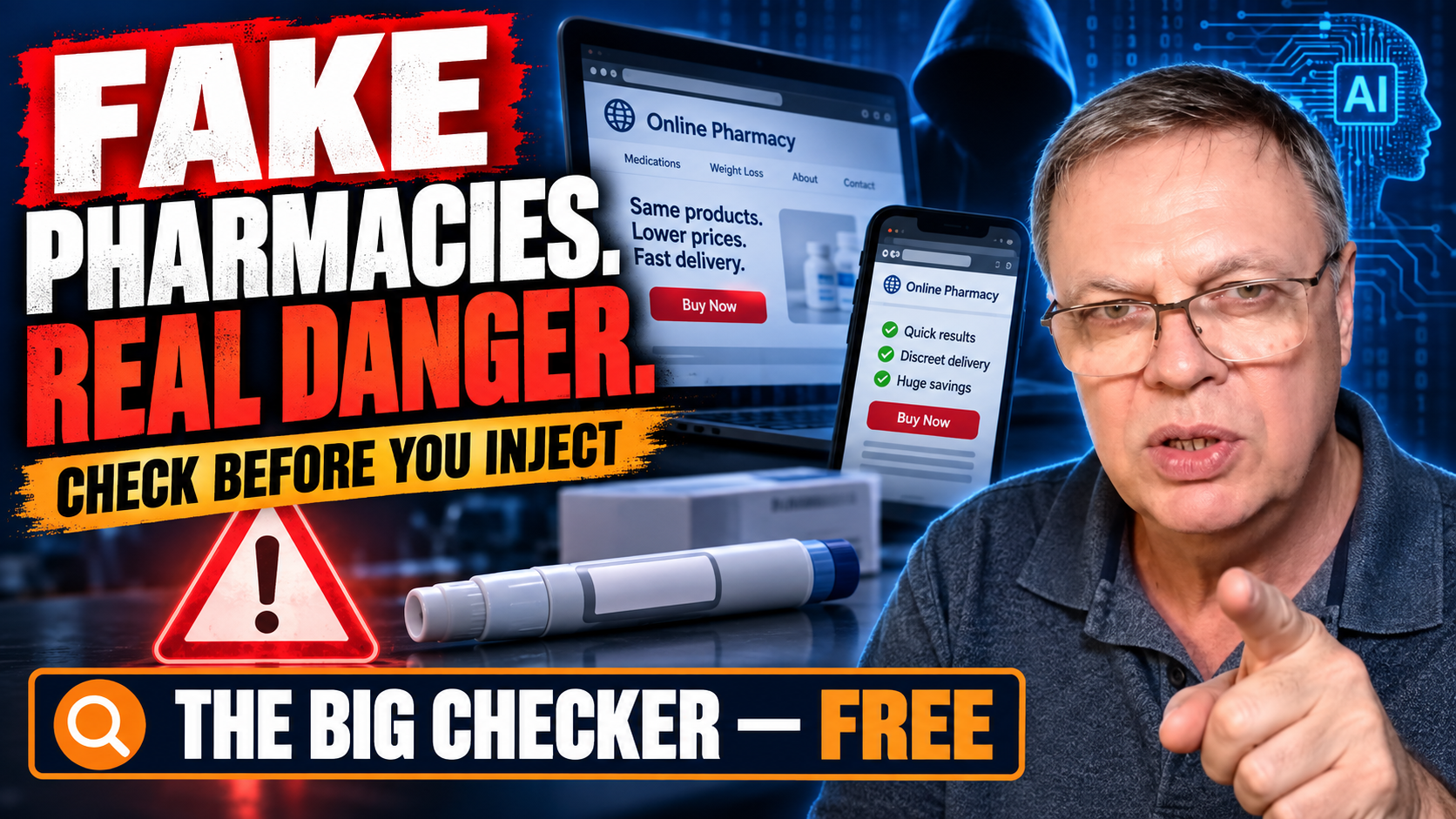
Check before the sales journey becomes a medical decision
Today, The Times reports that British regulators are playing “whack-a-mole” against organised criminals selling counterfeit weight-loss medicines through fake online pharmacies.
According to the investigation, UK consumers accessed around 5,000 suspected fake-pharmacy websites during 2025. Regulators have disrupted more than 1,500 illegal sites, but new ones can appear almost as quickly as others are removed.
The criminals are also using AI.
It can generate polished health articles, convincing testimonials, professional-looking clinician profiles and entire pharmacy websites. The familiar warning signs—bad spelling, crude design and implausible presentation—are disappearing.
The old consumer test was:
Does this look professional?
That is no longer enough.
AI can reproduce the appearance of authority. It cannot supply the provenance of authority.
The problem is no longer simply fake medicine
Counterfeit prescription medicines can contain the wrong ingredient, the wrong dose, dangerous contaminants—or no active medicine at all.
But the deception begins long before anything arrives through the letterbox.
It may begin with:
- a targeted social-media advert;
- a reassuring article that appears educational;
- scientific claims presented without their limitations;
- testimonials suggesting exceptional outcomes are typical;
- the logo of a regulator or respected institution;
- a heavily discounted introductory price;
- a short eligibility questionnaire leading directly into a subscription.
Each individual element may look plausible. Together, they can create a manufactured pathway from emotional vulnerability to medical purchase.
That is why this is not only a medicines-regulation problem. It is an agency problem.
Regulators can pursue criminals and remove websites. Technology platforms can restrict adverts. Banks can investigate payments. But consumers also need help at the point where a persuasive communication becomes a potentially life-changing decision.
BIG Checker has been upgraded
In response to the risks highlighted by the General Pharmaceutical Council and brought into public focus by The Times, we have upgraded The BIG Checker™ with a dedicated Prescription Medicines and Online Pharmacy safety module.
It is free to use. There is no account to create and no advertising.
You can paste the wording of an advert or scan a public webpage. BIG Checker then examines the communication using the B‑O‑G framework:
- Basis: What is being claimed and what evidence genuinely supports it?
- Options: What realistic alternatives have been omitted?
- Gap: Where does the evidence end and inference begin?
- Emotion: What feelings are doing work that evidence should be doing?
- Authority: Is expertise being borrowed or extended beyond what it supports?
- Agency: Are you better equipped to decide—or simply more likely to comply?
For prescription medicines, the tool now goes further.
Before displaying any score, it presents a safety notice explaining how to check the pharmacy independently through the GPhC register, what to expect from a legitimate clinical assessment and what warning signs demand particular caution.
It also links directly to the MHRA Yellow Card scheme and gives one unambiguous instruction:
If a medicine appears suspicious, do not inject it. Contact a pharmacist and report it.
Tested against a live weight-loss advert
We tested the upgraded tool against a live commercial landing page for a regulated online weight-loss service.
The purpose was not to declare the provider legitimate or illegitimate. BIG Checker cannot determine that from marketing copy—and does not pretend that it can.
It examines the communication and asks what the consumer can reasonably establish before proceeding.
The analysis identified:
- a strongly promotional structure around a prescription medicine;
- a population-level study being converted into a personalised weight-loss projection;
- exceptional testimonials doing substantial persuasive work;
- no meaningful presentation of NHS, GP-led or alternative pathways;
- institutional authority extending beyond what the cited research alone establishes;
- no direction to verify the pharmacy independently through the GPhC register;
- unanswered questions about prescriber credentials and the handling of health information submitted through the eligibility questionnaire.
One finding was particularly revealing.
The landing page referred to fewer than 1 per cent of customers cancelling because of side effects. BIG Checker recognised that this was a retention metric, not a clinical safety summary.
Not cancelling because of side effects is not the same as not experiencing side effects.
At the same time, the tool found none of the strongest signals commonly associated with illicit sellers: cryptocurrency payment, social-media-only supply, “research peptide” labelling or prescription-free offers.
That distinction matters.
The result was High Narrative Risk, but with an immediately visible clarification:
This score assesses the communication’s effect on informed decision-making. It does not determine whether the provider is legitimate or registered.
The report concluded:
High Narrative Risk in this context reflects the agency risk created by combining prescription medicine with high-conversion promotional tactics—not a finding that this is an unregistered or illegitimate service.
A provider may be legitimate and regulated while its promotional communication still makes fully informed consent more difficult.
A safety checker should not become another authority to obey
The first version of the analysis was too confident about information it had not retrieved. It treated “not identified” as “does not exist.”
We corrected the tool.
It now distinguishes between:
- information absent from the communication;
- information not found in the content successfully retrieved;
- claims that require independent verification.
It also changed its conclusions when better evidence became available.
That correction is not incidental to the story. It is the demonstration.
Trustworthy AI is not AI that never makes a mistake. It is AI that shows its reasoning, acknowledges its limits and improves its conclusion without defending the original answer.
Authority protects its answer.
Agency improves it.
Check before the sales journey becomes a medical decision
If you are considering an online prescription weight-loss service, BIG Checker will not tell you whether to buy.
It will help you ask:
- Is the pharmacy independently verifiable on the GPhC register?
- What proportion of everyone who started—not merely those who completed the programme—achieved the advertised result?
- Which medicine might be prescribed, and what are its serious and uncommon risks?
- What happens to the health information submitted through the eligibility questionnaire?
- Can the prescriber access the records needed to assess suitability safely?
- What alternatives are available through your GP or NHS services?
- What will the programme cost after the introductory offer ends?
These are not anti-medicine or anti-business questions.
They are informed-consent questions.
Regulators may continue playing whack-a-mole with criminal websites. Consumers should not have to wait for every false pharmacy to be identified before they can protect themselves.
Use The BIG Checker free at bigchecker.app.
Choose Health Claim Check, select Prescription Medicines and Online Pharmacy, and paste the communication or scan its public URL.
You can also read today’s investigation in The Times.
The BIG Checker is not a medical adviser, pharmacy regulator or substitute for professional care. It is something deliberately different:
Not the truth machine. The better-question machine.

