
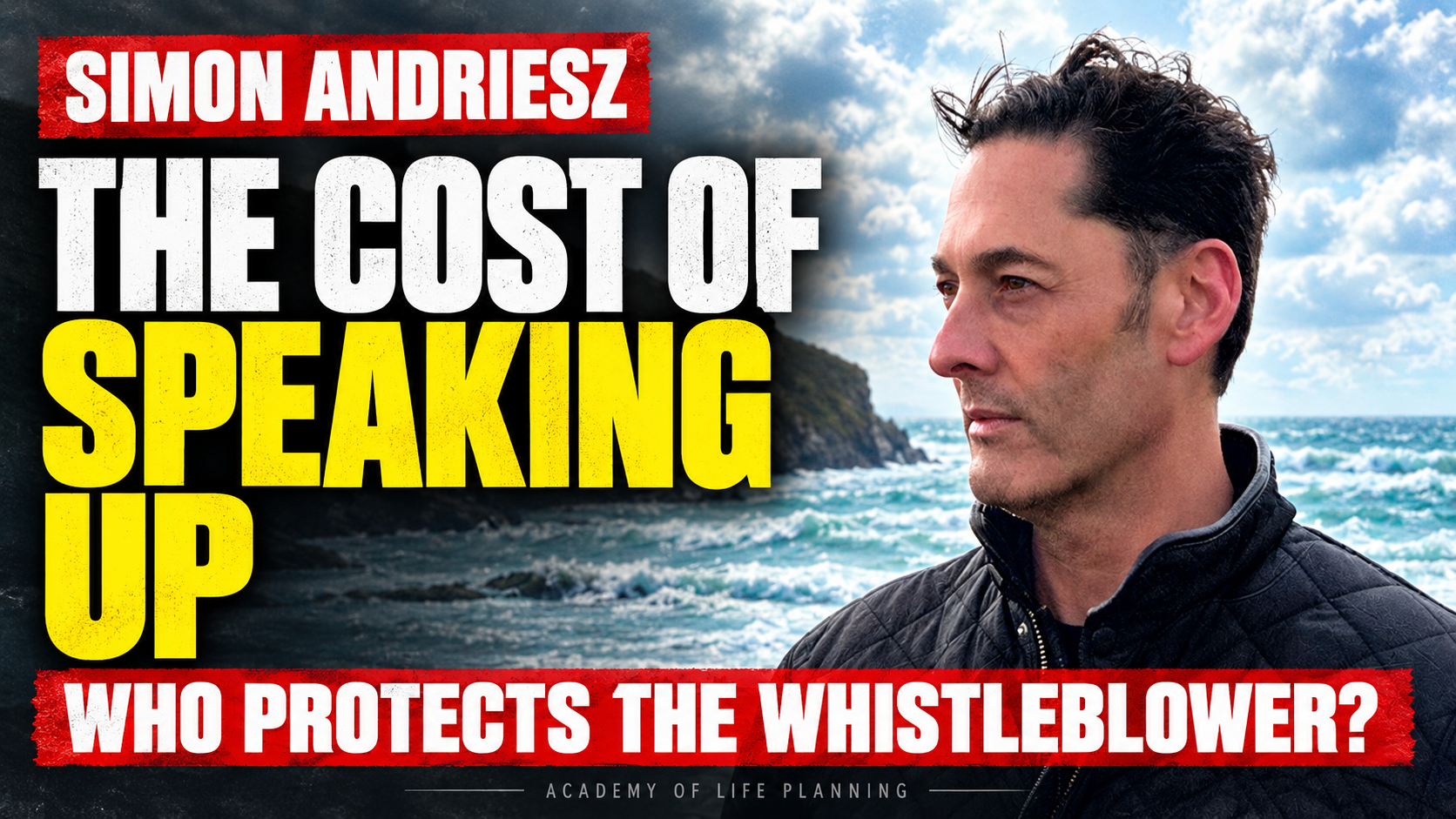
Acting on a whistleblower’s information and protecting the person who provides it are different outcomes. Someone facing retaliation needs a plan for both.
By Steve Conley, Founder, Academy of Life Planning
3 October 2026
At the end of a Transparency Task Force event in July, Simon Andriesz explained what he wanted.
An independent investigation. Parliamentary scrutiny. And the chance to regain his life.
“I don’t really want to spend the next 10 years fighting the FCA,” he said.
Earlier in the conversation, he had described living with his brother to recuperate from the previous decade. This was someone with a 35-year career in financial markets, trying to recover enough stability to move forward.
TTF has since announced his death. Law360 reported on 1 October that the Financial Conduct Authority had promised to review its engagement with him.
We should be careful about what that sequence establishes. The material reviewed does not establish the cause of Simon’s death or a causal connection with any organisation’s conduct. It does establish that, while alive, he publicly described severe distress and repeated requests for help.
His experience deserves careful examination. It also offers practical lessons for anyone facing retaliation after speaking up.
Simon had been a managing director at BGC Partners, with responsibilities spanning London, New York and Chicago. He said his duties included regulatory reporting, compliance and accounting.
He explained that reporting concerns was part of taking those responsibilities seriously. He described refusing regulatory sign-off when he believed he was witnessing wrongdoing.
His disclosures were extensive. The TTF account records allegations of fraud, money laundering, charity-day fraud, embezzlement, a Ponzi-style scheme and potential RICO-related conduct. They also concerned financial and business links involving Cantor Fitzgerald, Howard Lutnick, Jeffrey Epstein, Sarah Ferguson and Andrew Mountbatten-Windsor.
These were allegations with different evidential foundations. Naming someone in a disclosure does not establish that they committed a crime.
In the July testimony, Simon gave more concrete examples. He alleged that money was deducted from broker commission pools without brokers’ knowledge to cover costs including sexual harassment settlements, rogue trading losses and improper expenses. He challenged partnership arrangements which, he argued, functioned as a vehicle for employee compensation. He also described concerns about the Cantor Fitzgerald Relief Fund and its charity-day activities.
The transcript identifies the subjects of those concerns. It does not provide the complete underlying accounting records or prove each allegation.
Some regulatory action is independently documented. On 22 November 2019, the US Commodity Futures Trading Commission ordered BGC Financial, L.P. to pay a $3 million penalty for supervision, reporting and recordkeeping violations. Simon said he received a $420,000 whistleblower award connected with that action.
He also said HMRC acted on information he supplied about partnership tax arrangements, resulting in a £96 million assessment or determination. The underlying tax decision and its subsequent status need to be examined before treating that sum as a final outcome.
The narrower CFTC findings matter in their own right. They do not validate every broader allegation.
The BBC’s investigation also described what Simon uncovered about the Epstein connections. After finding his own FBI interview records among the released files, he searched for “HWL”—Howard William Lutnick’s initials—knowing that executives used initials in emails. He found a 2018 exchange in which Epstein asked Lutnick about the prospects of Adfin, a digital advertising company in which Epstein and Cantor Fitzgerald had invested. Lutnick replied with an update on its revenue and prospects. Simon supplied the correspondence to the House Oversight Committee before Lutnick’s May 2026 appearance. The emails raised questions about Lutnick’s statement that he had only learned in 2026 that Epstein was a co-investor. Committee Democrats challenged that account and called for his resignation. The Commerce Department disputed the accusations and said there was no evidence of wrongdoing. The BBC reported that Lutnick had not been accused of wrongdoing in connection with Epstein, and that the FBI had not investigated Simon’s earlier accusations about undeclared business ties. The correspondence is evidence relevant to the business relationship; it does not itself establish financial crime.
A separate discovery concerned a proposed £1 million loan from Cantor Fitzgerald to a company controlled by the then-Prince Andrew. According to the BBC, the arrangement would have given Cantor exclusive access to introductions through Andrew’s contacts with wealthy individuals and sovereign institutions. Epstein advised Andrew’s business aide, David Stern, against the proposal, including its exclusivity. Discussions ran from August to November 2013, but the deal did not proceed. Cantor did not deny the talks and said it had not gone into business with Andrew, who did not respond to the BBC’s request for comment. The BBC also described Lutnick’s longstanding friendship with Sarah Ferguson; it did not establish wrongdoing by her. These findings make the connections more concrete while keeping documented relationships separate from allegations of criminal conduct.
The retaliation Simon described was equally specific.
During employment, he alleged that he was sent home during an audit, questioned alongside people whose conduct he was reporting, and returned to the business after seeking protection through internal legal channels.
He described pressure to attend a video conference while receiving emergency hospital treatment, and disputed medical assessments preceding his dismissal in January 2017.
After leaving, he alleged damaging references, reputational attacks and delayed deregistration which obstructed his ability to obtain work.
He also described delayed US arbitration proceedings and the rehiring of his principal witness, whose subsequent testimony he said contradicted earlier regulatory disclosures.
The most acute later escalation concerned events in July 2024.
Simon said that, after WhatsApp communications with a former colleague about regulatory matters, BGC reported him to police for harassment. He said police contacted him while he was travelling to a trauma retreat. After he supplied evidence, he said, the matter was recorded as “no crime”.
He then described solicitors’ threats of prosecution, imprisonment and financial penalties. Despite rebuttals from his own lawyers, he said allegations that employees and their families feared him continued into January 2025.
He linked that episode to a severe trauma relapse and a two-month admission to a treatment centre.
BGC disputed his account. At the TTF event, BBC journalist Andy Verity relayed its response: it denied retaliation, gave medical and employment-related reasons for dismissal, and said it sought police involvement because it took employee safety seriously. It also disputed the allegation that requested medical assistance had been withheld.
These competing accounts require documentary scrutiny. The full messages, police records, solicitors’ correspondence and medical evidence matter.
The outcome was not a single verdict.
Simon described a US arbitration outcome which he regarded as a win, with an appeal ongoing. Separately, Law360’s October report said he had recently lost an employment tribunal claim. Those are different proceedings; without the decisions, we should not simplify either into a verdict on his entire story.
There was documented US regulatory action, a reported whistleblower award, reported HMRC action, contested employment proceedings and, following his death, a promised FCA review.
The review is a commitment to examine what happened. It is not yet a published finding of responsibility, an admission of liability or a completed remedy.
What Simon said about his appeals to the FCA makes that review especially important. At approximately 48 minutes into the July event, he described writing directly to Nikhil Rathi and senior enforcement leaders Steve Smart and Therese Chambers. He said he told them his family was in crisis and needed intervention.
The question is what happened after those warnings arrived.
The FCA has described improvements to its whistleblowing processes during 2024–25: better triage, restructuring, clearer communication and more detailed feedback. Broader rules addressing certain work-related bullying, harassment and violence in non-bank firms took effect on 1 September 2026.
Those developments are relevant. But the published whistleblowing statistics reviewed do not separately tell us how many people were protected from retaliation, what protective interventions were made, or whether they succeeded.
This reveals a distinction that everyone considering whistleblowing should understand:
Information can be useful to a regulator while the person providing it remains exposed.
The practical response is to build protection alongside disclosure. For someone already facing retaliation in Great Britain, the priorities are these.
1. Address immediate danger and serious distress.
If there is an immediate threat to safety, contact emergency services. Bring a trusted person into the situation and seek medical support where needed. If you are struggling emotionally, Samaritans is available free on 116 123.
Health, housing, income and family stability belong in the plan from the beginning.
2. Get independent specialist advice and protect deadlines immediately.
Contact Protect, a specialist employment solicitor or your trade union. Ask them to assess whether your disclosures qualify for protection, which legal routes apply and the deadline for each claim.
An eligible employee dismissed for whistleblowing may have only seven days from the effective termination date to apply for interim relief. If granted, this can preserve the employment contract or pay while the claim proceeds. It is not automatic.
Acas guidance updated on 1 October 2026 says most tribunal claims concerning events on or after that date have a six-month-minus-one-day limit; most earlier claims retain the shorter three-month-minus-one-day limit. Mixed dates and claims require individual advice.
Internal grievances and appeals do not extend tribunal deadlines. Timely Acas early conciliation can affect the calculation. Do not wait for a regulator’s investigation to finish.
3. Preserve the evidence of both wrongdoing and retaliation.
Create two linked chronologies: what you disclosed, and what happened to you afterwards.
For each alleged retaliatory act, record the date, decision-maker, their knowledge of your disclosure, the explanation given, witnesses, supporting documents and resulting loss.
Preserve complete exchanges, including your own messages. Secure original documents lawfully and seek advice before copying confidential material. Avoid unauthorised access or taking additional records unlawfully.
A clear chronology helps distinguish facts, inference and disputed interpretation.
4. Control communications and obtain representation for threats.
Keep communications factual, purposeful and directed through appropriate channels. Where criminal allegations or solicitors’ threats arise, obtain suitable legal representation promptly.
Avoid repeated personal approaches to implicated colleagues or potential witnesses. A request intended to encourage someone to speak up can be interpreted differently by the recipient.
Whistleblower status does not automatically defeat another allegation. Equally, a threatening letter is not a court judgment. Preserve it and have it assessed.
5. Ask for specific protective measures.
Request a named independent handler, preservation of records, agreed confidentiality arrangements, safeguards against adverse treatment and regular checks for further retaliation.
Where applicable, involve the firm’s whistleblowers’ champion. Ask the regulator to assess retaliation separately as a potential governance or fitness-and-propriety concern.
Ask what action will be taken, by whom and when. Keep the response.
6. Escalate with a strategy and a sustainable budget.
Independent complaints, regulatory reports and carefully considered public exposure can serve different purposes. Get advice before media or social-media disclosure: wider disclosures have additional conditions for legal protection.
Set objectives, spending limits and review dates. Consider negotiated resolution, safe departure and handing evidence to others alongside litigation.
Leaving an institution can preserve the capacity to pursue accountability. It does not erase the value of what you reported.
At the Academy of Life Planning, restoring agency means helping people retain the ability to understand, choose and act when circumstances become overwhelming.
For a whistleblower, that includes being able to decide how far to continue, who should carry the next part of the work, and what must be protected at home.
Simon asked for the chance to regain his life. Any serious review should keep that request in view.
A system should be judged by what happens to the person after it receives their information.
This article draws on Simon’s TTF testimony, the responses relayed by the BBC, regulatory publications and reporting available on 3 October 2026. It provides general information for Great Britain, not individual legal advice. Northern Ireland has a different framework.
Sources and practical support:
- BBC News article supplied: “How US commerce secretary’s Epstein links were uncovered by British whistleblower”, Andy Verity, Rob Byrne and Ben Milne, 14 July 2026.
- TTF event transcript supplied: “The Simon Andriesz Story; and the Role of the Financial Conduct Authority”, 21 July 2026. Relevant passages: 13:05–20:11; 22:26–33:38; 37:33–49:28; 50:14–56:41; 2:32:50–2:34:02.
- CFTC: BGC Financial $3 million order
- Law360: FCA pledges review after whistleblower’s death
- FCA: whistleblowing process improvements
- FCA: non-financial misconduct rules
- Acas: interim relief
- Acas: employment tribunal time limits
- Government: whistleblowing guidance for workers
- Protect: independent whistleblowing advice
- TTF The Simon Andriesz Story; and the Role of the Financial Conduct Authority
- BBC News How US commerce secretary’s Epstein links were uncovered by British whistleblower
- BBC Sounds Epstein Files: Lutnick, the Royals and the British Whistleblower


MPs call for investigation after Lutnick-Epstein whistleblower dies
https://ichef.bbci.co.uk/ace/standard/976/cpsprodpb/1e25/live/f56752a0-7eac-11f1-b976-0b9c15b0ccfc.jpg
Image caption,Simon Andriesz, a former senior employee of BGC Partners, died last month in Thailand
By: Andy Verity
Investigations correspondent
The treatment of whistleblowers by the UK’s financial watchdog must be investigated following the death of a British trader who exposed evidence of links between US commerce secretary Howard Lutnick and Jeffrey Epstein, MPs have said.
https://www.bbc.co.uk/news/articles/cwm2686gl6kno
Here’s the FCA AGM response: https://webinars.fca.org.uk/annual-public-meeting-2026