
People are already asking AI what to buy, what to invest in, what something means and what they should do next.
There is just one problem.
They do not necessarily trust the answers.
Recent McKinsey research found significant scepticism towards algorithm-driven sources of information, with trust in generative AI below 40 per cent. Yet consumers are nevertheless increasingly using AI during the evaluation stage of their decisions, and McKinsey expects that influence to grow as the technology becomes more ubiquitous.
At first sight, that sounds like a problem for AI.
I think it reveals something much more important.
The future does not depend upon persuading people to trust artificial intelligence.
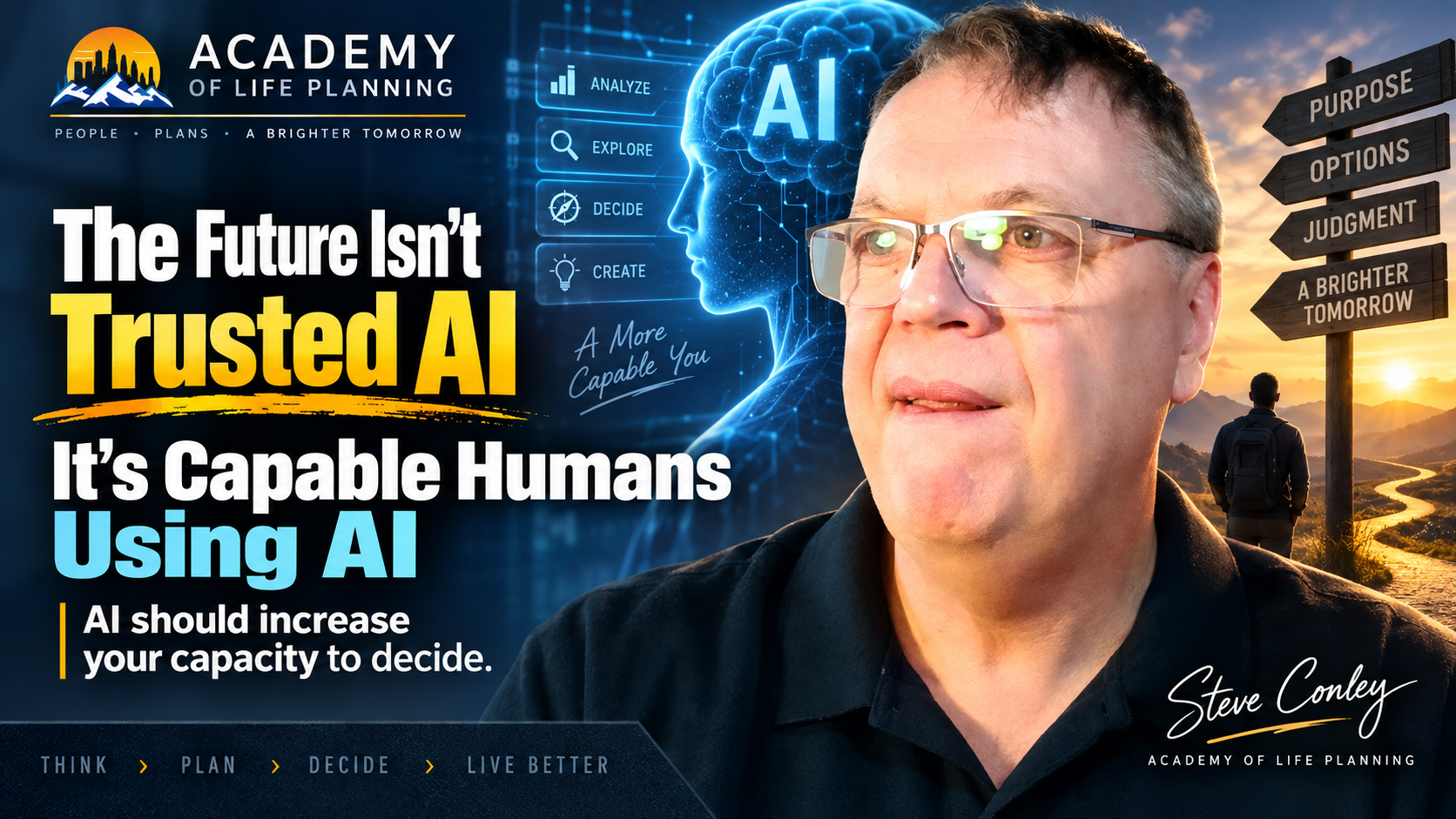
The future depends upon helping people become capable humans using artificial intelligence.
That distinction sits at the heart of the Academy of Life Planning.
The wrong question: How do we make people trust AI?
Much of the emerging debate starts from an understandable assumption.
If people are going to use AI to make important decisions, we need to make them trust it.
But trust can become another form of dependency.
For decades, financial services has largely operated through delegated authority.
Trust the adviser.
Trust the investment manager.
Trust the institution.
Trust the regulator.
Trust the expert.
The danger is that we simply reproduce the same architecture with a different authority at the centre.
Trust the algorithm.
Trust the chatbot.
Trust the AI adviser.
That would be technological progress without much progress in human agency.
We would have replaced dependency upon one source of authority with dependency upon another.
The Academy takes a different position.
AI should increase your capacity to decide, not increase your dependency on something else deciding for you.
From delegated judgement to augmented judgement
There is an important difference between asking AI to make a decision for you and using AI to improve the quality of your own decision-making.
The first model looks like this:
Human → AI recommendation → decision
The second looks very different:
Human → AI-assisted understanding → questioning → comparison → judgement → decision
That second architecture is what Academy OS is designed to support.
It is not principally an automated advice machine.
It is an environment in which people can think.
They can gather information.
Explore alternatives.
Test assumptions.
Understand consequences.
Identify what they do not know.
Ask better questions.
And ultimately decide what matters to them.
That is not artificial intelligence replacing human intelligence.
It is artificial intelligence increasing human capability.
McKinsey is seeing the same underlying shift
The McKinsey findings are particularly interesting because they reveal a paradox.
Consumers are bringing more information sources into their decisions while trusting those sources less.
They may consult AI, social media, reviews, brands, professionals, family and friends. The information environment becomes richer, while confidence in individual sources becomes weaker.
The result is not necessarily better decisions.
It can simply produce more noise.
The scarce resource therefore changes.
When information was scarce, access to information created advantage.
When information becomes abundant, the ability to judge information creates advantage.
This is an important distinction for financial planning.
The problem facing people in the future will rarely be:
“Where can I find an answer?”
AI can produce dozens of answers in seconds.
The harder questions become:
“Which answer is relevant to me?”
“What assumptions sit behind it?”
“What might be missing?”
“What are the trade-offs?”
“Whose interests are involved?”
“What happens if the answer is wrong?”
“Does this actually help me live the life I want?”
Those are questions of judgement.
And judgement belongs with the human.
Human capability becomes more valuable, not less
Another recent McKinsey analysis makes this point explicitly.
As AI removes routine tasks, the remaining human work may require more judgement, critical thinking and quality control, not less. McKinsey describes these capabilities as becoming increasingly valuable as artificial intelligence spreads.
That should fundamentally shape how financial professionals think about AI.
The objective should not be to remove the human from decision-making.
It should be to improve what the human brings to it.
Financial planning has sometimes treated capability as something the professional possesses on behalf of the client.
The adviser knows.
The client follows.
Academy professionals should invert that relationship.
Our job is increasingly to leave the client more capable after the interaction than before it.
That is a very different measure of professional value.
What Academy OS is actually for
Academy OS should therefore never be positioned as:
“Here is an AI system that will tell you what to do.”
That would misunderstand what we are building.
A better description is:
Academy OS helps you understand your situation, explore your choices and improve your ability to make decisions for yourself.
The distinction matters.
Navigator can help somebody articulate where they are trying to go.
A Total Wealth Plan can help them understand their financial life in the context of their whole life rather than as a collection of isolated products.
My Life Record can help provide personal context and continuity.
Investigation tools can help people interrogate propositions, claims and risks.
Planning tools can help them explore scenarios.
AI can help identify questions they may not have thought to ask.
None of those things require surrendering agency.
Quite the opposite.
Their purpose is to create it.
The success of Academy OS should therefore not be measured by how many decisions it makes.
It should be measured by how much better people become at making decisions.
And sometimes a human Second Brain matters
There will nevertheless be moments when someone reaches the edge of their confidence.
Perhaps a pension decision is unusually complicated.
Perhaps they are considering an investment.
Perhaps somebody has presented them with an apparently compelling opportunity.
Perhaps there are tax, estate-planning or family consequences.
Perhaps several reasonable choices exist.
Perhaps something simply does not feel right.
This is where the Academy’s Second Brain concept becomes important.
The answer is not necessarily to hand the decision to a professional.
It is to introduce another capable mind into the decision process.
A Second Brain Session should therefore not be sold as:
“Pay me and I will tell you what you should do.”
It should be positioned much closer to:
“Bring me the decision. We will examine it together.”
The professional can challenge assumptions.
Identify blind spots.
Separate facts from interpretations.
Look for missing information.
Help the client understand alternatives.
Explore consequences.
Recognise where regulated advice or another specialist may genuinely be required.
And then return the decision to the person who must live with it.
The client.
The test for an Academy professional
There is a simple question Academy professionals can ask themselves after almost every interaction:
Is this client becoming more capable, or more dependent?
If every problem requires the professional to provide the answer, dependency is increasing.
If the client gradually learns how to frame problems, investigate information, use Academy OS, recognise uncertainty, challenge recommendations and know when specialist help is warranted, capability is increasing.
That is the direction we want.
It also changes the economics of financial planning.
The traditional model often has an incentive to preserve dependency.
A client who permanently needs the adviser can become a permanent revenue stream.
An agency-based profession has a different objective.
Help people manage what they can manage themselves.
Provide technology and education to increase their capability.
Be available when complexity exceeds that capability.
Step back when the client no longer needs you.
Then return when another difficult decision arises.
That is the Academy model of:
continuous agency, with episodic expertise.
AI changes what a financial planner is
McKinsey’s discussion with Invesco CEO Andrew Schlossberg provides another useful clue.
He describes AI not as a replacement for people but as something that can augment them. In wealth and asset management, he argues that clients’ expectations of what professionals should be capable of achieving are rising as AI becomes more powerful.
That suggests the professional advantage of the future will not come from possessing information clients cannot access.
That advantage is disappearing quickly.
It will come from something else.
Context.
Judgement.
Wisdom.
Challenge.
Empathy.
Pattern recognition.
Knowing when something does not fit.
Knowing when a question has not yet been properly framed.
And helping another human think.
The financial planner of the future is therefore not primarily an information gatekeeper.
Nor should they become merely an operator of AI systems.
They become something closer to a decision partner.
A Second Brain when required.
From a trust economy to a verification economy
There may be an even bigger transition taking place.
Much of twentieth-century professional life operated through institutional trust.
We delegated because expertise was difficult to access.
AI dramatically reduces that information asymmetry.
People can now ask for another interpretation almost instantly.
That does not remove the need for trust.
But it changes its role.
Increasingly, people can verify.
They can compare.
Challenge.
Cross-reference.
Model alternatives.
Ask why.
The future may therefore move gradually from a trust economy towards a verification economy.
Not:
“Who should I believe?”
But:
“How can I examine this intelligently?”
For the Academy, that is enormously important.
Because restoring human agency is not primarily about teaching people to distrust experts.
Nor is it about teaching them to trust AI.
It is about developing the capability to engage intelligently with both.
The Academy professional’s position
So when Academy professionals introduce Academy OS, the message should be very clear.
We are not giving clients another authority to depend upon.
We are giving them tools with which to think.
When we introduce AI, we are not asking clients to surrender judgement.
We are helping them exercise it.
When we offer a Second Brain Session, we are not trying to take permanent ownership of their decisions.
We are helping them navigate the difficult ones.
And when expertise is genuinely required, we help them recognise that too.
That creates a fundamentally different relationship between technology, professionals and the public.
The old model was:
I know, therefore you depend upon me.
The emerging AI model risks becoming:
The machine knows, therefore you depend upon it.
The Academy model is:
You can understand more than you think. Let us help you build the capability to decide.
That is why the future is not trusted AI.
It is capable humans using AI.
And perhaps that should become one of the simplest tests we apply to every piece of technology we build and every professional service we provide:
Does this increase someone’s capacity to decide — or their dependency on somebody else deciding for them?
Because AI should not become the next authority standing between people and their lives.
Used properly, it can help remove some of those authorities altogether.
And give the decision back to the person to whom it always belonged.

