
PARLIAMENT • REDRESS • HUMAN AGENCY
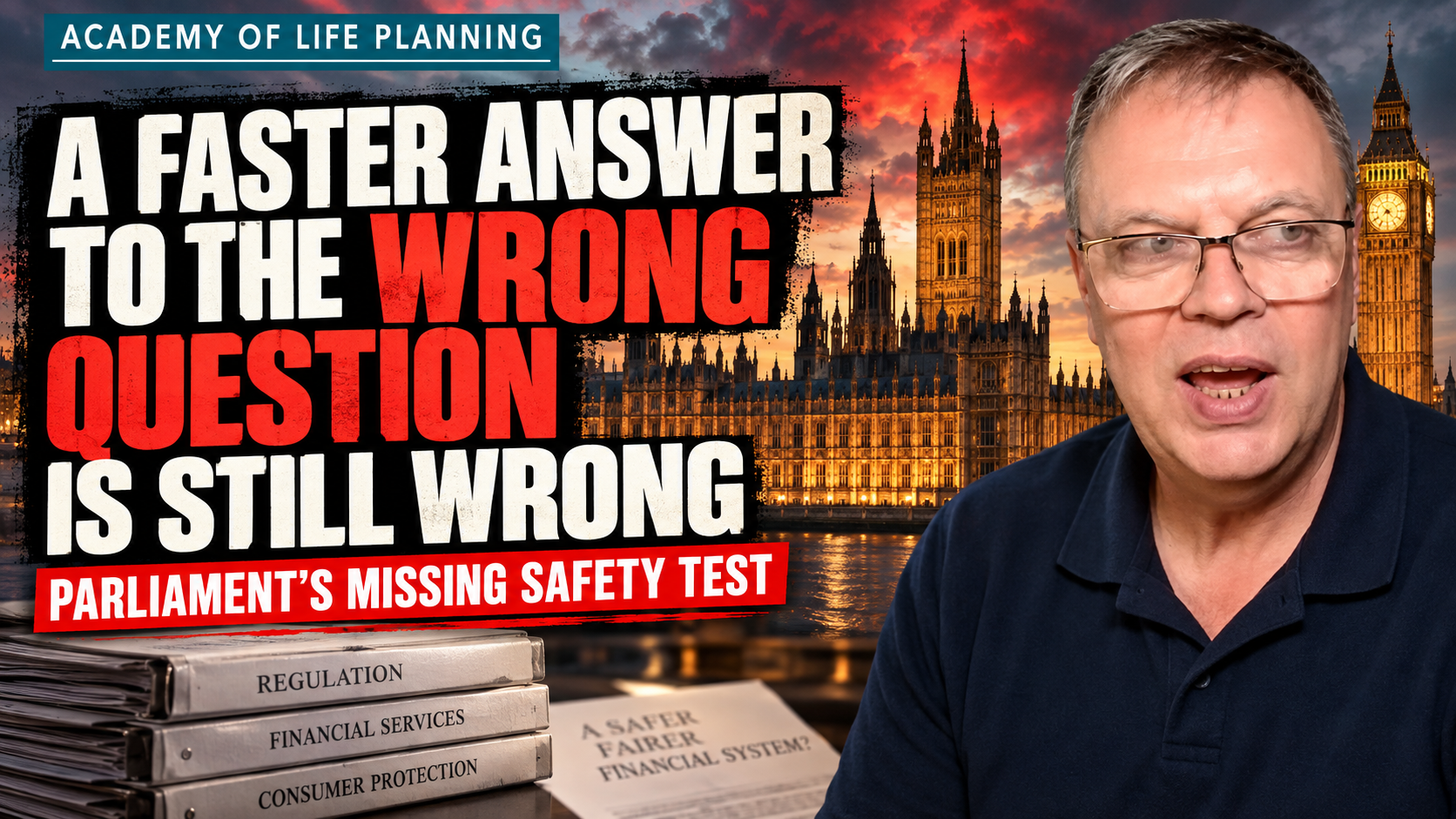
A Faster Answer to the Wrong Question Is Still Wrong
Parliament is redesigning financial regulation in the name of growth. But efficiency without effective challenge may simply make consumer harm easier to finalise—and harder to correct.
Academy of Life Planning
8 September 2026
There is a familiar promise at the heart of the Financial Services and Markets Bill now passing through Parliament.
Financial regulation will become simpler. Decisions will become faster. Firms will receive greater certainty. The financial sector will become more competitive—and Britain will grow.
Few people would object to any of those aims.
But the first day of Report stage in the House of Lords exposed a question beneath them:
What if the system becomes faster at answering the wrong question?
That is not a technical objection to modernisation. It is the central safety test for modernisation.
A financial system should not be judged only by how quickly it reaches an outcome. It should also be judged by whether the consumer’s real problem entered the process, whether the right law and rules were applied, and whether somebody can correct the position when an important question falls between institutions.
On 7 September, Parliament debated consumer credit, access to banking, reform of the Financial Ombudsman Service, fraud, productive lending and regulatory accountability. The subjects appeared different. The pattern was remarkably consistent.
Protection now contained in legislation would increasingly depend on future regulatory rules. Statutory reporting would increasingly give way to strategies and institutional co-operation. Independent redress would be drawn closer to the regulator’s interpretation of its own rules. Parliament was repeatedly asked to trust that the intended outcome would remain, even where the enforceable mechanism was changing.
This is the difference between promised protection and operable protection.
Consumer credit: a promise is not a guarantee
The Government proposes to move significant parts of the Consumer Credit Act 1974 into the Financial Conduct Authority’s rulebook.
There is a sensible case for reform. The Act belongs to another technological age. Some information requirements are rigid, inaccessible and capable of obscuring rather than improving understanding. FCA rules can be updated more readily than primary legislation.
The concern is not modernisation itself. It is what happens to the status of the protection.
Baroness Bowles proposed a principle of non-diminution: consumer credit law could be modernised, but the overall protection available to consumers should not be weakened in the transfer. The Government declined to place that guarantee in the Bill.
Lord Pitt-Watson told the House that there was “no intention to reduce consumer protections”. He confirmed that important statutory protections, including section 75 and the unfair-relationship provisions, would remain in legislation. But he also confirmed that statutory sanctions attached to some Consumer Credit Act requirements would be repealed. Protection would instead come through FCA supervision and enforcement, firms’ complaint and monitoring arrangements, and the Financial Ombudsman Service.
The distinction matters.
An intention is not a right. A consultation is not a remedy. A regulator’s power to intervene is not the same as a consumer’s enforceable route to redress.
Parliament is therefore not merely updating the wording of consumer protection. It is changing its architecture: from protections fixed in statute towards protections dependent on regulatory design, discretion and enforcement.
The proper test is not whether the Government intends diminution. It is whether a consumer facing the same harm after the reform will retain a remedy that is practically equivalent.
Mortgage prisoners: when rights fail to travel
The debate over mortgage prisoners showed why architecture matters.
When mortgage books were sold to inactive lenders and investment vehicles, borrowers could retain the obligation to pay while losing meaningful access to the competitive mortgage market. Lord Sharkey proposed that consumer rights and protections should travel with a regulated mortgage when it is transferred, and that pricing by inactive lenders should be constrained by a reasonable market proxy set by the FCA.
The amendment was defeated by 164 votes to 76.
This was not simply an argument about interest-rate caps. It revealed a recurring feature of complex financial systems: rights, duties and decision-making can be divided among several entities until no single entity carries the whole relationship.
The product travels. The payment obligation travels. The consumer protection does not always travel with equal force.
That is a form of institutional fragmentation. Each organisation may be able to explain its limited role, while the person harmed is left to reconstruct the complete chain.
Parliament rejected power first, evidence later
The clearest defeat for the Government concerned Clause 3, which would have given the Treasury broad powers to act on access to banking, including powers capable of amending primary legislation.
The difficulty was timing. The independent Lloyd review had not yet reported, so Parliament was being asked to confer extensive powers before the precise problem, evidence and required intervention were known. The Government argued that flexibility would allow it to act rapidly once the review was complete.
The Lords rejected that approach and removed Clause 3 by 246 votes to 165.
That vote established an important principle:
Parliament should not grant broad powers first and discover the evidential case later.
The same principle should apply to the proposed reform of financial redress.
The Financial Ombudsman: consistency is not the same as correctness
Clauses 7 and 8 would reshape the relationship between the Financial Ombudsman Service and the FCA.
The Government says the purpose is greater clarity and consistency. Where an FCA rule is relevant, the Ombudsman’s determination should be consistent with it. The Ombudsman may refer questions concerning the regulator’s rules to the FCA, while remaining responsible for deciding the individual complaint.
Lord Sharkey argued that the changes would narrow the Ombudsman’s independence and weaken the “fair and reasonable” jurisdiction that makes it a practical alternative to court. The Government disputed that characterisation. Lord Pitt-Watson told the House that the fair-and-reasonable test would remain, but that decisions should be consistent with applicable FCA rules, including the Principles for Businesses and Consumer Duty.
This is an important disagreement, but it is not the only one.
The deeper problem comes earlier.
Before anyone can interpret a rule, the system must identify the rule that matters. Before it can decide what is fair, it must correctly classify the transaction, the relationship, the consumer and the harm.
Was the activity regulated? Which contract governed it? Was the complainant within the protected category? Which statutory gateway applied? Was an issue dismissed as background when it was actually decisive?
If the starting classification is wrong, every later stage can be orderly, consistent and professionally administered while still resolving the wrong case.
Consistency tests the answer within the frame. Correctness also tests the frame.
The proposed FCA referral mechanism helps where the meaning or application of a relevant FCA rule is in doubt. It does not obviously solve the prior problem of a decisive question that was omitted, narrowed or never recognised as relevant. A question that never enters the frame cannot be referred for clarification.
This is the Bill’s missing safety test.
Where is the evidence?
The Government has said that, in a “small but significant minority” of cases, the Ombudsman has acted as a quasi-regulator by producing outcomes inconsistent with the FCA’s rules.
Lord Sharkey asked how many cases this meant, how significance had been measured, and what evidence justified statutory reform. He quoted an August letter from FCA deputy chief executive Sarah Pritchard saying that the FCA had formally repeated its request for the Treasury to provide Parliament with the evidence and analysis underpinning the proposals.
Baroness Kramer offered motor finance as the obvious real-world test. Complaints considered by the Ombudsman helped expose a much larger market problem. She asked what would have happened under the proposed architecture: would the same harm have emerged, or could closer alignment with the FCA’s existing interpretation have prevented the Ombudsman from revealing it?
The Minister did not provide that counterfactual analysis during the debate. He said an industry publication containing examples of alleged inconsistency was expected.
Parliament then rejected Lord Sharkey’s alternative formulation—expressly requiring the Ombudsman to take account of relevant law, regulation, rules, guidance, codes and good industry practice—by 144 votes to 59. His proposed independent review was not put to a vote.
Later that evening, Lord Pitt-Watson resisted a different amendment, concerning claims-management regulation in Northern Ireland, with a sound principle: “we should not rush to regulate without clear evidence.”
That standard should apply consistently.
If clear evidence is required before Parliament creates an enabling power over claims-management activity, it should also be required before Parliament alters the architecture of the independent body on which consumers and small firms rely for accessible redress.
Fraud: when everyone has a role but nobody owns the failure
The debate over authorised push-payment fraud revealed the same structural weakness.
Baroness Kramer argued that the cost of reimbursement should be shared with the technology platforms on which fraud is initiated or facilitated. She described a world in which neither the FCA nor Ofcom appeared sure which should take the initiative. “Regulatory courtesy”, she said, had led to inaction.
Lord Vaux separately asked for annual publication of fraud-performance data previously produced by the Payment Systems Regulator. The Government preferred to leave the FCA flexibility over publication. When asked why the earlier reports had stopped, the Minister could not answer and undertook to write.
This is the responsibility gap: several institutions possess relevant powers, yet no institution clearly owns the failure that occurs between them.
For the victim, a hand-off is not a remedy.
Telling someone that their issue belongs with another regulator, the Ombudsman or a court may accurately describe institutional boundaries. It does not establish that the person has an affordable and effective route to determination. Courts may exist in theory while remaining financially inaccessible in practice. If litigation is the residual safety valve, the availability and funding of litigation become part of the redress system—not matters outside it.
What kind of growth?
The Bill repeatedly invokes growth. But “growth” can conceal two very different outcomes.
One is productive-economy growth: finance reaching households, entrepreneurs, small businesses, infrastructure and innovation across the country.
The other is financial-sector growth: lower compliance costs, reduced redress exposure, greater profitability and expansion inside the financial system itself.
The two may overlap. They are not the same.
Baroness Kramer proposed a framework for measuring how banks provide affordable credit to households, SMEs and underserved communities, including through partnerships with community development finance institutions. She called it growth “in every postcode”. That amendment was defeated.
Later, the House accepted a Government amendment requiring the FCA’s five-year strategy to include priorities for advancing its competitiveness and growth objective.
The contrast is revealing. The Bill now strengthens the strategic expression of regulatory growth objectives, but does not yet show a clear transmission mechanism from reduced regulatory friction to productive lending in the wider economy.
Reducing the cost of accountability may increase a firm’s profit without financing one additional business, home, research project or job.
This is not an argument against growth. It is a demand to specify what is growing, for whom, and through which mechanism.
Trust is not a soft benefit sitting outside the economy. Trust is economic infrastructure. People and small businesses are more willing to save, borrow, invest and innovate when they know that serious mistakes can be identified and corrected.
From statutory accountability to voluntary co-operation
The final debate concerned how Parliament will scrutinise increasingly powerful regulators.
The Government wants accountability to focus more on outcomes and performance, and less on process reporting and explanations of internal methodology. It resisted proposals to retain or add statutory reporting requirements and opposed permanent offices for regulatory evaluation within the FCA and Bank of England.
Instead, the Minister relied partly on letters from the FCA and PRA promising enhanced engagement with parliamentary committees.
Baroness Noakes, chair of the Lords Financial Services Regulation Committee, described the letters as “orchestrated” by the Treasury and doubted whether the proposed engagement would improve accountability by more than a margin. The Minister himself acknowledged that the FCA commitment might not be “as fulsome” as some would want.
Engagement is welcome. But voluntary co-operation is not equivalent to a statutory information right.
Outcome reporting can tell Parliament what happened within the system’s chosen categories. It cannot necessarily reveal an issue excluded before the outcome was defined. To find that, an evaluator needs access to source material, scoping decisions, hand-offs and the questions that were raised but never determined.
There is a crucial distinction between measuring a system and testing it.
The agency test for financial reform
At the Academy of Life Planning, we believe protection and human agency must reinforce one another.
Rules alone cannot make every person financially capable. But neither should “consumer responsibility” become an excuse for transferring institutional risk onto the person with the least information, power and money.
A system restores agency when people can understand the decision before them, see which institution is responsible, challenge the framing of their case, and reach an affordable route to correction when something goes wrong.
Before Parliament completes this reform, it should apply five tests:
- The equivalence test: When a statutory protection moves into regulatory rules, will the consumer retain a practically equivalent remedy—not merely an equivalent policy intention?
- The premise test: Who checks that the correct legal, regulatory and causal question entered the complaint before the system makes its answer final?
- The responsibility test: When an issue falls between a firm, the FCA, the Ombudsman, another regulator and the courts, which institution owns the route to determination?
- The correction test: If a decisive issue was raised but never determined, what bounded mechanism allows that omission to be examined without reopening every historic complaint?
- The productive-growth test: What evidence shows that lower regulatory friction will become useful investment in the real economy rather than merely lower conduct costs and redress liabilities?
These are not arguments for keeping every old rule. Some rules are obsolete. Some reports produce little value. Some processes protect institutions more than people.
But removing a safeguard requires more than naming it “friction”. Parliament must understand the function it performs, the failure it prevents and the remedy that will remain when it is gone.
A faster system is not necessarily a better system. A more final decision is not necessarily a more correct decision. And growth that leaves consumers carrying more unresolved risk is not the same as growth that enlarges human possibility.
The question is not whether Britain should modernise financial regulation.
It is whether we are building a system that can move quickly and still notice when it has started in the wrong place.
This article reflects the Financial Services and Markets Bill [HL] and the first day of its House of Lords Report stage on 7 September 2026. Further proceedings may change the Bill.
Sources
• Financial Services and Markets Bill: Bill page and progress
• House of Lords Hansard, Report stage, 7 September 2026—part one)
• House of Lords Hansard, Report stage, 7 September 2026—part two)


Update and further observation — 9 September 2026
This article should be read as a snapshot in a rapidly moving argument rather than a final account.
One qualification is appropriate. The House of Lords’ decision to remove Clause 3 did not establish a general constitutional principle. It did, however, strongly endorse an important principle in this context: Parliament should be cautious about granting exceptionally broad powers before the underlying evidence and policy requirements are known.
For clarity, the Clause 3 vote was initially announced as 247–165. Hansard records that the House subsequently corrected the result to 246–165, as stated in the article.
A later-discovered letter dated 23 July 2026 materially strengthens the accountability concerns.
Baroness Noakes, writing formally as Chair of the Lords Financial Services Regulation Committee to Lord Pitt-Watson, specifically warned that Clauses 16, 17 and 18 would reduce Parliament’s ability to hold the financial regulators to account.
The Committee’s concern was not simply that Parliament might receive less information. It warned that removing requirements concerning the regulatory principles—and the obligation for regulators to explain how they had regard to those principles—would impair the Committee’s ability to perform its scrutiny work properly.
That changes the context in which the subsequent letters from FCA chief executive Nikhil Rathi and PRA chief executive Katharine Braddick should be considered.
Those letters should not merely be viewed as welcome offers of greater engagement. They appear to have followed a formal warning from the parliamentary committee responsible for regulatory scrutiny that the Bill was removing statutory information rights it regarded as necessary.
The question is therefore:
Do voluntary commitments from regulators genuinely replace what Parliament is being asked to surrender in statute?
This is becoming less a debate about the effects of individual clauses and more a debate about what the Bill itself rests upon.
What evidence justifies the reforms?
What assumptions are being made about future regulatory behaviour?
What does “growth” mean, and through what mechanism will regulatory easing become productive investment?
What does “accountability” mean when statutory information rights are replaced by institutional co-operation?
And what is the safety mechanism when the system efficiently answers the question it was given—but the wrong question entered the process?
The legislative process may now be moving faster than the evidence and accountability architecture required to justify it.
That, in itself, is becoming part of the story.