
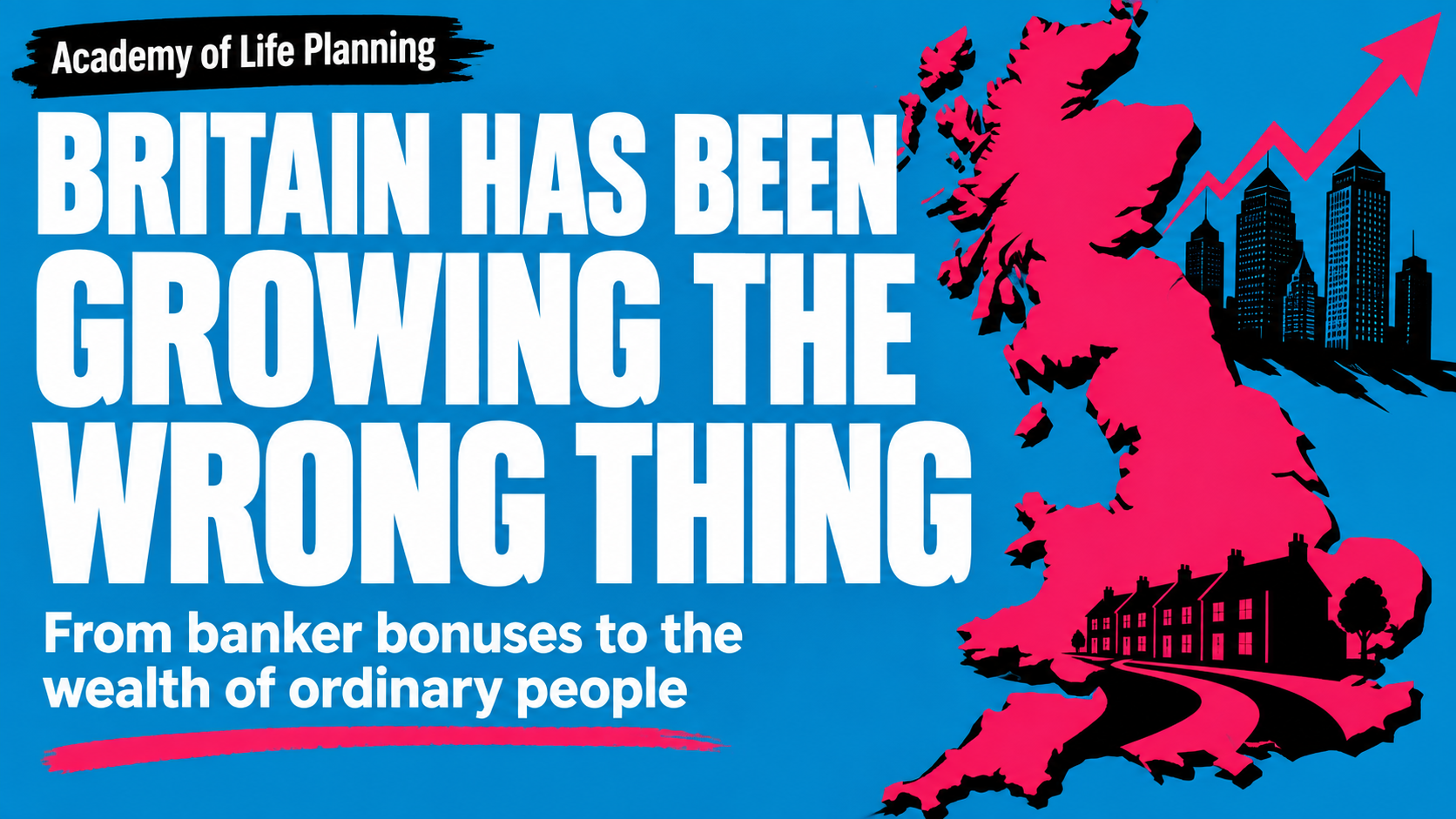
For forty years, governments have treated financial-services growth as though it were national economic growth. Andy Burnham now has an opportunity to change that — by making human agency, capability and the wealth of ordinary people the real engine of prosperity.
Will Andy Burnham Change Britain’s Growth Strategy, and grow the wealth of ordinary people
I was reading Andy Burnham’s Head North and, for much of it, found myself thinking:
Exactly.
He writes about Britain’s political class absorbing the market-driven mantra of the 1980s.
Exactly.
He writes about the consequences of the obsession with cutting so-called “red tape”, while increasingly powerful institutions became better and better at making money from ordinary people.
Exactly.
He talks about housing. Banking. Privatisation. Institutions making money while transferring risk to everyone else.
He describes what amounts to a forty-year market experiment during which we gradually lost sight of some fairly basic truths.
He describes ordinary people taking on institutions with vastly greater resources: the best lawyers, endless administrative endurance and the ability to turn process itself into a weapon.
David versus Goliath.
Except modern Goliath does not stand conveniently on the other side of the valley.
Goliath is distributed across corporations, regulators, lawyers, government departments, ombudsmen and sometimes the media. Responsibility moves around the system while the individual becomes exhausted trying to find somewhere that will actually take responsibility.
Anyone who has spent time supporting victims of financial exploitation will recognise the pattern.
The citizen may possess rights.
But the institution possesses power.
That distinction matters.
And it was why Head North gave me hope.
Here, I thought, was a politician who understood something much deeper than the familiar left-versus-right argument about how much government should spend.
He seemed to understand agency.
Then I reached the postscript.
And there it was:
“We support the government’s growth agenda…”
My heart sank a little.
Not because I oppose growth.
Quite the opposite.
I am strongly pro-growth.
But Britain urgently needs to decide what we mean by the word.
Because I believe one of the great economic mistakes of the last forty years has been confusing the growth of an intermediary with the growth of the thing it was supposed to intermediate.
And nowhere is that confusion clearer than financial services.
Finance is supposed to serve the economy
Finance performs an extraordinarily important social function.
At its best, it takes accumulated capital and connects it with productive human endeavour.
Savings finance businesses.
Investment finances innovation.
Mortgages help people acquire homes.
Insurance allows people to pool risks.
Pensions convert productive activity today into security tomorrow.
Capital markets allow enterprises to raise the resources required to create things.
All of that is useful.
Finance is an intermediary.
The problem begins when policymakers start treating expansion of the intermediary as though it were synonymous with expansion of the underlying economy.
That is rather like deciding the health of Britain’s food system should be measured by the profitability of supermarkets rather than whether people are well nourished.
Or measuring the success of the NHS by the growth of pharmaceutical companies rather than improvements in human health.
The intermediary matters.
But it is not the purpose.
For decades, Britain increasingly behaved as though a bigger financial-services industry automatically meant a stronger British economy.
So governments asked:
How can we make Britain more attractive to financial capital?
How can we increase investment?
How can we increase lending?
How can we make our financial markets more competitive?
How can we remove regulatory friction?
How can we encourage pension money into markets?
How can we make London the financial centre of choice?
Those are not inherently foolish questions.
The problem is what happens when they become the dominant questions.
Because eventually the servant can become the master.
The old growth engine
The economic theory behind much of the past forty years can be simplified like this:
Grow financial capital → expand financial services → attract investment → remove regulatory friction → increase economic activity → prosperity eventually reaches ordinary people.
Deregulation follows naturally from that model.
If financial capital is the engine of growth, then regulation appears to be friction in the engine.
Reduce the friction and the engine should run faster.
Hence the repeated promises to cut red tape.
Bonfires of regulation.
Competitiveness objectives for regulators.
Pressure to make Britain an attractive jurisdiction for international finance.
The logic is internally coherent.
But what if the growth engine was wrongly identified?
What if financial capital is not the primary engine at all?
What if finance is better understood as part of the transmission system?
Then making the transmission system ever larger while neglecting the engine underneath it will eventually produce disappointing results.
That, I believe, is close to what Britain has experienced.
The financial sector could prosper.
Asset owners could prosper.
Intermediaries could prosper.
Executive remuneration could prosper.
House prices could rise.
Assets under management could rise.
Fees could rise.
Financial complexity could rise.
And yet millions of ordinary people could feel no richer at all.
Indeed, many could become less secure.
That should have told us something.
When financial growth extracts rather than enables
Finance can create enormous social value.
But it can also become extractive.
Consider what happens when economic activity increasingly centres on extracting value from existing assets rather than expanding productive human capability.
House prices rise faster than wages.
Housing wealth increases for existing owners while younger people surrender a larger proportion of lifetime income simply to obtain somewhere to live.
Pension assets rise, but layers of percentage-based charges quietly transfer enormous amounts of lifetime wealth from households to intermediaries.
Credit becomes easier to obtain, while household indebtedness rises.
Essential infrastructure produces predictable financial returns while households face increasing costs.
Financial products multiply faster than people’s ability to understand them.
Regulation becomes more complicated while large institutions become better equipped than ordinary citizens to navigate it.
The financial economy can therefore expand while human agency contracts.
That is the paradox.
And it points towards something we ought to have realised years ago:
Financial-services growth and national economic growth are not the same thing.
Sometimes they reinforce each other.
Sometimes they do not.
And occasionally the growth of the intermediary can actively weaken the thing it was created to support.
Filling pockets or emptying them?
There is a deliberately provocative way to express the choice facing Britain.
Do we want an economic strategy designed primarily around growing banker bonuses or growing the wealth of ordinary people?
Of course the real economy is more complicated than that sentence.
Banks need to be profitable.
Entrepreneurs need returns.
Investors need incentives.
Capital needs somewhere productive to go.
This is not an argument against banking, business, markets, investment or profit.
It is an argument about purpose and hierarchy.
Which outcome are we ultimately trying to optimise?
If a policy increases financial-sector profits but leaves households less secure, has it worked?
If GDP grows while housing becomes less affordable, has Britain become richer?
If investment portfolios grow while an increasing share of people’s earnings is extracted through housing, finance, energy and other essential services, where exactly is the prosperity?
If the economy becomes more sophisticated while ordinary people become less able to understand or control their financial lives, can we genuinely call that progress?
We need to start measuring economic policy from the other end of the telescope.
Not simply:
How much capital did Britain attract?
But:
What became possible for people because that capital was deployed?
There is another growth engine
I believe sustainable economic growth begins somewhere else.
With people.
With human capability.
With agency.
The alternative model looks more like this:
Restore agency → develop human capital → increase productive capability → enable enterprise and innovation → attract useful capital → generate sustainable economic growth.
That is agency-driven growth.
Think about the economic consequences of an ordinary person who is healthy, educated, securely housed and financially resilient.
Someone who understands their choices.
Someone with enough savings to survive a setback.
Someone who can retrain without catastrophe.
Someone confident enough to start a business.
Someone whose wages are not consumed by housing costs.
Someone who is not servicing excessive debt.
Someone with access to transport.
Someone who has time to care for family members.
Someone able to challenge exploitation rather than simply endure it.
Someone with enough control over their life to think beyond next month’s bills.
That person possesses greater productive capability.
Multiply that across millions of people and something economically important happens.
You do not simply create happier citizens.
You create a more capable economy.
People learn.
People work.
People create.
People collaborate.
People start businesses.
People take calculated risks.
People invest.
People care for others.
People innovate.
People participate in their communities.
Human agency is therefore not merely a social outcome to be distributed after the economy has grown.
Human agency is itself productive infrastructure.
That changes the growth debate completely.
The difference between the two models
The traditional financial-capital model asks:
How do we make capital more productive?
Agency-led growth asks:
How do we make people more capable?
Both questions matter.
But the order matters enormously.
Under an agency-led model, capital remains essential.
Finance remains essential.
Banks remain essential.
Investment remains essential.
Markets remain useful.
But finance returns to its proper place.
It becomes an enabling system serving productive human activity rather than the organising principle around which productive human activity must arrange itself.
The sequence becomes:
People → capability → enterprise → productive investment → prosperity.
Rather than:
Capital → finance → asset growth → GDP → hopefully people benefit eventually.
That is not an anti-market argument.
It is arguably a better market argument.
Because genuinely productive markets need capable human beings on both sides of transactions.
Which brings me back to Andy Burnham
This is why Head North mattered to me.
Burnham appeared to understand how Britain had allowed power to migrate away from ordinary people.
He understood what happens when places lose control.
When services become distant.
When markets become masters rather than servants.
When institutions become more powerful while individuals become more exposed.
And since becoming Prime Minister, he has continued to use remarkably similar language.
In his first statement to the House of Commons on 1 September, Burnham said Britain had taken a series of “wrong turns” from the 1980s onwards: political power had been centralised, economic power privatised and councils hollowed out, depriving them of the agency to act.
He went further.
He described a failed economic model that allowed wealth to be “extracted and siphoned out” of communities.
That is an extraordinarily important diagnosis.
And then he said something even more interesting.
His government, he said, would give people and places greater ownership and control and:
“from that control over their destiny comes change and growth.”
There it is.
Agency first.
Growth follows.
Burnham even described this explicitly as his “theory of growth.”
That gives me hope.
But there is another inheritance
Because Burnham has inherited something else.
Britain already has a ten-year Financial Services Growth and Competitiveness Strategy.
Its stated ambition is for the UK to become the world’s “centre of choice for financial services investment” through to 2035. Government describes the success of the financial-services sector as a mechanism through which it intends to support the real economy and improve living standards.
Under the previous government, this thinking became deeply embedded in the growth agenda.
At Mansion House in July 2026, only days before Burnham entered Downing Street, the Chancellor highlighted changes intended to release as much as £150 billion in additional lending, move savers towards investment, increase pension-fund allocations to private markets and expand SME lending.
Meanwhile, reforms to banking ring-fencing have been explicitly justified partly by the desire to make regulation more flexible and supportive of growth.
Again, none of these measures is automatically wrong.
Some may prove extremely useful.
Capital directed towards productive British businesses can absolutely support agency-led growth.
But the intellectual question comes first:
What are we trying to grow?
Because if the objective remains financial-sector growth, with national prosperity assumed to follow, Burnham risks inheriting the same engine while changing the driver.
Will Burnham change the engine?
That, for me, is now the question.
Not:
Is Andy Burnham pro-growth?
I hope he is.
Britain desperately needs growth.
Nor:
Is Andy Burnham pro-business?
I hope he is that too.
Britain needs flourishing businesses, entrepreneurs, innovators and investors.
The important question is:
What does Andy Burnham believe causes prosperity?
If the answer is:
Give financial capital greater freedom, make Britain more attractive to international finance, reduce regulatory friction, increase financial-sector activity and wait for prosperity to spread through the economy—
then I fear we already know where that road leads.
But if the answer is:
Give people and places greater agency, provide the infrastructure they need, make life’s essentials affordable, build skills and confidence, support productive enterprise and ensure finance serves those purposes—
then Britain may genuinely be changing economic direction.
Burnham’s first Commons statement suggests he understands this distinction.
He spoke about rebuilding resilience, reindustrialising the regions, devolving power and creating “good growth in every postcode.”
His government has subsequently placed cost of living, public control of essential services and community renewal at the centre of its programme, explicitly linking these to growth.
Those are promising signs.
But government machinery has enormous inertia.
Financial institutions have enormous influence.
And the old growth story is deeply embedded in Whitehall, the Treasury, financial regulation and much of our economic commentary.
The pressure to return to it will be immense.
Protection is not enough either
There is another danger.
A government reacting against forty years of marketisation might conclude that the answer is simply more state protection.
I don’t think that is sufficient.
Because transferring power from corporations to government does not automatically transfer power to people.
An ordinary person can be dependent on a public institution just as easily as a private one.
That is why the Academy of Life Planning talks about restoring human agency.
Protection matters.
Good regulation matters.
Public institutions matter.
Markets matter.
But the ultimate objective should be increasing people’s practical ability to understand, choose and act.
A useful distinction is:
Protection constrains institutional power.
Agency increases human power.
A healthy society needs both.
The test of a system should therefore not merely be:
Has the institution complied with the rules?
It should also be:
Can an ordinary person realistically understand this system, navigate it, challenge it and exercise meaningful control over their life within it?
That is a much higher standard.
Formal rights are not enough
One of Burnham’s strongest observations in Head North concerns the experience of ordinary people fighting powerful institutions.
We give people rights.
The right to complain.
The right to seek redress.
The right to approach an ombudsman.
The right to go to court.
The right to contact their MP.
But exercising those rights can require extraordinary amounts of money, knowledge, persistence and psychological stamina.
An institution can employ lawyers.
It can wait.
It can absorb cost.
It can write another letter.
It can refer the citizen somewhere else.
It can survive another year of dispute.
An individual may have savings, a job, a family, declining health and one finite life.
Eventually people become exhausted.
That suggests another basic truth Britain needs to rediscover:
A society is not genuinely free merely because people possess rights. It is free when ordinary people possess enough power to exercise them.
That is agency.
And I would argue that agency is also economic capital.
From extracting wealth to creating it
Imagine applying this principle systematically to economic policy.
Housing policy would ask how we enable households to build secure lives rather than how we maximise the financial value extracted from land and property.
Financial policy would ask how much lifetime wealth households retain rather than simply how large the investment-management industry becomes.
Pension policy would ask whether citizens understand and control their retirement resources, not merely how much capital can be mobilised from pension funds.
Banking policy would ask whether credit expands productive human capability rather than simply how much credit can be generated.
Education policy would be understood as economic infrastructure.
Health policy would be understood as economic infrastructure.
Transport would be economic infrastructure.
Community resilience would be economic infrastructure.
Financial capability would be economic infrastructure.
Even confidence and personal agency begin to look economically significant.
Suddenly many policies traditionally treated as costs start looking like investments in productive capacity.
That is a very different theory of the economy.
Perhaps Britain has been growing the wrong thing
And this brings us back to the most uncomfortable possibility.
Perhaps Britain’s problem was never insufficient commitment to growth.
Perhaps we were simply growing the wrong thing.
We grew financial intermediation.
We grew asset values.
We grew financial complexity.
We grew household debt.
We grew institutional balance sheets.
We grew the amount of money managed on behalf of people.
We grew the machinery surrounding wealth.
But did we grow the ability of ordinary people to create, retain and control wealth themselves?
Not nearly enough.
The irony is that weakening human capability may eventually have undermined national economic growth too.
When households lack money, demand weakens.
When housing consumes excessive income, capital cannot easily flow elsewhere.
When people feel insecure, entrepreneurial risk becomes harder.
When skills deteriorate, productivity suffers.
When regions lose infrastructure, businesses struggle.
When communities lose agency, regeneration stalls.
And when ordinary people cease believing that economic growth has anything to do with improving their lives, political consent for the entire system begins to collapse.
Perhaps the failure of the old growth model was therefore not merely moral.
Perhaps it was economically self-defeating.
A better growth agenda
So I will happily say:
I support Britain’s growth agenda.
But I want to know what we intend to grow.
I want Britain to grow human capability.
Grow financial resilience.
Grow skills.
Grow productive enterprise.
Grow entrepreneurship.
Grow community wealth.
Grow technological capability.
Grow people’s confidence in their ability to shape their futures.
Grow the proportion of the value people create that stays in their own pockets and communities.
And yes, allow a successful financial-services industry to grow alongside all of that.
But let us remember what finance is for.
Finance is the intermediary.
People and productive enterprise are the economy.
We should never again confuse the growth of the intermediary with the growth of the thing it was supposed to intermediate.
Agency-led growth
There is a simple way of expressing the alternative.
Financial-capital-led growth asks:
How do we make capital more productive?
Agency-led growth asks:
How do we make people more capable?
A successful country needs both.
But I believe we have spent forty years getting the hierarchy wrong.
Human beings should not exist to feed the economy.
The economy should exist to enable human beings to flourish.
Finance should serve productive enterprise.
Productive enterprise should create value.
And people should have a fair opportunity to retain enough of that value to build secure, purposeful lives.
That is not anti-growth.
It is a different theory of growth.
Perhaps even a better one.
Andy Burnham has arrived in Downing Street saying Britain needs a new economic model. He has spoken explicitly about giving people and places control over their destiny and allowing growth to emerge from that control.
I hope he means it.
Because Britain does not merely need a new person driving the old machine.
We need to change the engine.
From an economy that grows by emptying the pockets of ordinary people—
to one that grows by helping them fill them.
That would be growth worth supporting.

