
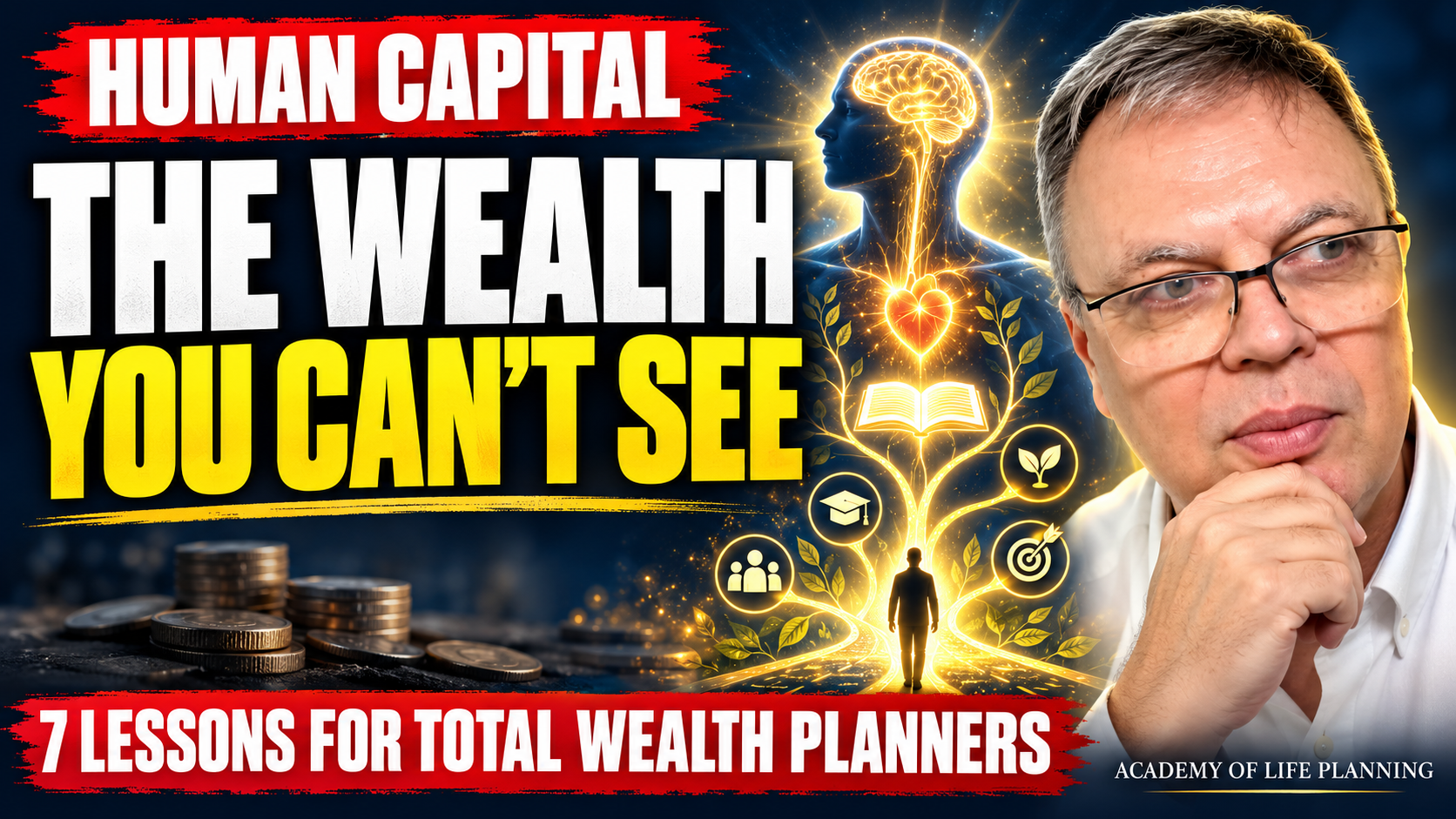
By Steve Conley, Founder, Academy of Life Planning
Abstract
Financial planning can describe accumulated assets in considerable detail while giving less systematic attention to the capabilities through which people earn, adapt, contribute and exercise choice. This article examines six supplied papers on human capital, education, income distribution and sustainable development. It develops seven lessons for Total Wealth Planners: recognise capability alongside financial assets; evaluate learning as an investment with costs and uncertain benefits; maintain and protect human capital; distinguish capability development from access to opportunity; use measurement without false precision; recognise unequal access to development; and retain human well-being as the purpose of planning. The article is a critical narrative synthesis, rather than a systematic review. Its proposed practice framework is an Academy interpretation of the literature, not an intervention validated by these studies.
Keywords: human capital; Total Wealth Planning; lifelong learning; agency; sustainable livelihood; well-being.
Introduction: the wealth a portfolio cannot describe
Consider two people with similar savings. One has current skills, manageable health needs, trusted relationships and several realistic ways to earn. The other faces declining health, skills with limited demand and dependence on a single employer. Their financial statements may look alike. Their capacity to sustain a chosen life may differ substantially.
Human capital theory provides one way to understand this difference. It treats knowledge, skills, experience and health as resources that can support productive activity and future income. The supplied literature also exposes the limits of that approach: capabilities are difficult to value, education does not guarantee employment, and economic productivity cannot fully express the value of a human life.
For Total Wealth Planners, the resulting challenge is practical and ethical. Human capability deserves explicit attention in planning, while the person remains the author of the purposes that capability should serve.
A plan that counts a person’s investments but overlooks their capacity to live and act is incomplete.
What the evidence can establish
The six papers differ substantially in design and evidential strength.
| Paper | Approach | Contribution to this article | Principal limitation |
|---|---|---|---|
| Leka and Pojani (n.d.) | Questionnaire study of 300 adults in Albanian cities | Associations between education, income, investment patterns and education expenditure; acquisition, protection and maintenance of human capital | Observational findings from a particular national and urban context cannot establish causation or predict individual UK outcomes |
| Taş (2022) | Cross-sectional OLS analysis of 89 countries using 2018 data | Positive association between tertiary enrolment and the paper’s income-equality measure | Country-level associations, a narrow human-capital proxy and possible reverse causation limit interpretation |
| Muravska, Medukhanova and Bekmurza (2020) | Comparative and descriptive analysis, particularly of South Asia | Development of human capital must be accompanied by conditions for its effective use | Policy analysis does not test an individual planning intervention |
| Akinyemi and Abiddin (2013) | Narrative literature review | Interdependence of education, health and development across individual, organisational and national settings | Conceptual synthesis rather than a new causal estimate |
| Kang (n.d.) | Academic review and critique, including discussion of South Korea | Valuation difficulties and the importance of connecting skill formation with economic demand | An MA academic paper; its historical interpretation should not be treated as independently established causal evidence |
| Yarmatov and Choriyeva (2022) | Conceptual discussion of sustainable growth | Relationships among human, social, financial, productive and natural capital | Broad claims and secondary statistics are not independently verified here |
These papers support a reasoned discussion of planning priorities. They do not demonstrate that an Academy framework improves income, health or agency. Nor do they justify transferring national economic estimates into promises about an individual client’s return on education.
Lesson 1: recognise human capital explicitly
Leka and Pojani (n.d.) identify earning power as a financially relevant form of human capital, while acknowledging the difficulty of including it in a conventional balance sheet. Their discussion distinguishes acquiring, protecting and maintaining that capital. This is a useful starting point for personal planning.
Recognition need not begin with a monetary estimate. A planner can first help a person identify what they know, what they can do, what experience they possess and the conditions under which those capabilities remain usable.
The distinction between general and employer-specific skills, discussed by Leka and Pojani through the earlier literature, is particularly relevant. Expertise valued by one organisation may not transfer readily to another. Broader capabilities may support a wider range of opportunities.
The planning questions therefore extend beyond current salary: which capabilities are transferable, which depend on a particular institution, and which could support a different way of working?
For someone with modest financial assets, these questions may reveal options that a portfolio-centred conversation misses. They should not imply that everyone has an immediately marketable talent or an obligation to become an entrepreneur.
Lesson 2: treat development as an investment decision
Education and training involve direct expenditure, time, effort and sometimes earnings forgone. Leka and Pojani (n.d.) discuss these costs alongside the potential benefits of schooling and work-based learning. Kang’s review (n.d.) adds an essential qualification: learning may provide both economic benefits and satisfaction valued for its own sake.
Consequently, the appropriate question is not simply whether more education is beneficial. It is whether a particular learning activity is worthwhile for this person, at this stage, given their objectives, resources and available alternatives.
A qualification, supervised practice, a short course and a small practical experiment may serve different purposes. Their value depends partly on what the person can subsequently do with the learning.
For example, an experienced administrator considering independent work might investigate demand, undertake a limited assignment and identify specific skill gaps before committing to an expensive programme. This is a proposed planning application, rather than a finding tested by the supplied studies.
The planner’s contribution is to make the decision clearer: define the intended benefit, account for the full cost, examine uncertainty and agree how progress will be reviewed.
A certificate records an achievement. The planning question is what that achievement enables.
Lesson 3: maintain and protect the capacity to act
Akinyemi and Abiddin (2013) present education and health as closely connected components of human capital development. Knowledge alone is insufficient if a person cannot use it sustainably. Leka and Pojani (n.d.) similarly emphasise continuing learning and protection against threats to earning capacity.
For Total Wealth Planning, this suggests treating health, workload, recovery and skills maintenance as substantive planning considerations. Their effects on livelihood and choice should be visible alongside spending and saving.
Protection also requires a broader discussion than product selection. Relevant considerations may include accessible working arrangements, household resilience, contingency plans, support networks and, where appropriate, specialist input on insurance or health.
The literature does not establish a universal relationship between human-capital value and the amount of insurance someone should buy. That judgement depends on needs, dependants, existing provision and available resources.
Nor should maintaining capability become a demand for constant self-improvement. A period of rest or a reduction in paid work may serve a person’s life better than another qualification. Preservation can be a deliberate investment in future choice.
Lesson 4: distinguish capability from opportunity
Muravska et al. (2020) identify a central problem in human capital development: expanding education does not ensure that an economy provides suitable work. Their discussion of educated unemployment and employment mismatches highlights the importance of conditions that permit capabilities to be used.
Kang’s review (n.d.) makes a related argument through its interpretation of South Korean development, emphasising connections between skill formation and changing demand. Although this historical discussion is not a causal test, it reinforces the need to examine both sides of the relationship.
At the personal level, a useful Academy distinction is between a capability gap and an opportunity gap. The first concerns what someone needs to learn or develop. The second concerns access to settings in which existing capability can be recognised and used.
A skilled person struggling to find work may need an accessible role, a credible introduction or recognition of existing experience. Additional training may help, but it may also leave the main barrier untouched.
Planning should therefore examine evidence of demand, routes to participation and the constraints affecting access. Age discrimination, caring responsibilities, location, disability, recruitment practices and insecure working conditions may warrant investigation in an individual case. These are proposed diagnostic considerations, not findings independently demonstrated for UK clients by the six papers.
Before prescribing development, ask whether the person lacks capability or lacks a viable opportunity to use it.
Lesson 5: measure carefully and avoid false precision
Human capital has economic consequences, but its measurement is inherently selective. Taş (2022), for example, uses gross tertiary enrolment as a proxy. This measures participation in a particular form of education, rather than the complete stock of knowledge, experience, health or practical judgement in a population.
The study finds a positive association between that proxy and income equality across 89 countries. The equality measure compares the income share of the lowest-income tenth with that of the highest-income tenth. This is informative, but it cannot show that a particular individual’s additional qualification will increase their income, or that education alone causes a more equal distribution.
Kang (n.d.) discusses related difficulties in separating the effects of education from differences in background, ability and circumstances. Leka and Pojani’s survey also warrants attention to effect size: the reported correlation between education level and education expenditure is approximately 0.184. Statistical significance should not be mistaken for a strong relationship or a guarantee of practical benefit.
A Total Wealth Planner can use ranges, scenarios and explicit assumptions where a financial estimate of future earning capacity helps a decision. Such estimates should not be added uncritically to spendable assets: future earnings require future activity and carry uncertainty.
Often a qualitative assessment will be more useful. Which skills remain relevant? What evidence supports demand? How dependent is income on one source? What would make the next step feasible?
Economic valuation can inform planning. It cannot determine a person’s worth.
Lesson 6: recognise unequal access to development
Leka and Pojani (n.d.) report that respondents with higher education were more inclined to allocate income to education. Taş (2022) discusses mechanisms through which income inequality can constrain access to education and health, as well as the possible relationship in the other direction.
Taken together, these papers suggest a potential reinforcing pattern: existing resources can facilitate further development, while limited resources can restrict it. The direction and strength of those relationships cannot be settled by these papers alone.
For planners, this is a reason to investigate constraints before interpreting limited development as limited motivation. Course fees may be only one obstacle. Time, care commitments, transport, digital access and the risk of losing current income can also shape what is feasible.
The Academy’s agency approach should therefore distinguish responsibility from blame. A person can retain ownership of decisions while acknowledging barriers they did not create and cannot remove alone.
Practical support may involve identifying affordable learning routes, making existing experience visible or designing a smaller first step. Its value lies partly in expanding feasible options, especially for people whose financial resources are limited.
Lesson 7: keep well-being as the purpose of development
Yarmatov and Choriyeva (2022) situate human capital within a wider discussion of sustainable development and its relationships with social, financial, productive and natural capital. Their conceptual account supports considering connections between resources rather than treating each in isolation.
For Total Wealth Planning, this provides a useful bridge to whole-person thinking. Financial resources can fund development; relationships can support participation; health can sustain activity; and environmental conditions can shape whether a livelihood remains viable.
However, the Academy’s emphasis on meaning, spiritual well-being and human agency is a normative extension of this literature. These six papers do not empirically validate the Academy’s complete model of total wealth.
That distinction strengthens the argument. Economic research helps explain why capabilities matter. The person decides which capabilities are worth cultivating and what life they should support.
Paid work is only one possible expression. Caring, volunteering, creative activity, community participation and learning for enjoyment may all matter. Retirement may involve a change in the use of capability rather than its disappearance.
The purpose of developing human capital is to expand the possibility of a worthwhile life.
A proposed practice framework: recognise, develop, protect, connect and review
The following framework translates the synthesis into a practical conversation. It is an Academy proposal requiring evaluation, not a validated assessment instrument.
| Stage | Core question | Possible planning output |
|---|---|---|
| Recognise | What capabilities and supporting conditions are already present? | A record of skills, experience, health-related constraints and transferable strengths |
| Develop | What learning or practice would serve the person’s chosen goals? | A proportionate development plan with costs, alternatives and intended benefits |
| Protect | What could impair the capacity to act or sustain livelihood? | Contingencies, maintenance priorities and appropriate specialist questions |
| Connect | Where could capability find a viable and worthwhile use? | Evidence of demand, participation routes and barriers to address |
| Review | What has changed, and what does the person now choose? | An updated decision record and a justified next step |
Used within the Academy ecosystem, My Life Record can document relevant experience and evidence; Navigator can help explore alternative futures; and a Total Wealth Planner can support reflection when complexity or uncertainty makes it useful. These are intended applications, rather than outcomes established by the reviewed studies.
The professional’s contribution should increase the person’s ability to understand, choose and act. Evaluation should therefore consider more than income: whether options became clearer, barriers were identified, the person could explain the trade-offs and a chosen action became feasible.
Conclusion: from accumulated wealth to sustained capability
The supplied literature gives Total Wealth Planners a defensible reason to bring human capital into the centre of planning. It also gives them reasons for restraint. Education, health and experience matter, but their benefits depend on opportunity, institutions and individual circumstances. Measurement can illuminate some consequences while obscuring others.
A fuller plan considers what a person owns, what they can do, what they want to do and what conditions make that possible. It recognises both the development of capability and the removal of barriers to its use.
For the Academy of Life Planning, the practical implication is clear: planning should help people sustain sufficient resources and capability to live according to their own values.
Wealth planning becomes life planning when it asks what enables a person to live the life they choose.
References
Akinyemi, G. M., & Abiddin, N. Z. (2013). Human capital developments an interdisciplinary approach for individual, organization advancement and economic improvement. Asian Social Science, 9(4), 150–157. https://doi.org/10.5539/ass.v9n4p150
Kang, S. (n.d.). “Human capital theory”: A review and critique. MA International Education and Development academic paper, School of Education and Social Work, University of Sussex. Publication date not stated in the supplied copy.
Leka, B., & Pojani, E. (n.d.). Human capital—theoritical and statistical study focused mainly on education. Publication date and publication venue not stated in the supplied copy. Title spelling follows the source.
Muravska, T., Medukhanova, L. A., & Bekmurza, A. Zh. (2020). Problems of development and effective use of human capital in developing countries. Central Asian Journal of Social Sciences and Humanities, 6(2), 35–43. https://doi.org/10.26577/CAJSH.2020.v6.i2.05
Taş, B. (2022). The effect of human capital on income equality: Cross-sectional analysis. Sinop Üniversitesi Sosyal Bilimler Dergisi, 6(1), 183–199. https://doi.org/10.30561/sinopusd.1085223
Yarmatov, S. C., & Choriyeva, M. S. Q. (2022). The importance of human capital development in ensuring sustainable economic growth. International Journal for Research in Applied Science & Engineering Technology, 10(XII), 1428–1430. https://doi.org/10.22214/ijraset.2022.48261
Source note: This article is based on the six supplied documents. References to earlier scholars are discussed through those documents; their original publications have not been independently reviewed. Publication details are reproduced from the supplied copies where available.

