
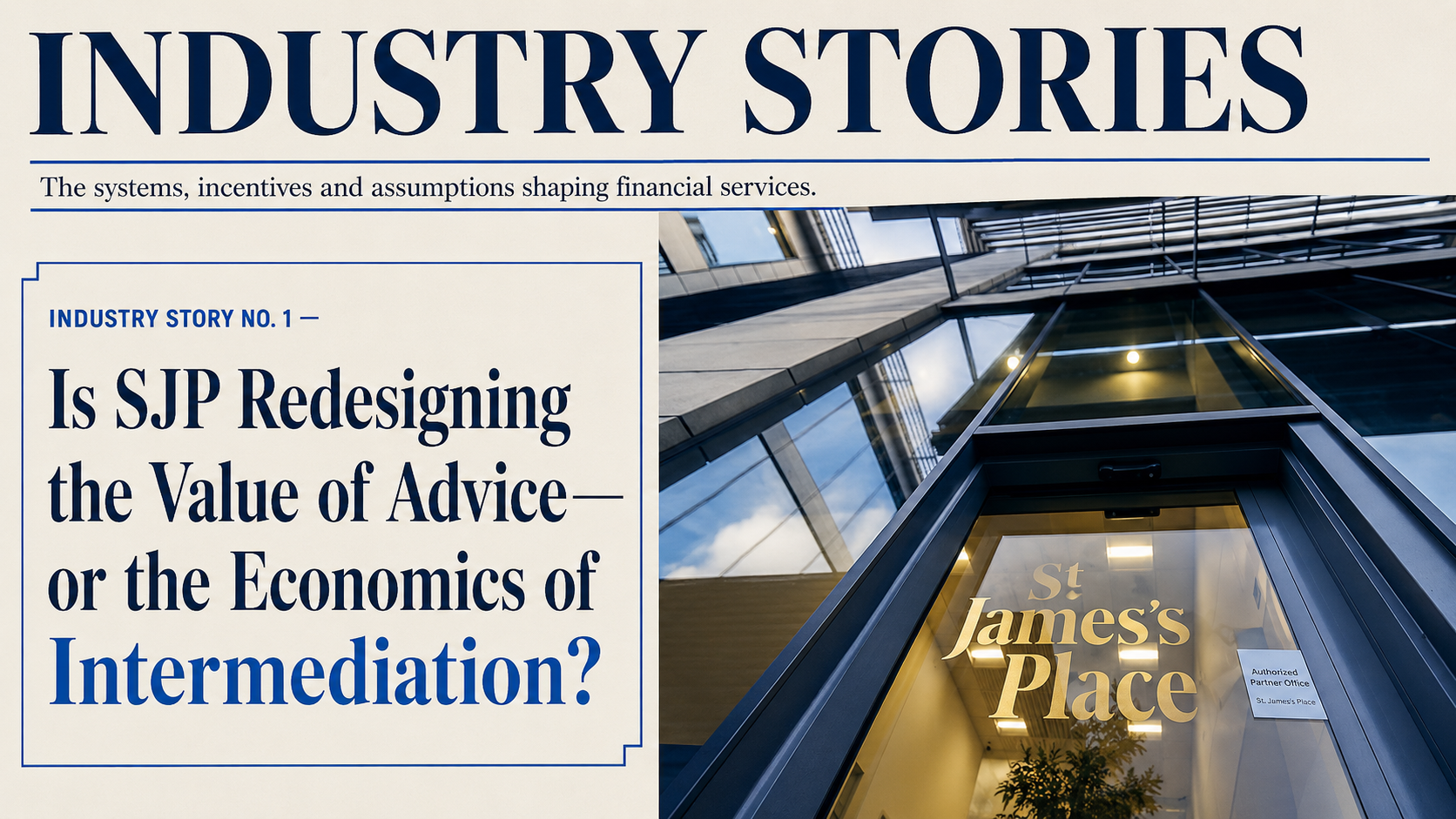
St James’s Place is changing how it pays its advisers.
From March 2027, ongoing advice remuneration that was previously paid annually will be distributed monthly. Partners will receive a transitional payment to bridge the change, while remuneration relating to mortgages and individual protection is also being revised.
SJP says the changes will give partners smoother cash flow, greater certainty and more confidence to invest in their businesses, people and client service. The firm has presented the reforms as part of ensuring that advisers are properly rewarded for the full value of their advice.
On the surface, this is a story about adviser remuneration.
Beneath it lies a more important question:
Is SJP redesigning its economics around the value of advice—or redistributing the proceeds of intermediation to retain its distribution network?
The visible event
Payment timing matters to any advice business.
An annual payment may look predictable on a spreadsheet, but it can create working-capital pressures for practices employing advisers, paraplanners, administrators and support staff throughout the year. Moving to monthly payments brings income closer to the period in which the service is delivered.
That could make partner firms more financially stable. It may help them recruit, invest in technology and improve client service. It may also reduce the pressure to generate new business simply to fund current operations.
The timing of the announcement, however, has attracted attention.
Several substantial SJP partner firms have recently left the network or considered doing so. Prospera Wealth Management and Wellesley Investment Management, which reportedly oversaw more than £2 billion between them, have departed. Sovereign Wealth, responsible for approximately £3 billion, was also reported to be considering its position.
Former advisers have therefore interpreted the remuneration changes partly as a response to partner-retention pressure. SJP describes them more positively: as changes that give partners greater flexibility and enable clients to continue receiving high-quality advice.
Both explanations may contain some truth.
A business can improve adviser economics, support client service and protect its distribution network at the same time.
The more revealing issue is what the system is designed to reward.
The hidden pattern
Most large financial-advice institutions do not merely provide advice.
They operate an interconnected economic system involving advice, product distribution, platform administration, fund management and recurring charges. The adviser is the human relationship layer through which clients enter and remain within that system.
This makes the adviser valuable in two different ways.
The adviser may create value for the client by helping them understand their circumstances, make better decisions and avoid costly mistakes.
But the adviser also creates value for the institution by attracting assets, retaining clients and sustaining recurring revenue.
These two forms of value can overlap, but they are not identical.
A professional may spend considerable time helping a family organise its affairs, understand its options or decide not to invest. That work may be valuable to the family but generate little institutional revenue.
Conversely, an adviser who successfully gathers and retains substantial assets may generate significant revenue for the institution even where the client becomes no more capable of making decisions independently.
This creates a structural tension.
The industry speaks increasingly about the value of advice, but its economics often continue to measure value through assets acquired, products arranged and revenue retained.
SJP’s current published charging structure illustrates the connection. Initial advice charges are generally calculated as a percentage of the amount invested: 3% on the first £250,000, 2% on the next £250,000 and 1% above £500,000. Its ongoing advice charge is generally 0.8% a year.
The charges are now more clearly separated into advice, product and fund components. That is a meaningful improvement in transparency.
But unbundling charges does not necessarily unbundle incentives.
When advice revenue remains linked to the value of assets entering or remaining within the institution, the economic centre of gravity is still intermediation.
The client pays for advice, but the commercial system is sustained by the client remaining advised, invested and institutionally attached.
That does not make individual advisers dishonest or uncaring. Many advisers operating inside these systems work hard, act conscientiously and form valuable long-term relationships with their clients.
The issue is not the character of the people.
It is the architecture surrounding them.
Why it matters
For consumers, the question is what they are becoming through the relationship.
Are they becoming clearer, more confident and more capable?
Do they understand their financial position, the decisions being made and the charges they are paying?
Could they recognise when circumstances have changed, challenge a recommendation or manage more of their affairs themselves?
Or does the service remain valuable primarily because the client continues to depend upon the professional and the institution?
This distinction is rarely visible in conventional measures of advice quality.
A firm can demonstrate regular reviews, compliant documentation and suitable recommendations without asking whether the client’s decision-making capability has increased.
For advisers, the consequences are equally significant.
A remuneration system shapes professional identity.
When rewards are linked mainly to asset gathering and retention, advisers are encouraged—however subtly—to become relationship managers within a distribution system.
When rewards are attached to planning work, education, decision support and capability development, advisers can become something different: professionals who help people take increasing ownership of their lives and money.
The distinction is not between paid and unpaid advice. Good planning deserves to be paid for.
Nor is it between human and digital service.
The distinction is between two economic models:
One monetises continuing intermediation.
The other monetises increasing capability.
The first model asks how much revenue can be retained through the relationship.
The second asks how much agency can be left behind because of it.
This is becoming more important as artificial intelligence reduces information asymmetry.
Much of what once required professional access—calculations, comparisons, explanations, scenario modelling and technical research—can increasingly be performed with consumer-side technology.
That does not eliminate the need for human support.
It changes the basis on which human support remains valuable.
The adviser of the future may be valued less for possessing information the client cannot access and more for helping the client interpret evidence, clarify trade-offs, manage uncertainty and act according to their own values.
The emerging alternative
The emerging alternative is not automated advice replacing human advice.
It is a different division of labour.
Consumer-side AI can give individuals access to planning tools, explanations, financial models and persistent records of their own circumstances. It can help them prepare before speaking to a professional, test assumptions during the relationship and retain what they have learned afterwards.
The human professional can then concentrate on the areas where human judgement and connection matter most: listening, challenging, contextualising, reassuring and helping someone move from intention to action.
This creates the possibility of a capability-building planning model.
In that model, technology does not sit behind the adviser as an institutional efficiency tool. It sits beside the individual as a source of independent capability.
The planner is not removed. The planner’s purpose changes.
The aim is no longer simply to deliver recommendations or maintain assets under advice. It is to help the person understand, choose and act with progressively greater confidence.
This is the transition the Academy of Life Planning is seeking to interpret and support: from advice-based dependency towards capability-building planning.
It is also why we distinguish between three kinds of story.
Industry Stories show why the old model is under pressure.
Planner Stories show professionals building the alternative.
Agency Stories show what changes for the individual.
The SJP remuneration reforms may improve practice cash flow and allow partners to invest more confidently in client service. They may be reasonable and commercially necessary changes.
But the deeper transformation will not be determined by whether adviser remuneration is paid annually or monthly.
It will be determined by what the remuneration rewards.
Does it reward the movement of products and the retention of assets?
Does it reward the volume of continuing intermediation?
Or does it reward work that leaves the client more informed, more capable and less dependent than before?
That is the question facing not only St James’s Place, but the whole advice industry.
When advisers are “remunerated properly”, what exactly are they being remunerated to produce?
Advice out. Agency in.

