
What Rising Advice Thresholds Are Really Telling Us About the Future of Financial Planning
The latest industry statistics may prove to be one of the clearest signals yet that financial planning is entering a structural transition.
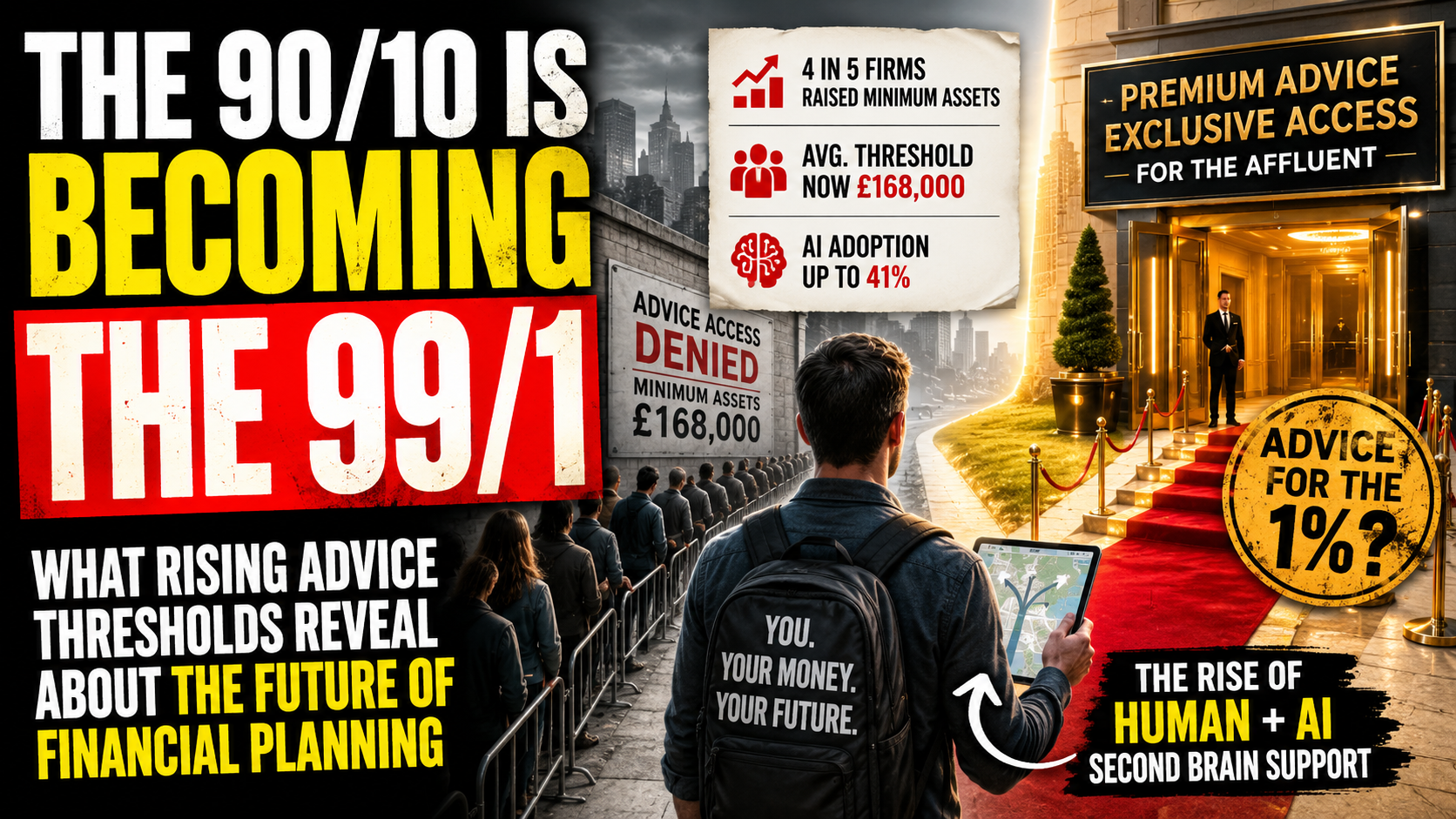
According to the latest adviser survey data [Dynamic Planner’s Advice 2026 report], the average minimum investable asset threshold has now risen to £168,000. At the same time:
- advisers are serving more clients,
- AI adoption is accelerating,
- operational efficiency is improving,
- and firms are increasingly optimistic about growth.
On the surface, this appears contradictory.
If technology is increasing efficiency, why are access barriers still rising?
The answer may be uncomfortable for the profession:
AI is not currently democratising traditional advice. In many cases, it is helping established firms scale affluent servicing models more efficiently.
The result is a widening divide between:
- those economically attractive to the existing advice model,
- and everyone else.
What was once a “90/10” dynamic may gradually be becoming a “99/1” structure:
a highly optimised advice market focused on increasingly affluent households, while the majority of the population navigates growing financial complexity largely unsupported.
But something equally important is happening beneath the surface.
The qualitative feedback emerging from planners and consumers suggests the real shift is not merely technological.
It is psychological.
People increasingly want:
- support without surrender,
- guidance without dependency,
- clarity without intimidation,
- and capability without losing control.
That distinction matters enormously.
Historically, financial planning evolved around a world where:
- information was scarce,
- modelling capability was institutional,
- products were difficult to access,
- and consumers lacked technical understanding.
Under those conditions, delegation made sense.
The adviser held the map.
But AI changes the economics of information asymmetry.
Today, individuals can increasingly access:
- forecasting tools,
- educational insight,
- document interpretation,
- scenario modelling,
- behavioural prompts,
- and strategic guidance,
without needing to fully outsource decision-making.
This does not eliminate the role of the planner.
It changes it.
The emerging value of the planner may lie less in controlling assets and more in helping human beings remain capable inside increasingly complex systems.
That means:
- helping people think clearly,
- organise complexity,
- avoid avoidable mistakes,
- regulate emotional decisions,
- understand trade-offs,
- and navigate institutions confidently.
In other words:
restoring human agency.
This is where we may be witnessing the early emergence of a new category:
the “second brain” support model.
Not artificial intelligence replacing human judgement.
But AI augmenting human capability.
A thinking companion.
A planning scaffold.
A cognitive support layer that reduces overwhelm and helps individuals stay oriented while dealing with:
- pensions,
- taxation,
- retirement decisions,
- intergenerational planning,
- financial stress,
- bureaucracy,
- and institutional complexity.
Importantly, this model changes the emotional dynamic of the relationship.
Many consumers are not merely price-sensitive.
They are trust-sensitive.
Increasingly, people want confidence that:
- recommendations are not driven by asset gathering,
- advice is not shaped primarily by platform economics,
- and the planner’s role is genuinely aligned with their wellbeing rather than product distribution.
That may explain why many individuals appear increasingly receptive to:
- fixed-fee guidance,
- coaching models,
- collaborative planning,
- educational engagement,
- and digital-first support structures.
Not because they reject expertise.
But because they want participation alongside expertise.
This is a subtle but profound shift:
from delegated dependence toward collaborative capability.
The implications for the profession are significant.
The future planner may increasingly resemble:
- a strategic guide,
- educator,
- interpreter,
- accountability partner,
- behavioural coach,
- systems navigator,
- and contextual thinking partner.
Less:
“Leave it all to me.”
More:
“Let’s think this through together.”
This may also explain why many planners themselves are beginning to feel uneasy inside legacy structures.
The technology is changing.
Client expectations are changing.
The economics are changing.
And increasingly, the meaning of value itself is changing.
When portfolio management becomes progressively automated, the enduring human value may not be:
- implementation,
- rebalancing,
- or access to information.
It may be:
- judgement,
- wisdom,
- perspective,
- trust,
- and helping people stay psychologically and financially capable during uncertainty.
The firms that understand this early may not necessarily be the largest firms.
They may simply be the ones that recognise the future of financial planning is not ultimately about scaling products more efficiently.
It is about helping more people remain functional, thoughtful, resilient, and empowered in a world of accelerating complexity.
That is a very different vision of financial planning.
And the market signals increasingly suggest it may already be emerging.

