
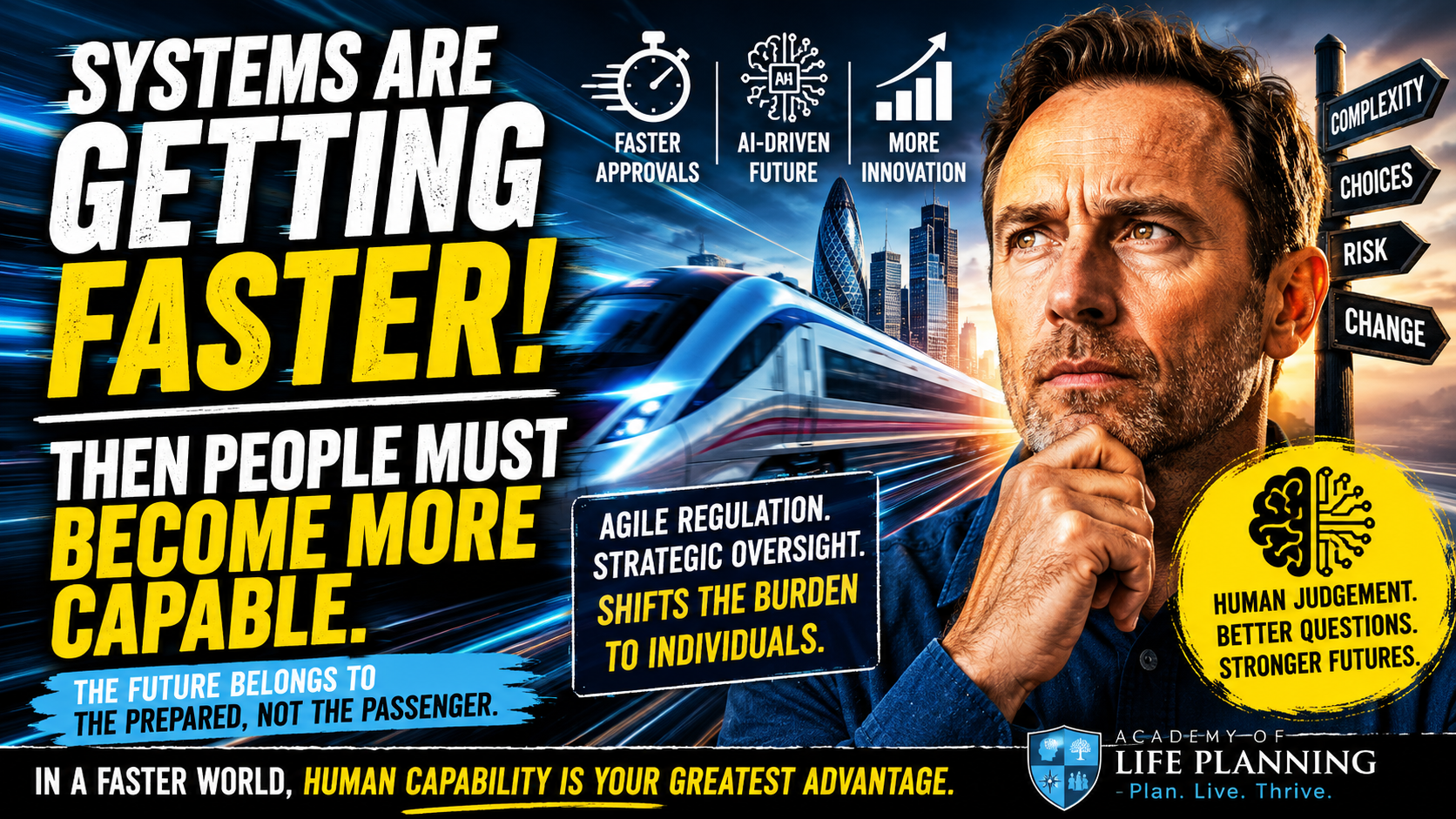
The UK government has quietly signalled the direction of travel for the future of financial services.
Faster approvals.
Faster innovation.
Faster regulation.
More flexibility for firms.
More strategic oversight.
Less procedural friction.
The recent HM Treasury consultation response on financial services regulatory reform makes the trajectory increasingly clear: the UK wants a more agile, competitive, innovation-friendly financial system designed to move at greater speed.
In many ways, that makes sense.
The world is changing rapidly.
Artificial intelligence is accelerating decision-making, product development, customer engagement, and financial analysis at extraordinary pace. Regulators themselves are beginning to explore greater use of digital systems and AI to process applications and supervise markets more efficiently.
The old industrial-era regulatory model — slow, paper-heavy, process-dense — is struggling to keep pace with technological change.
So the system is adapting.
But there is another side to this story that matters just as much.
As systems become faster, individuals must become more capable.
That is the real challenge of the AI era.
Because speed alone does not create understanding.
Automation does not automatically create wisdom.
And innovation does not necessarily increase human agency.
In fact, without the right safeguards, capability, and support, faster systems can increase confusion, dependency, and vulnerability — particularly for ordinary people trying to navigate complexity during moments of stress, uncertainty, or life transition.
The consultation response repeatedly emphasises the need for regulators to become more “agile,” “proportionate,” and “responsive.”
At the same time, some procedural requirements, consultation obligations, and reporting processes are being streamlined or removed to reduce burden and increase operational flexibility.
The government argues this will improve competitiveness and allow regulators to focus on higher-value strategic oversight rather than granular administrative processes.
That may well be true.
But structurally, it also means something important:
The burden of navigation increasingly shifts toward the individual.
And that changes the role of financial planning entirely.
For decades, much of financial services operated on a delegation model.
Consumers delegated complexity to institutions.
Advice firms delegated responsibility to compliance systems.
Institutions delegated trust to regulation.
But the AI era is exposing the limitations of that model.
People are discovering that:
- more information does not necessarily create more clarity,
- more technology does not automatically create better decisions,
- and institutional scale does not always produce trustworthy outcomes.
At the Academy of Life Planning, we believe the future requires a different model.
Not dependency.
Capability.
Not passive consumers.
Active participants.
Not simply “financial advice.”
Human agency.
This does not mean people must become experts in every financial, legal, tax, or technological issue themselves.
It means they need:
- clearer thinking,
- better questions,
- stronger judgement,
- practical decision frameworks,
- and safe ways to explore consequences before making irreversible decisions.
That is why the Academy is evolving beyond traditional financial planning.
We are building tools, systems, and educational frameworks designed to help ordinary people remain informed, capable, and autonomous inside increasingly fast-moving institutional environments.
Not against technology.
Alongside it.
AI itself is not the problem.
Used properly, AI can become one of the greatest capability amplifiers humanity has ever seen.
A person with limited financial knowledge can now:
- model scenarios,
- explore trade-offs,
- understand terminology,
- compare options,
- and stress-test decisions
within minutes.
That is extraordinary.
But AI still requires human judgement.
It still requires context.
It still requires ethics.
And it still requires people to understand what questions they should be asking in the first place.
Otherwise, individuals risk becoming passengers inside systems they no longer understand.
That is why the Academy’s work increasingly focuses on:
- restoring human judgement,
- strengthening informed consent,
- reducing dependency,
- improving practical understanding,
- and helping people think clearly before they act.
In many ways, the future Total Wealth Planner™ is not simply an adviser.
They are a capability guide.
A thinking partner.
Someone who helps people navigate complexity without surrendering autonomy.
Someone who helps individuals remain psychologically and financially grounded in environments increasingly shaped by algorithms, institutional incentives, and accelerating change.
The consultation response highlights a broader societal transition already underway.
The state is becoming more strategic.
Institutions are becoming more technologically enabled.
Regulation is becoming more adaptive.
Markets are becoming faster.
AI is becoming embedded everywhere.
The question now is not whether this transformation will happen.
It already is.
The real question is:
Will ordinary people become more empowered within this system — or more dependent upon it?
That is the defining challenge of modern financial planning.
And increasingly, it is the mission of the Academy of Life Planning.
Because in a faster world, human capability is no longer optional.
It becomes infrastructure.
And restoring human agency may become one of the most important public-interest responsibilities of the AI age.
Explore the Academy of Life Planning and the Total Wealth Plans operating system — designed to help people think clearly, plan independently, and navigate complexity with greater confidence in the age of AI.
Curious how others see this transition between faster systems and human capability.

