
By Steve Conley | Academy of Life Planning
The FCA’s 2025 financial advice firms survey has been presented as a picture of a stable, resilient and evolving advice market.
Look more closely, and it tells a deeper story.
It reveals a market that is consolidating, digitising and preparing for AI, while still operating on an old assumption:
That consumers need more access to advice.
But what if the real problem is different?
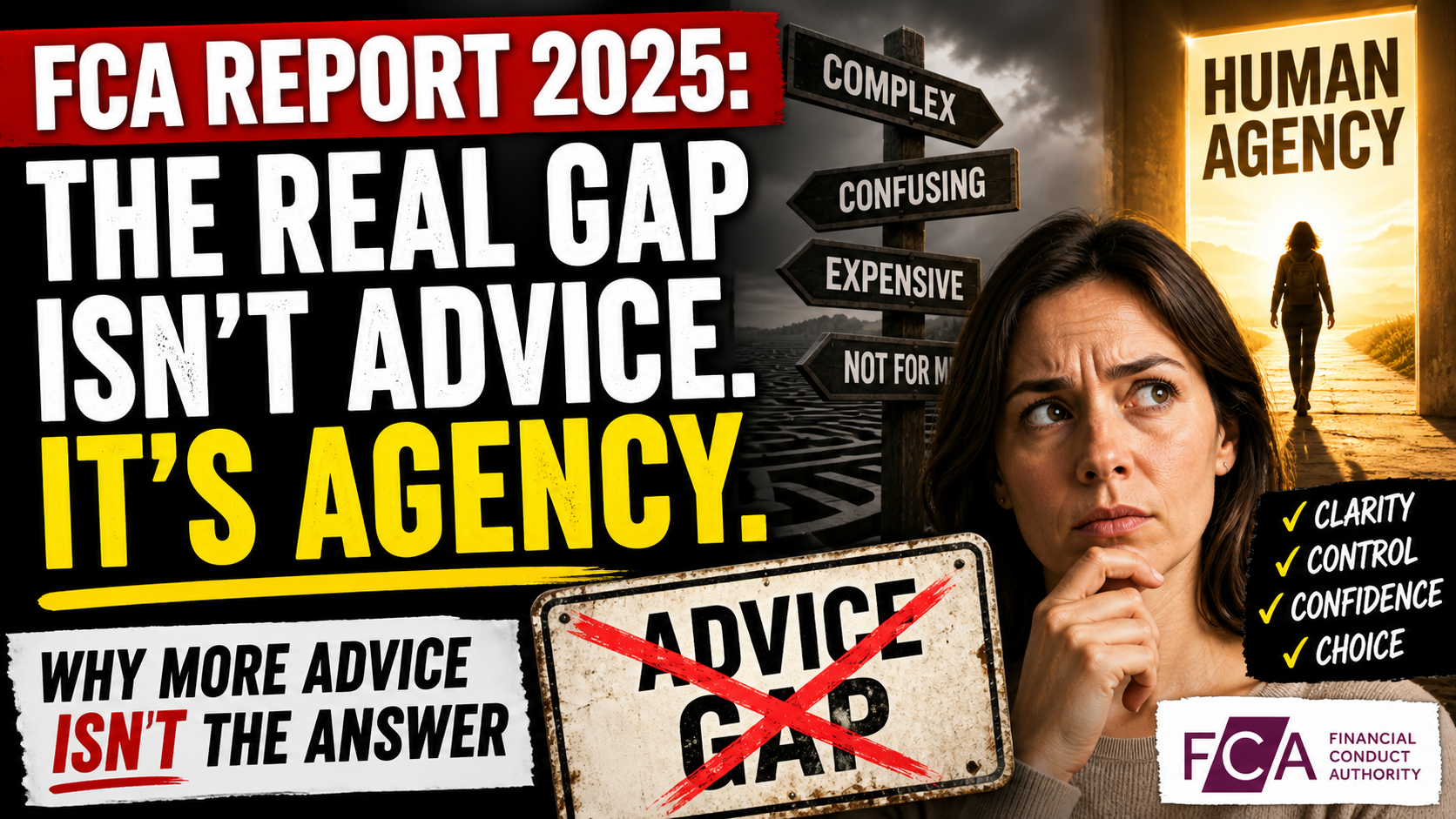
What if the gap is not an advice gap at all?
What if it is an agency gap?
A Market That Looks Stable — But Is Changing Shape
The headline numbers appear reassuring.
The UK has around 31,000 financial advisers, broadly stable since 2021. The sector serves around 4.1 million retail clients and oversees around £1 trillion of assets under advice.
But beneath that stability, the structure is shifting.
The number of advice firms has fallen by 15% since 2021. Large firms, representing just 1% of firms, now account for around half of all assets under advice.
That is not simply market evolution.
It is concentration of control.
As firms consolidate, advice increasingly becomes part of larger industrial systems: centralised propositions, preferred platforms, standardised investment solutions, and recurring revenue models.
The danger is not that individual advisers lack integrity.
Many care deeply about their clients.
The danger is structural.
When advice, platform, product and commercial strategy begin to sit closer together, consumer outcomes depend less on design and more on trust.
And trust is not enough.
A trustworthy system must be aligned by structure, not merely by promise.
Ongoing Advice Has Become the Economic Engine
One of the most striking findings is that around 88% of retail clients receive ongoing advice.
This matters.
Ongoing advice is not a side feature of the market. It is the commercial backbone of the modern advice model.
Yet the FCA also reports that firms review around 20% of ongoing advice files, and that some firms conduct no reviews for certain advice types.
That creates an uncomfortable question.
If almost nine out of ten clients are in ongoing fee arrangements, how consistently is ongoing value being evidenced?
Consumer Duty requires fair value, good outcomes and clear evidence.
But a recurring fee model cannot simply assume value because a relationship exists.
The client needs to know:
What am I paying for?
What decisions are being improved?
What risks are being reduced?
What life outcomes are being supported?
If those questions cannot be answered clearly, the model is vulnerable.
Not because advice is bad.
But because value has become embedded in an annual ritual rather than in visible, measurable human progress.
The Retirement Bias Shows the Limits of the Old Model
The report confirms that 69% of advice clients seek advice mainly for pensions and retirement.
That is understandable.
Pensions are complex. Retirement income decisions matter. Mistakes can be costly.
But it also reveals the narrowness of the traditional model.
Financial advice remains heavily centred on retirement, investment and pension decisions.
In other words, it is still largely money-first.
But people do not live inside pension wrappers.
They live inside families, careers, businesses, communities, health pressures, emotional transitions, caregiving roles, housing choices, and changing identities.
The key question is not simply:
“How do I make my pension last?”
It is:
“What kind of life am I trying to build, sustain, protect or recover?”
Money is part of that answer.
It is not the whole answer.
This is where financial planning needs to evolve.
The future is not just better retirement income advice.
The future is Total Wealth Planning: planning that begins with the whole person, not the product, the portfolio or the pension.
The Advice Gap Is Being Misdiagnosed
The FCA again points to the familiar “advice gap”.
Only around 9% of UK adults take financial advice, while millions hold meaningful cash savings that could potentially be invested.
The usual conclusion is that more people need more advice.
But that assumes the current advice model is the natural answer.
It may not be.
Many people do not avoid advice because they are irrational.
They avoid it because the proposition does not feel relevant, accessible, independent, or worth the cost.
They may not want to hand control to an adviser.
They may want to understand their position, explore options, test decisions, and stay in control.
That is not an advice gap.
It is a decision-support gap.
It is a capability gap.
It is a human agency gap.
The industry keeps asking:
“How do we get more people into advice?”
A better question is:
“How do we help more people become capable financial decision-makers?”
That shift changes everything.
AI Could Transform Planning — But Not If It Is Used to Preserve the Old Model
The report shows growing interest in AI, especially among larger firms.
But the pattern is telling.
AI is being explored mainly for efficiency, compliance, automation, meeting notes, data extraction and business assurance.
Useful, yes.
Transformative, not yet.
Used well, AI can help people understand documents, organise evidence, model decisions, compare options, identify risks, and build confidence.
Used poorly, it simply helps institutions scale the same old model faster.
The real opportunity is not AI-powered advice distribution.
It is AI-supported human agency.
AI should not become another tool for extracting assets into managed propositions.
It should become a thinking partner that helps consumers ask better questions before they sign, transfer, invest, consolidate, borrow or delegate.
That is why the Academy of Life Planning is building tools such as the Leveller, Navigator and Goliathon.
Before harm. During uncertainty. After harm.
Not to replace human judgement.
To restore it.
Vulnerability Is Really About Capability
The FCA reports that around 12% of retail clients are identified as having characteristics of vulnerability, with only 5% receiving service adjustments.
This deserves far more attention.
Vulnerability is often treated as a label attached to a person.
But in many financial situations, vulnerability is created or intensified by the system itself.
A person may become vulnerable because they are:
confused by technical language,
pressured by deadlines,
unable to compare options,
overwhelmed by documentation,
emotionally distressed,
or unable to challenge an institution on equal terms.
That is not a character flaw.
It is a capability imbalance.
The answer is not merely to identify vulnerability.
The answer is to build capability, restore clarity and reduce dependency.
This is why education, structured thinking, plain English, decision tools and trauma-informed support matter.
A capable client is not just better informed.
They are safer.
The Market Is Becoming More Capability-Dependent
This is the real message beneath the FCA report.
The regulator wants a market that is:
more innovative,
more digital,
more scalable,
more flexible,
more investment-oriented,
and more supportive of growth.
At the same time, initiatives such as targeted support and simplified advice will blur the old boundaries between guidance and advice.
That means consumers will increasingly be expected to navigate a more complex support landscape.
Some services will be personalised.
Some will not.
Some will involve advice.
Some will involve nudges.
Some will involve product pathways.
Some will feel helpful while still being commercially designed.
In that environment, consumer protection cannot depend solely on regulation.
It must also depend on capability.
People need to understand:
Who is helping me?
Who is paying them?
What are they allowed to do?
What are they not allowed to do?
What product pathway am I being moved towards?
What lifetime cost am I accepting?
What alternative routes exist?
This is not cynicism.
It is modern financial literacy.
The Future Belongs to Decision Support, Not Product Distribution
The FCA report describes a sector seeking to grow, innovate and maintain trust.
But the deeper opportunity lies outside the old advice frame.
The future is not simply more advisers serving more clients through more efficient systems.
The future is a new professional role:
The Total Wealth Planner.
A Total Wealth Planner does not begin by asking:
“How much money do you have to invest?”
They begin by asking:
“What are you trying to create, protect, sustain or recover in your life?”
They do not sell dependency.
They build decision capital.
They do not replace the client’s agency.
They restore it.
They do not treat AI as a back-office efficiency tool alone.
They use it to help people think more clearly, act more independently, and navigate complexity with confidence.
This Is the Real Advice Market Shift
The FCA is right about one thing.
The market is evolving.
But the most important shift is not consolidation.
It is not AI adoption.
It is not simplified advice.
It is not targeted support.
It is the shift from delegated advice to restored agency.
The question for the future is not:
“How do we scale the old advice model?”
The question is:
“How do we build a financial planning system where people are capable, informed and protected by design?”
That is the work ahead.
And it begins with a simple principle:
Plan the person first.
Then the money.
Then the financial architecture.
That is how we move beyond the advice gap.
That is how we build decision capital.
That is how we restore human agency.

