
By Steve Conley
In 2009, a quietly radical idea was proposed in the pages of a private investor magazine.
It did not call for revolution.
It did not reject the financial system.
It simply asked a very reasonable question:
What if fund managers were only paid when they genuinely outperformed?
The proposal—known as the Active Management Partnership (AMP)—was an attempt to repair one of the most persistent and uncomfortable truths in investing:
The interests of investors and the interests of those managing their money are rarely aligned.
A System That Rewards the Wrong Outcomes
The AMP concept emerged from a clear-eyed critique of the investment industry.
- Investors commit capital for decades
- Managers charge annual fees regardless of outcome
- Advisers and brokers are often rewarded for distribution, not results
- And, over time, many portfolios underperform low-cost passive alternatives after fees
This is not a fringe view. It is widely supported by academic research and increasingly acknowledged by institutional investors.
But the more subtle—and arguably more important—insight lies elsewhere.
The system persists not because it works, but because it feels like it works.
Investors are not just buying performance.
They are buying reassurance.
They are outsourcing uncertainty.
The AMP Solution: Alignment Through Discipline
AMP sought to correct this imbalance through a simple but powerful structure:
- No annual management fees
- No commissions to intermediaries
- Payment only for genuine outperformance
- A high-water mark—losses must be recovered before any reward
- Long-term commitment (minimum 8 years)
- Manager co-investment to ensure “skin in the game”
In effect, AMP attempted to create a true partnership:
If the investor wins, the manager wins.
If the investor does not win, the manager is not paid.
It is difficult to argue with the fairness of this arrangement.
And yet, despite its clarity, it never reshaped the industry.
Why It Didn’t Scale
The answer is not intellectual. It is structural.
AMP failed to gain traction not because it was flawed in principle, but because it was incompatible with the economic realities of the system it sought to reform.
- Financial firms depend on predictable, recurring revenue
- Distribution networks rely on embedded incentives
- Advisers operate within commercial and regulatory frameworks that favour continuity over disruption
In short, AMP asked the industry to behave against its own financial interests.
And industries rarely do that voluntarily.
But there is a deeper reason.
The Hidden Assumption
AMP improves the terms of engagement between investor and manager.
But it does not question the relationship itself.
It assumes that:
- The investor needs a manager
- The manager’s role is to outperform
- And the problem is simply how that role is priced
This is where the idea reaches its natural limit.
Because over the past decade—accelerated dramatically by artificial intelligence—that assumption has begun to break down.
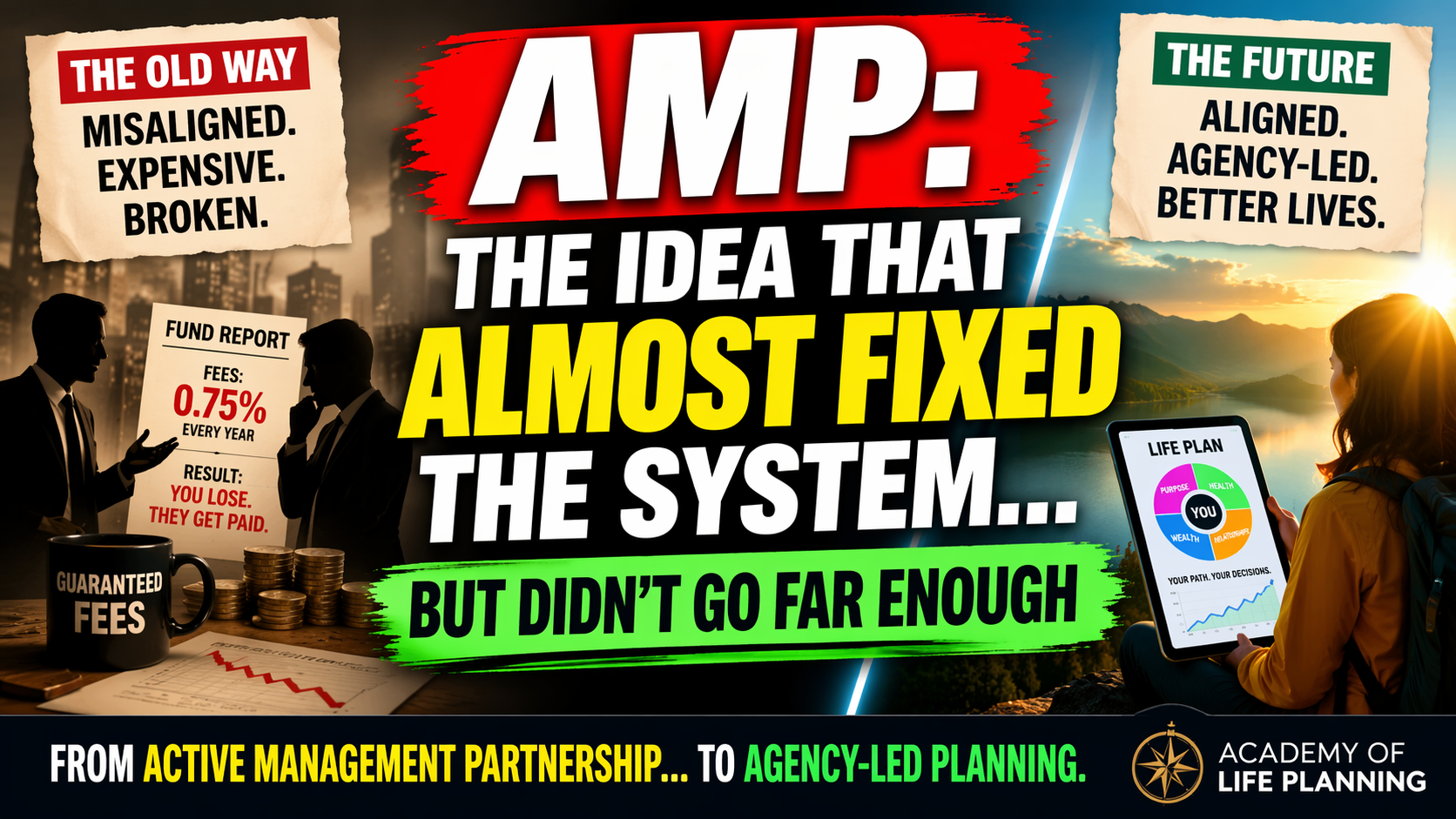
From Alignment to Agency
The real shift we are now witnessing is not about better incentives.
It is about who holds the decision-making power.
Historically:
- Information was scarce
- Expertise was concentrated
- Intermediation was necessary
Today:
- Information is abundant
- Insight is increasingly accessible
- And the cost of analysis is collapsing
The result is a structural transition:
From advice… to agency.
AMP as a Precursor, Not a Solution
Seen in this light, AMP becomes something more interesting.
Not a failed reform.
But a transitional idea.
It represents a moment when the system recognised its own contradictions and attempted to correct them—without yet having the tools to move beyond them.
It asked:
“How do we make this fairer?”
But the question we can now ask is different:
“Do we still need this at all?”
The Emergence of Agency-Led Planning
At the Academy of Life Planning, we frame this shift in practical terms.
The future of financial planning is not:
- Done for you
- Or even done to you
It is:
Done by you, with support where needed.
This is not about removing expertise.
It is about repositioning it.
The planner is no longer:
- A gatekeeper of knowledge
- Or a distributor of products
They become:
- A thinking partner
- A guide in moments of complexity
- A contributor to the client’s decision capital
Beyond Performance: A Broader Definition of Wealth
AMP focused on investment performance.
But financial life is wider than portfolios.
A truly aligned model must consider:
- Human capital
- Health and wellbeing
- Relationships and purpose
- Time, energy, and meaning
In this context, outperforming an index is no longer the primary objective.
The objective is:
To live a well-planned life.
The Quiet Evolution
There is a tendency to look for dramatic turning points.
But most real change is evolutionary.
AMP was one step in that evolution.
- It exposed misaligned incentives
- It challenged fee structures
- It highlighted the importance of long-term thinking
And, perhaps most importantly, it pointed toward a deeper truth:
Alignment matters.
What we are now seeing is the next step:
Agency matters more.
A Final Reflection
The investment industry spent decades attempting to align interests within a model built on intermediation.
That work was necessary.
But it was not sufficient.
Because once individuals have the tools, clarity, and confidence to make informed decisions themselves, the question is no longer:
“How should we pay the manager?”
It becomes:
“What role should the manager play at all?”
The answer to that question is now emerging.
And it is reshaping financial planning from the ground up.
If you are exploring what this shift means for your own planning—or your role as a planner—this is exactly the conversation we are having at the Academy of Life Planning.
Curious how others see this.

