
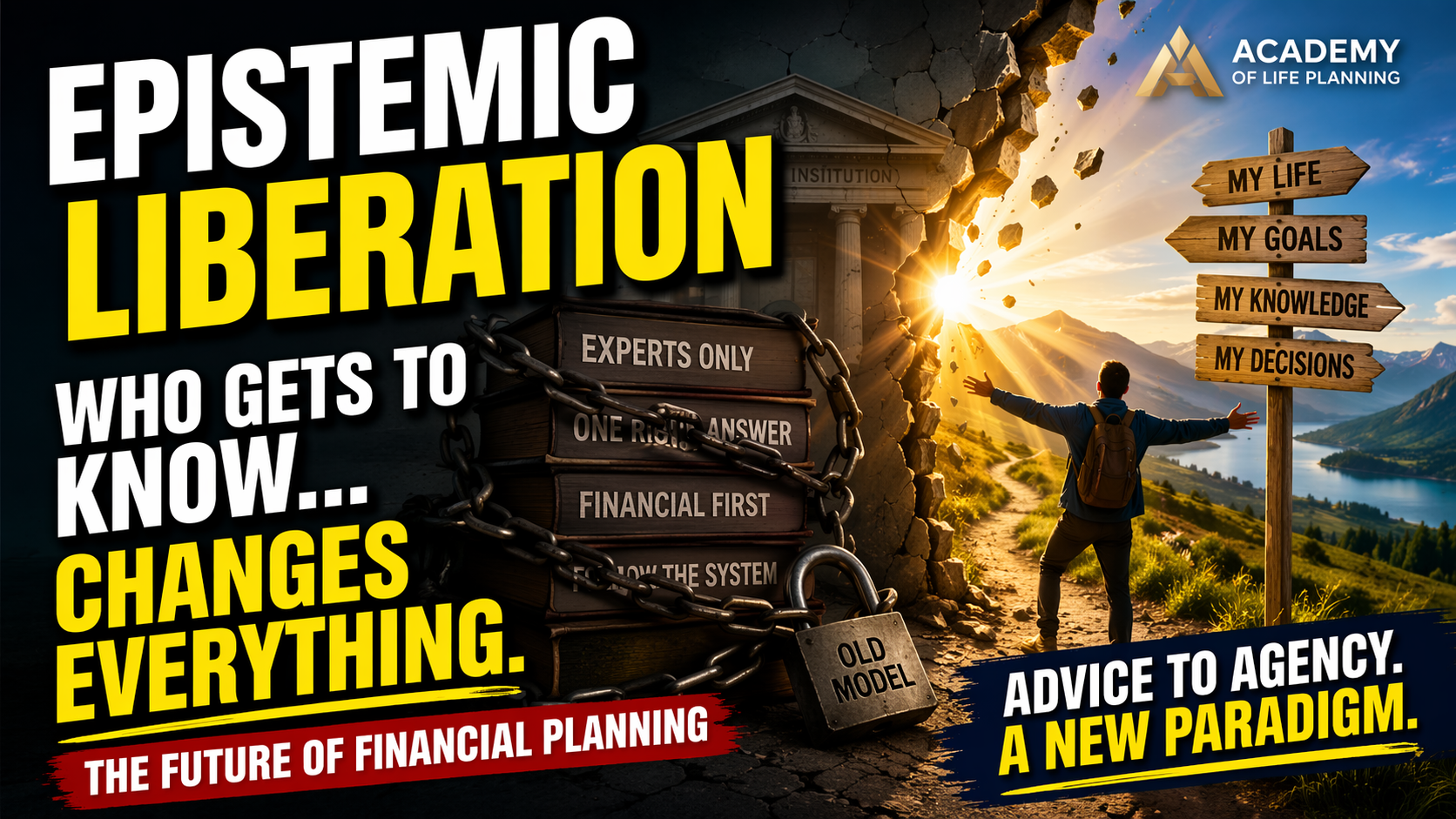
By Steve Conley, Academy of Life Planning
For decades, the financial planning profession has focused on improving answers.
Better models.
Better forecasts.
Better products.
But what if the real issue is not the quality of the answers…
but who is allowed to ask the questions?
This is the deeper challenge now emerging across multiple fields—education, policy, healthcare, and increasingly, financial planning. It is known as epistemic liberation: the restructuring of how knowledge itself is defined, validated, and applied.
And it has profound implications for the future of our profession.
The Hidden Architecture of Financial Planning
Every system operates on an underlying assumption about knowledge.
In traditional financial planning, that assumption has been clear:
- The adviser is the expert
- The client is the recipient
- The system defines what “good” looks like
This structure determines:
- What counts as valid information
- Which goals are considered legitimate
- How decisions are framed and evaluated
Over time, it creates a hierarchy:
- Technical knowledge over lived experience
- Financial capital over human potential
- Standardised models over personal meaning
The result is not just a professional model—it is an epistemic system. A system that decides whose knowledge matters.
When Knowledge Becomes Control
The consequences of this structure are subtle, but significant.
When institutions control what counts as knowledge, they also shape:
- What people believe is possible
- How they interpret their own lives
- The decisions they feel permitted to make
This is not about bad actors. It is about design.
A system built on expert authority inevitably creates dependency.
A system built on product distribution inevitably narrows the definition of value.
And a system that prioritises financial metrics above all else inevitably sidelines the very thing it claims to serve: the human life behind the numbers.
Epistemic Liberation: A Structural Shift
Epistemic liberation does not reject expertise.
It repositions it.
It asks a different question:
What if the individual is not the least informed participant in the planning process… but the most contextually informed?
From this perspective, the role of the planner changes fundamentally.
No longer:
- The authority who defines reality
But:
- The partner who helps individuals interpret and act within their own reality
This shift has three practical consequences.
1. From Validation to Co-Validation
In traditional models, knowledge flows one way.
The adviser validates.
The client complies.
In an epistemically liberated model:
- Lived experience becomes legitimate evidence
- Context is treated as data
- Meaning is not dismissed as “soft”—it is recognised as foundational
Planning becomes a process of co-validation, where both parties contribute to understanding what is true and relevant.
2. From Single Framework to Multiple Ways of Knowing
Most financial planning frameworks present themselves as universal.
But they are not neutral.
They are products of specific histories, assumptions, and incentives.
Epistemic liberation recognises that:
- There is no single “correct” way to understand wealth
- Financial outcomes cannot be separated from human context
- Different lenses reveal different truths
This leads to a plural model of planning—one that integrates:
- Financial capital
- Human capital
- Decision capital
Not as add-ons, but as equally valid dimensions of wealth.
3. From Extraction to Participation
Traditional systems extract knowledge:
- Advisers interpret clients
- Institutions define best practice
- Research speaks about people, not with them
An epistemically liberated system reverses this dynamic.
Individuals become:
- Authors of their own plans
- Interpreters of their own data
- Active participants in the planning process
The role of the planner evolves into something more valuable:
A thinking partner.
A guide in complexity.
A stabilising presence when decisions matter most.
The GAME Plan: A Practical Expression
This shift is not theoretical.
At the Academy of Life Planning, it is embedded in the GAME Plan™ framework.
By starting with Goals, rather than products or projections, the process restores the individual as the primary source of meaning.
Actions, Means, and Execution follow—but only after the individual has defined what matters.
This is a subtle but radical inversion.
It moves planning from:
- External prescription
To:
- Internal orientation
From:
- “What should I do with my money?”
To:
- “What am I trying to create with my life?”
Why This Matters Now
The rise of artificial intelligence is accelerating this shift.
Information is no longer scarce.
Models are no longer exclusive.
Technical analysis is increasingly commoditised.
In this environment, the value of the planner cannot rest on access to knowledge alone.
It must rest on something deeper:
- The ability to help individuals orient themselves
- The ability to navigate meaning, not just metrics
- The ability to support decision-making in real human contexts
In other words, the future belongs not to those who hold knowledge,
but to those who help others use it wisely.
A New Role for the Profession
This is the opportunity now facing financial planners.
Not to defend the old model.
But to step into a new one.
A model where:
- The client is not dependent, but empowered
- The planner is not an intermediary, but a partner
- The system is not extractive, but enabling
This is what it means to move from advice to agency.
The Path Forward
Epistemic liberation is not a destination.
It is an ongoing practice.
It requires:
- Reframing how we teach planning
- Expanding what we recognise as valid knowledge
- Redesigning the relationship between planner and individual
Most importantly, it requires a shift in mindset:
From believing that expertise gives us authority…
to recognising that authority must be shared.
Closing Reflection
The future of financial planning will not be defined by better tools alone.
It will be defined by a deeper question:
Who is the primary knower of a life?
If the answer remains “the system,”
we will continue to refine dependency.
If the answer becomes “the individual,”
we open the door to something far more powerful:
A profession built not on control,
but on liberation.
Explore the Academy of Life Planning
Discover how to become a Total Wealth Planner and take part in shaping the future of planning—where human agency comes first.

