
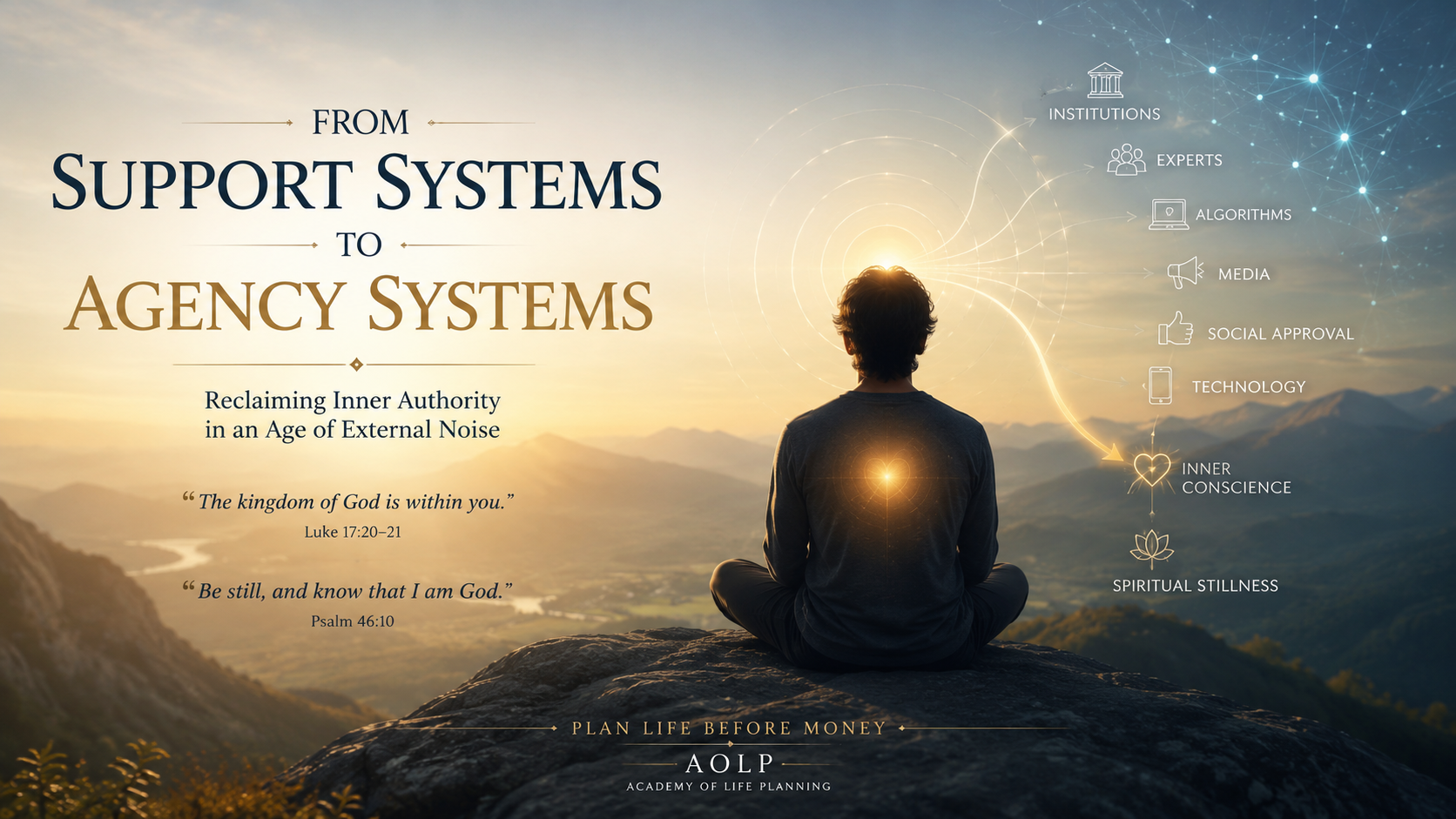
What if the real crisis is not stress — but disconnection from inner authority?
There is a quiet assumption running through much of modern wellbeing culture:
People are struggling because life has become too complex to navigate alone.
In response, society has built layer upon layer of support systems:
employee assistance programmes,
financial wellbeing services,
mental health platforms,
coaching ecosystems,
expert networks,
AI assistants,
life administration tools.
Most are well intentioned.
Many genuinely help people during periods of stress, grief, overload, burnout, or uncertainty.
But beneath this expansion of institutional support lies a deeper question that society rarely pauses to ask:
Are we helping people become stronger…
or simply more dependent?
At the Academy of Life Planning, we increasingly see this as one of the defining philosophical questions of the AI age.
Not because support is wrong.
But because support and agency are not the same thing.
A support system helps people cope with complexity.
An agency system helps people develop the capability to navigate complexity consciously for themselves.
That distinction matters.
For decades, many systems have evolved around the assumption that individuals need increasing external guidance:
experts to interpret,
institutions to reassure,
algorithms to recommend,
platforms to decide.
The unintended consequence is subtle but profound.
People can gradually lose trust in their own judgement.
And when that happens, something deeper than financial wellbeing is affected.
Human agency begins to erode.
At first glance, this may appear to be merely a technological or behavioural issue.
But underneath it lies something spiritual.
Because almost every wisdom tradition points toward the importance of inner discernment.
Not blind independence.
Not isolation.
But conscious relationship with one’s own inner life.
Two passages capture this beautifully.
In The Bible, Luke 17:20–21 states:
“The kingdom of God cometh not with observation… behold, the kingdom of God is within you.”
And Psalm 46 reminds us:
“Be still, and know that I am God.”
These are not simply religious statements.
They point toward an ancient insight:
the deepest source of orientation is not external noise, but inner stillness.
Yet modern systems increasingly train attention outward.
More alerts.
More feeds.
More recommendations.
More institutional mediation.
More optimisation.
Even wellbeing itself can become outsourced.
A legend shared in Margaret Silf’s One Hundred Wisdom Stories captures this paradox powerfully.
The story tells of God seeking a place to hide within creation so humanity would not discover the divine too quickly. After rejecting the earth, the moon, and the stars, an angel finally suggests:
“Why don’t you hide yourself within their own hearts? They will never think of looking there.”
The story resonates because it reflects something many people quietly feel today:
despite unprecedented connectivity, information, and support infrastructure, many individuals feel increasingly disconnected from themselves.
This is where the AI conversation becomes especially important.
Most current AI discussion focuses on efficiency:
How can AI automate tasks?
Improve productivity?
Reduce costs?
Scale advice?
Increase engagement?
But perhaps the deeper question is:
Can AI help restore human agency rather than replace it?
At AoLP, we believe this may become one of the most important design questions of the next decade.
AI can either:
increase dependency,
fragment attention,
and centralise control,
or it can help people reflect, organise, understand, and think more clearly for themselves.
That is why the Academy increasingly speaks about “agency systems” rather than simply support systems.
An agency system does not aim to make people permanently reliant.
It aims to increase:
discernment,
clarity,
self-awareness,
capability,
and conscious decision-making.
This is also why the distinction between institutional optimisation and human development matters so much.
Many systems are designed to stabilise people so they can continue functioning within existing structures.
But what if the deeper task is helping people reconnect with:
purpose,
meaning,
stillness,
and inner authority?
That does not mean rejecting community, expertise, or support.
Healthy support matters deeply.
But perhaps support should increasingly function as scaffolding for growth rather than permanent substitution for judgement.
This opens fascinating possibilities for the future of AI-enabled planning.
Imagine an AI tool not designed primarily to optimise consumption or productivity — but to encourage reflection.
An “Agency Score” application, for example, might gently ask:
Where do you currently place your agency?
In:
- employers?
- financial institutions?
- governments?
- algorithms?
- media?
- experts?
- social approval?
- technology?
- religion?
- inner conscience?
- spiritual stillness?
Not to judge.
But to increase awareness.
Because perhaps the first step in restoring agency is recognising where we have unconsciously surrendered it.
In many ways, this is the deeper philosophy underneath the Academy of Life Planning.
Planning is not merely about money.
It is about restoring the individual’s relationship with conscious choice.
Not dependency.
Not isolation.
But awakened participation in life.
The future may not belong to those with the most information.
It may belong to those who can remain internally coherent amidst overwhelming information.
And perhaps that begins exactly where the old wisdom traditions always suggested:
not outside ourselves…
but within.
From “God is Hiding”, by:
Luke 17 20-21 and Psalm 46
A legend says that, at the beginning of time, God resolved to hide himself within his own creation. As God was considering how best to do this, the angels drew around him.
“I want to hide myself in my own creation,” God said. “I need to find a place that is not too easily discovered, for it is in their search for me that my creatures grow in spirit and in understanding.”
“Why don’t you hide yourself deep in their earth?” the first angel asked.
God pondered this a moment and replied, “No, it will not be too long before they learn how to mine the earth and discover all the treasures it contains. They will find me too quickly, and they will not have had enough time to do their growing.”
“Why don’t you hide yourself on their moon?” said the second angel.
“God gave this more thought but then replied, “No, it will take them a little longer, but eventually they will learn to fly through space. They will arrive at the moon and explore its secrets—and they will find me too soon, before they have had enough time to do their growing.”
The angels were at a loss to suggest any more hiding places. There was a long silence.
“I know,” piped up one angel, finally. “Why don’t you hide yourself within their own hearts? They will never think of looking there!”
“That’s it!” said God, delighted to have found the perfect hiding place. And so it is that God secretly hides deep within the heart of every one of God’s creatures, until that creature has grown enough in spirit and understanding to risk the great journey into the secret core of its own being. And there, the creature discovers it creator, and is rejoined to God for all eternity.
(from One Hundred Wisdom Stories, by Margaret Silf)

