
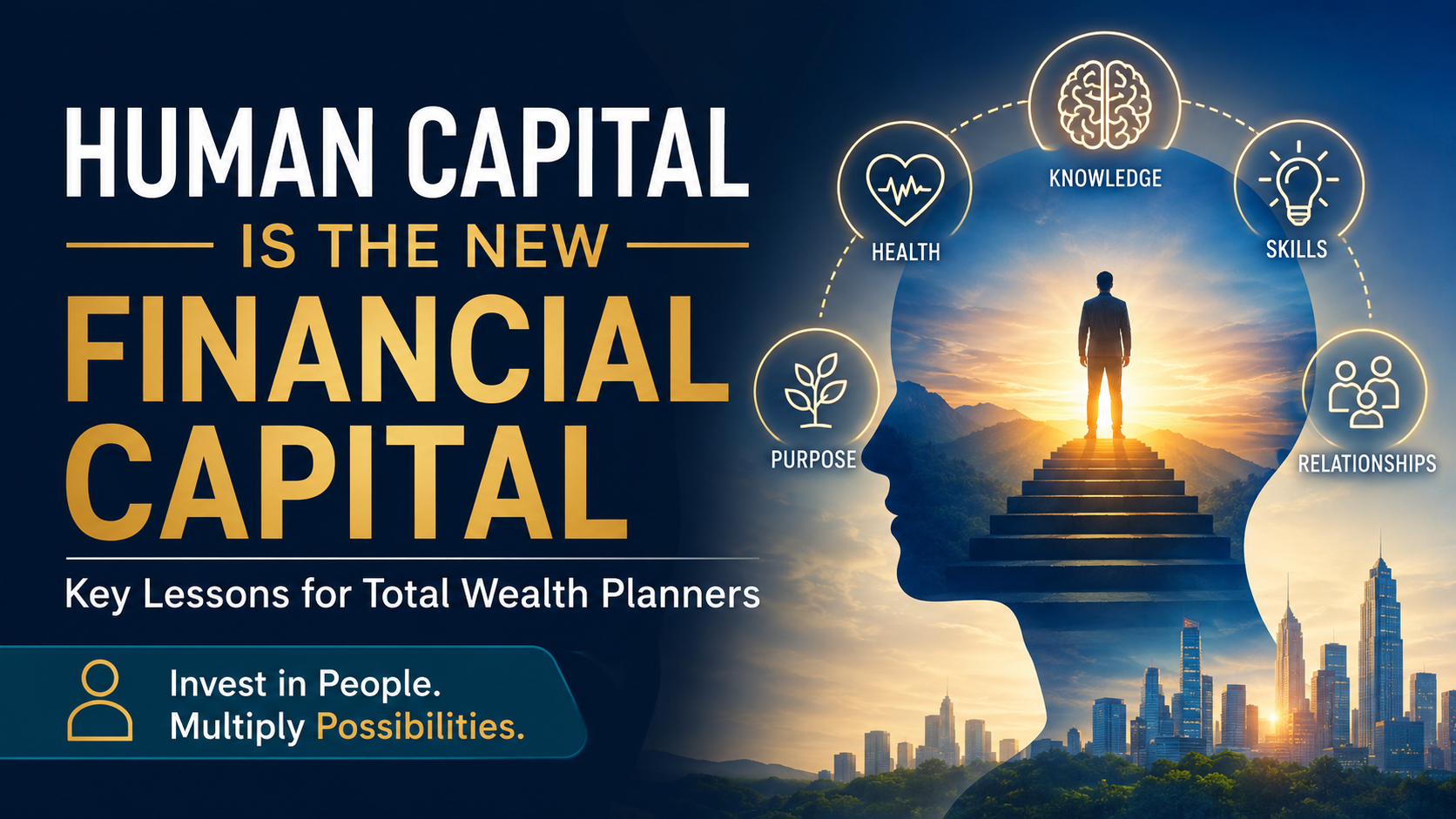
There is a quiet but profound shift happening beneath the surface of financial planning.
For decades, much of the profession has focused on managing financial capital:
pensions, ISAs, investments, tax wrappers, accumulation rates, withdrawal strategies.
But a deeper question is now emerging:
What actually creates sustainable human prosperity in the first place?
A fascinating academic paper titled “Role of Human Capital Formation in Economic and Human Development” explores this question through the lens of economic development theory.
For Total Wealth Planners, the implications are enormous.
Because the study unintentionally reinforces something many planners are only beginning to realise:
The true engine of wealth is not money.
It is human capability.
And in the age of AI, that distinction matters more than ever.
Human Beings Are Not Inputs Into the Economy
The paper draws heavily on the work of Amartya Sen, who argued that development should not merely be measured through GDP or income growth, but through the expansion of human freedoms, capabilities, and meaningful life choices.
That is remarkably aligned with the philosophy underpinning the Academy of Life Planning.
A person with:
- better health,
- stronger emotional resilience,
- greater clarity,
- improved skills,
- meaningful relationships,
- and a stronger sense of purpose,
is not merely “better prepared financially.”
They are wealthier in the deepest sense.
This reframes the role of the planner entirely.
The planner is no longer simply a manager of financial products.
They become a facilitator of human capability.
A Total Wealth Planner asks:
- What gives this person agency?
- What expands their options?
- What strengthens their resilience?
- What improves their ability to navigate complexity?
- What enables them to live well — not just retire solvent?
That is a very different conversation.
Human Capital Formation Is the Real Compound Interest
The paper defines human capital formation as the process of transforming human beings into more capable, productive, and creative contributors through:
- education,
- health,
- training,
- experience,
- and moral development.
Traditional financial planning often treats these things as secondary lifestyle considerations.
But development economics treats them as foundational economic infrastructure.
That is an important distinction.
Because when you look honestly at most people’s lives, their outcomes are rarely determined primarily by investment selection.
They are determined by:
- emotional regulation,
- health,
- adaptability,
- relationship quality,
- confidence,
- judgement,
- communication ability,
- learning capacity,
- and the ability to respond to change.
In other words:
human capital.
This is one reason the Academy increasingly positions financial planning as a branch of human development rather than merely financial engineering.
The future planner will need to understand:
- behavioural dynamics,
- identity transitions,
- career reinvention,
- wellbeing,
- AI augmentation,
- learning systems,
- and capability development,
not just tax wrappers and model portfolios.
AI Makes Human Capital More Valuable — Not Less
One of the most important insights hidden inside the paper is its discussion of innovation.
It notes that economic value increasingly comes from creativity, innovation, and uniquely human capability because “human brains cannot simply be copied or multiplied.”
That observation becomes even more significant in the AI era.
AI is rapidly commoditising:
- information,
- calculations,
- technical analysis,
- process work,
- and administrative efficiency.
Which means the scarce asset is shifting.
The scarce asset is becoming:
- judgement,
- wisdom,
- emotional intelligence,
- ethical discernment,
- meaning-making,
- creativity,
- adaptability,
- and coherent decision-making under uncertainty.
The planner who only sells information may struggle.
The planner who helps build human capability may become more valuable than ever.
This is why Total Wealth Planning is increasingly about:
“restoring human agency in the age of AI.”
Not resisting technology.
Not worshipping technology.
But helping people remain psychologically and practically sovereign within technological systems.
Financial Capital Is Often a Lagging Indicator
One of the most important implications for planners is this:
Financial capital is often downstream of human capital.
The paper repeatedly links human capital formation with:
- increased income,
- higher participation,
- greater equality,
- improved wellbeing,
- innovation,
- and improved standards of living.
This mirrors what many experienced planners observe in practice.
A client who:
- gains confidence,
- improves health,
- escapes burnout,
- develops new skills,
- rebuilds identity after crisis,
- or discovers renewed purpose,
often experiences financial improvement later as a consequence.
Not always immediately.
But structurally.
This challenges the old model where money is treated as the starting point.
Sometimes the real leverage point is upstream.
At AoLP, this is why the GAME Plan begins with:
Goals → Actions → Means → Execution.
Not the reverse.
Because resources tend to organise around coherent human direction over time.
The Quiet Crisis Inside Traditional Financial Planning
There is also an uncomfortable implication for the profession itself.
If planners spend most of their time discussing:
- products,
- wrappers,
- investment performance,
- and accumulation,
while largely ignoring:
- capability,
- identity,
- meaning,
- adaptability,
- relationships,
- emotional resilience,
- and purpose,
then the profession may be overweighting financial capital while underweighting the very thing that creates it.
This is especially important as society enters an era of:
- longer lives,
- portfolio careers,
- AI disruption,
- declining institutional trust,
- mental health strain,
- and increasing complexity.
People do not simply need better products.
They need stronger internal architecture.
That is the opportunity for the Total Wealth Planner.
A New Question for the Profession
Perhaps the central question emerging from this paper is this:
What if the future of financial planning is not primarily about managing money…
…but about helping people become more capable human beings?
Not in a vague motivational sense.
But in a structured, measurable, economically relevant sense.
Because the evidence increasingly suggests:
human development is not separate from wealth creation.
It is the foundation of it.
And perhaps that is where the profession now has the opportunity to evolve.
From:
financial product distribution,
to:
human capability development.
From:
intermediation,
to:
agency.
From:
managing assets,
to:
helping people build lives worth living.
Curious how others see this.

