
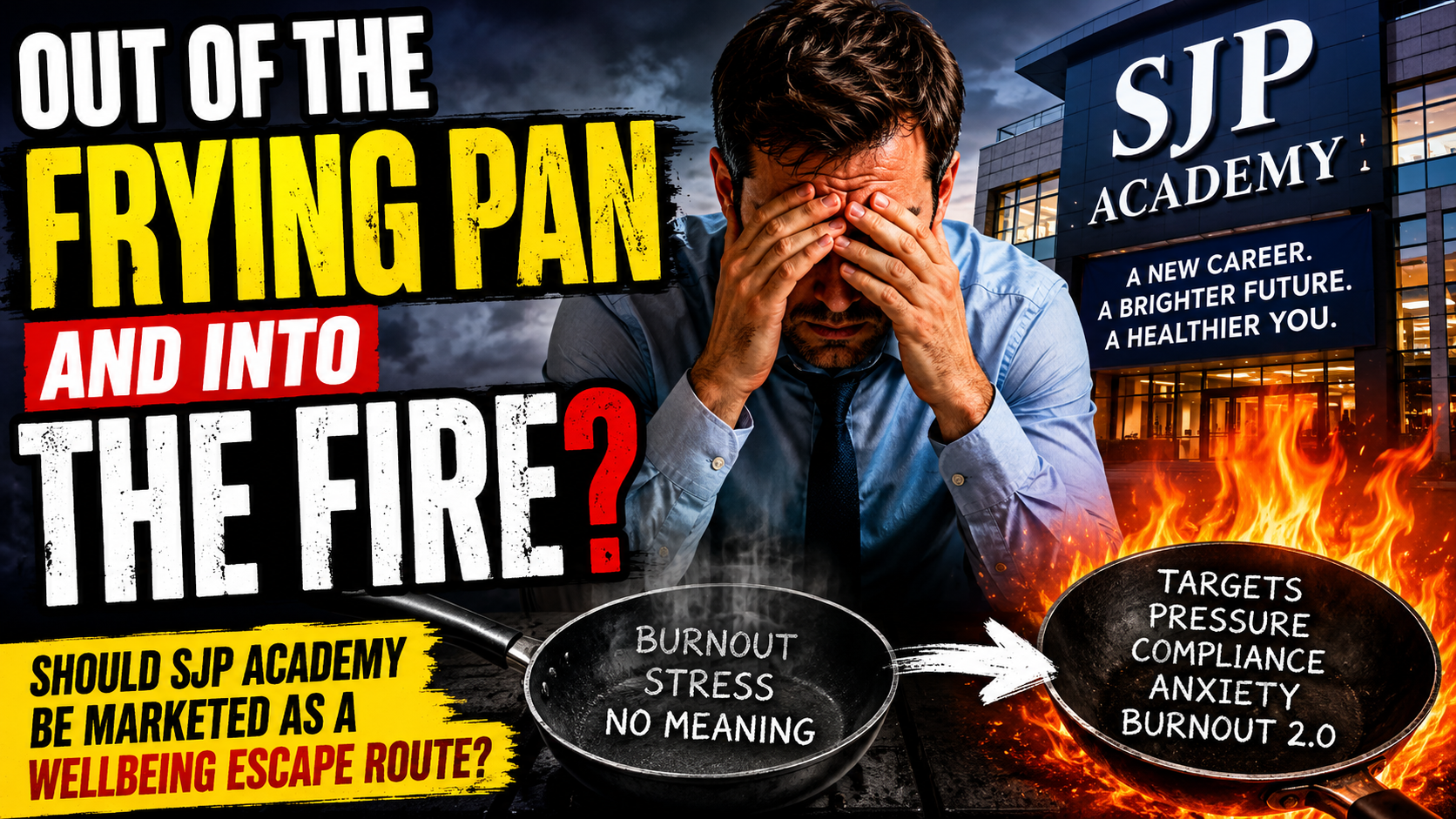
Should Financial Advice Academies Market Themselves as a Wellbeing Escape Route?
There was something in a recent recruitment message from St. James’s Place that genuinely stopped me in my tracks.
The campaign highlighted rising levels of burnout, stress, emotional exhaustion, and poor mental wellbeing across the UK workforce. It cited research suggesting:
- 1 in 4 workers say their job negatively affects their mental health
- 63% show signs of burnout
- people whose jobs damage wellbeing report dramatically lower life satisfaction
So far, so reasonable.
But then came the pivot.
The message positioned the St. James’s Place Academy as a pathway toward a healthier, more balanced, and more fulfilling future.
And that raises a serious question.
Should financial advice academies be marketed as destinations for people whose jobs are already harming their mental wellbeing?
Because for many advisers — quietly, privately, and increasingly publicly — financial services itself has become one of the sources of stress, burnout, anxiety, and emotional fatigue.
That is not a criticism of individual advisers. Nor is it an attack on any one firm. Many good people work incredibly hard across the profession.
But we need an honest conversation about the environment people are entering.
The Pressure Few Talk About Publicly
Modern financial advice can be deeply meaningful work. At its best, it helps people navigate uncertainty, protect families, and make wiser long-term decisions.
But it can also involve:
- relentless performance pressure,
- revenue expectations,
- target cultures,
- regulatory anxiety,
- compliance surveillance,
- emotional labour,
- prospecting pressure,
- social media visibility demands,
- fee justification stress,
- vulnerable clients,
- economic uncertainty,
- and increasingly, fear about the future role of advisers in the age of AI.
Many advisers carry these burdens quietly.
Some thrive in the environment.
Some do not.
So when a recruitment campaign effectively says:
“Feeling burned out? Come into financial advice.”
…we should at least pause long enough to ask:
Is this genuinely a route toward wellbeing?
Or could some people be stepping out of one psychologically demanding environment and into another?
Out of the frying pan and into the fire.
The Human Vulnerability Question
There is an ethical line here worth exploring carefully.
People experiencing burnout are often searching for:
- meaning,
- belonging,
- identity,
- flexibility,
- security,
- hope,
- and a sense of regained control over their lives.
That makes them emotionally receptive.
The concern is not that vulnerable people should be excluded from opportunity. In fact, many people who have overcome hardship become exceptional planners because they understand human struggle deeply.
The concern is whether recruitment messaging fully reflects the realities of the profession people are entering.
Especially within vertically integrated commercial ecosystems where:
- revenue generation matters,
- retention matters,
- production matters,
- and the adviser themselves can become economically dependent on the system they join.
That deserves transparent discussion.
A More Honest Starting Point
At the Academy of Life Planning, we believe the first conversation should rarely be:
“What career should you move into?”
It should be:
“What kind of life are you trying to build?”
Because a career is not therapy.
A profession is not healing.
And changing industries does not automatically restore wellbeing.
Sometimes the real issue is deeper:
- loss of agency,
- loss of meaning,
- misalignment of values,
- chronic overwork,
- dependence on external validation,
- financial pressure,
- or a life architecture that no longer fits the human being living inside it.
Those problems can follow someone into any profession.
Including financial advice.
Planning Before Profession
This is why we believe in planning life before planning money.
Before someone commits to a new career path — especially one requiring emotional resilience, commercial pressure tolerance, and identity transformation — there should perhaps be space to ask:
- What does “enough” look like for me?
- What environment helps me flourish?
- What level of pressure is healthy?
- How important is autonomy?
- What does meaningful work actually mean to me?
- What kind of human being do I want to become through my work?
Those are life planning questions.
And they matter.
Because if the profession genuinely wants to support human wellbeing, then wellbeing cannot simply become a recruitment narrative.
It has to become part of the structure itself.
The Future Question
Financial planning now stands at an important crossroads.
As AI transforms information access and technical capability, the future value of planners may increasingly lie not in product distribution, but in helping human beings navigate complexity, uncertainty, trade-offs, emotion, and life itself.
That future could become healthier, wiser, and more human.
But only if the profession is willing to have honest conversations about its own culture, incentives, and psychological realities.
Including this one.
Because if people are entering financial advice seeking wellbeing, purpose, and freedom…
…we should make very sure we are not simply offering a more sophisticated form of burnout.
I’d be interested in the profession’s perspective on this.

