
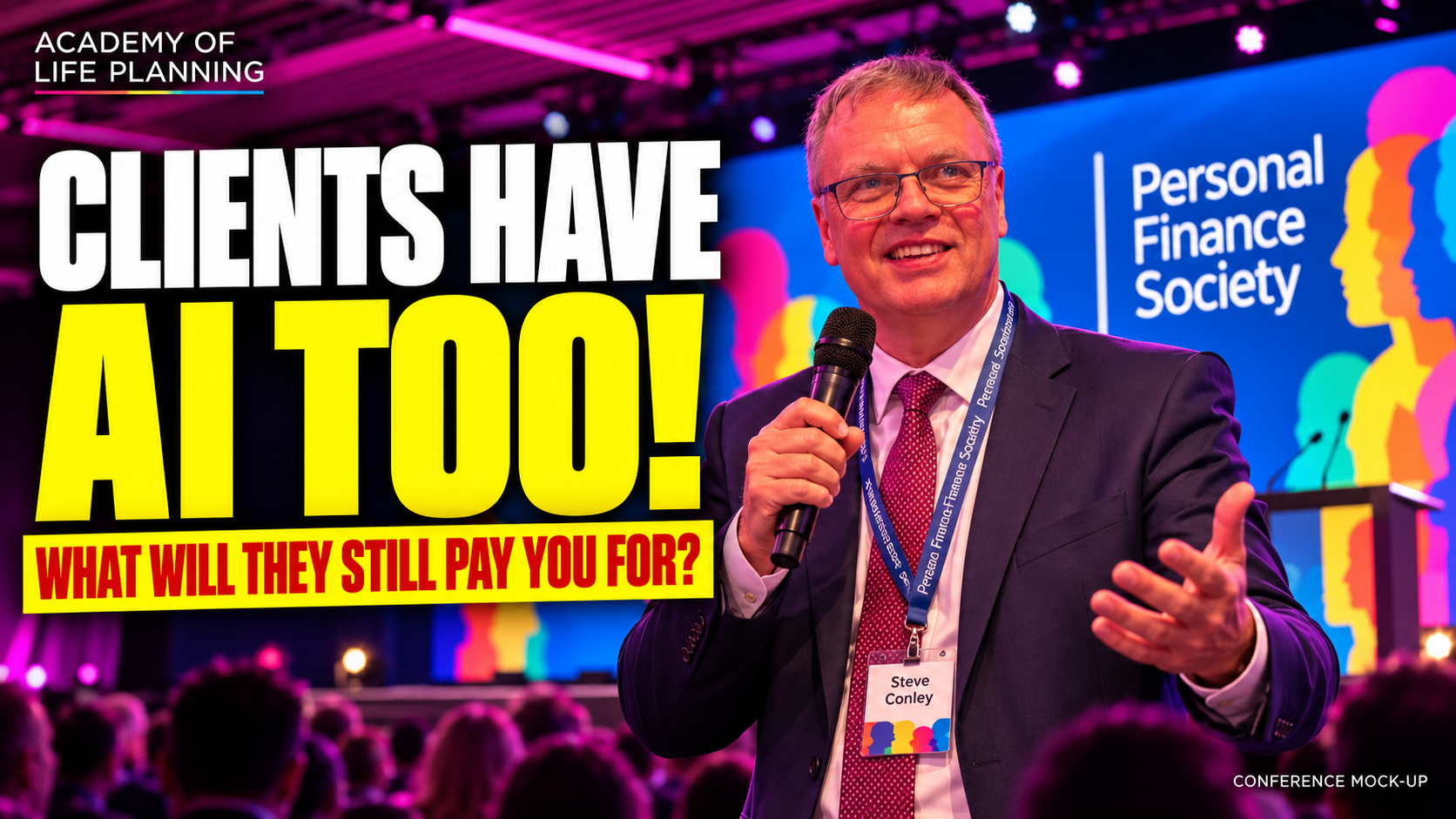
Why Customer Operating Systems belong at the centre of the conversation about the future of financial planning.
By Steve Conley, Founder, Academy of Life Planning
Imagine your next prospective client arriving with their financial records organised, their objectives written down and several possible futures already explored.
They have compared charges. Read the documents. Identified inconsistencies. Prepared questions about your recommendations.
They have also asked an AI to challenge their assumptions—and yours.
What will you contribute that makes a meaningful difference?
And how will you charge for it?
That is the conversation I wanted to bring to the conference stage.
I was initially told I could speak at the PFS conference, then subsequently told I would not be welcome. I do not know why the position changed. I cannot infer the organisers’ motives from that decision.
But I can explain why the message matters to the financial planners attending—and why I believe it deserves a prominent place in the profession’s conversation.
Clients have AI too.
The other side of the AI story
The profession is asking how AI can make advisers more productive.
That is a legitimate question. Faster administration, better document handling and less repetitive work could improve both businesses and services.
The PFS’s public speaker listings include sessions on AI, business growth, client trust and standards. This is not a programme pretending technology does not exist. Its AI panel also includes a founder whose work involves consumer-facing financial guidance.[1]
My concern is about the question we put at the centre.
On the firm’s side, AI can reduce the cost of supplying a service.
On the client’s side, AI can reduce the amount of that service someone needs to buy.
These are different commercial effects. Celebrating the first while overlooking the second leaves a business dangerously underprepared.
AI does not need to replace every professional task. It only needs to make enough previously chargeable work accessible for customers to reconsider the package.
A business can remain useful while its traditional pricing stops making sense.
From chatbot to Customer Operating System
A chatbot answers a question. A Customer Operating System helps a person manage an ongoing process.
I use Customer Operating System to describe a system through which an individual can organise their information, clarify what matters, explore options, record decisions, coordinate action and revisit their plan as life changes—with AI and human support where appropriate.
It is an organising concept, not a claim that every app already delivers all these functions safely or well.
The distinction matters because financial planning does not happen in a single conversation. It happens across time.
A person changes jobs. A parent needs care. A pension statement arrives. A marriage ends. A business opportunity appears. Their health changes. Their priorities shift.
A useful system helps them connect those events to their resources, commitments and choices. It gives them somewhere to return to, rather than requiring them to start again each time they need help.
In the Academy model, Total Wealth Plans is the AI operating system, with a Total Wealth Planner providing the human support layer.
The design principle is straightforward: your life, your information, your decisions and your plan remain yours.
That principle has practical requirements. People need usable access to their records, clear explanations of where data goes, appropriate security, ways to export or recover information and the freedom to change support providers.
A system is not sovereign simply because somebody calls it sovereign. Ownership must work in practice.
The client can become the centre of coordination
In many intermediary relationships, the firm holds the structured record, the planning software, the workflow and much of the continuity.
The client supplies information. The professional interprets it. The firm produces the plan. The client returns when something changes.
A Customer Operating System opens another possibility.
The individual maintains their own record and plan. They bring a professional into a particular question, share the relevant information, obtain help and retain what they have learned.
They may need a regulated adviser for one decision, a tax specialist for another and practical planning support during a life transition. Those contributions can connect through the person’s system.
The professional remains valuable. But the client no longer needs the professional to be the permanent location of their organised financial life.
The planner of the future will not be the client’s operating system. They will help the client operate one.
That changes the structure of the relationship—not just its technology.
What happens to intermediaries?
An intermediary earns a place between a person and something they need: information, interpretation, expertise, a product, a transaction or coordination.
Some of those functions involve legal responsibilities, specialist knowledge and accountability that a general-purpose AI cannot simply assume.
Others become harder to charge for when the person can perform more of the work themselves.
The relevant question is therefore not whether every intermediary disappears. It is which functions customers still value enough to purchase, and on what terms.
Three pressures deserve attention.
First, the information advantage can narrow. Explaining terminology or summarising documents may still help, but firms should expect some clients to arrive having already done that work.
Second, coordination can move. If the person has a usable record, plan and workflow, the firm may no longer be their only source of continuity.
Third, the service can become more selective. A client may want a second opinion on one consequential decision rather than a comprehensive ongoing arrangement.
None of these changes guarantees a particular outcome. Together, however, they challenge the assumption that increasing client capability will leave intermediary economics untouched.
Human capital changes the conversation too
A Customer Operating System need not begin with an investment portfolio.
It can begin with a person’s life.
Consider somebody in their late fifties with modest savings, substantial experience and uncertainty about how they will earn enough over the next decade.
Their most valuable planning question may concern skills, reputation, health, relationships, caring responsibilities and sustainable work.
Moving an existing pension may be less consequential than finding a viable way to use their experience.
A system designed around total wealth can help them organise that wider picture. It can connect financial capital with earning capacity, time, housing, relationships and purpose.
This matters commercially as well as ethically. Where revenue follows investable assets, there is an incentive to focus on questions that bring assets into the arrangement.
That does not establish misconduct by an individual adviser. It identifies a structural incentive.
A person’s best next step may create no assets under advice at all.
Financial planning needs room to recognise that as a successful outcome.
“But clients need protecting from AI”
Yes. Greater access to answers does not automatically create sound judgement.
AI can invent facts, overlook context, reinforce a preference or produce a confident explanation of a poor conclusion. A well-presented dashboard can conceal weak assumptions. Apparent independence can become dependence on a technology provider.
A Customer Operating System should therefore help a person recognise uncertainty and know when to pause. It should make assumptions visible, distinguish evidence from speculation and support appropriate human review.
This is an opportunity for planners to teach the discipline of checking:
- What facts have been verified?
- What assumptions drive the result?
- What important information is missing?
- What would change the decision?
- What needs specialist expertise or regulated advice?
- Am I making this decision freely, with enough time and capacity?
Client capability includes recognising the limits of independent action.
Agency also includes the freedom to delegate. Some people want substantial continuing support. Others need it because of complexity, vulnerability, health or capacity.
The aim is to offer meaningful choices and match support to need.
The fee question cannot remain outside the room
If clients can organise records, explore scenarios and maintain their own plans, what does the ongoing fee purchase?
There may be a good answer: continuing complexity, monitoring, coordination, accountable advice or availability for consequential decisions.
That answer should be explicit.
An enduring relationship is not, by itself, an explanation of an enduring fee.
Percentage charging deserves the same examination. If the portfolio grows substantially, what additional work, responsibility or benefit grows alongside the charge?
A firm may have a persuasive answer. It should be able to give it.
As customer capability develops, some clients may prefer project fees, decision reviews, hourly expertise or a modest support subscription. Others may continue to choose comprehensive ongoing services.
The business challenge is to create models that remain viable across those choices.
Continuous capability. Episodic expertise.
That is the direction we are building towards at the Academy—not a claim that every person needs the same arrangement.
What planners can do now
Start with the work the client has already done. Ask what they have explored, which tools they used and what remains uncertain. Treat their preparation as a starting point for collaboration.
Define your contribution clearly. Testing assumptions, resolving a difficult issue, coordinating specialists and accepting responsibility for regulated advice are concrete services. “Human touch” needs an explanation of what it changes.
Help clients retain usable records. A person should be able to understand their plan, retrieve their decisions and continue their work when a professional relationship changes.
Offer support at different intensities. A capable client with a narrow question and a vulnerable client with continuing complexity should not automatically receive the same service package.
Review your economics. Ask what happens if clients need fewer reports, fewer routine explanations or fewer ongoing appointments. Build a credible response before that change becomes a revenue problem.
Measure capability alongside satisfaction and retention. Does the person understand more? Can they recognise pressure? Can they act on the next step? Do they know when to seek help?
The professional test becomes: what capability did you leave behind?
The conversation the conference needed
A professional body should help its members examine changes that might unsettle their businesses, as well as innovations that improve them.
A session about AI productivity is useful.
A session about clients owning the planning process asks something more demanding: who holds the information, who coordinates the work, who retains authority and what earns a continuing fee?
A conference can offer variety in techniques while leaving its economic assumptions largely unexamined.
That is the distinction I wanted to bring into the room.
I am not asking planners to abandon useful expertise. I am asking them to prepare for a world in which more clients can choose when and how to use it.
Customer Operating Systems could make financial planning more accessible, more continuous and more firmly owned by the person whose life is being planned. They could also create new dependencies if we fail to design them carefully.
The profession has a role in shaping that future. It needs to discuss it explicitly.
Clients have AI too. What happens to your business when they become more capable—and need less of what you currently sell?
The strongest answer will be a service that remains worth choosing as the client becomes more capable.
[1] PFS Festival of Financial Planning 2026, official speaker and session listings: https://www.pfsfestival2026.org/speakers/
This article sets out the author’s interpretation of the public programme and his proposed direction for financial planning. It does not claim that consumer AI will be absent from every conference discussion or establish the organisers’ reasons for changing his speaking invitation.

