
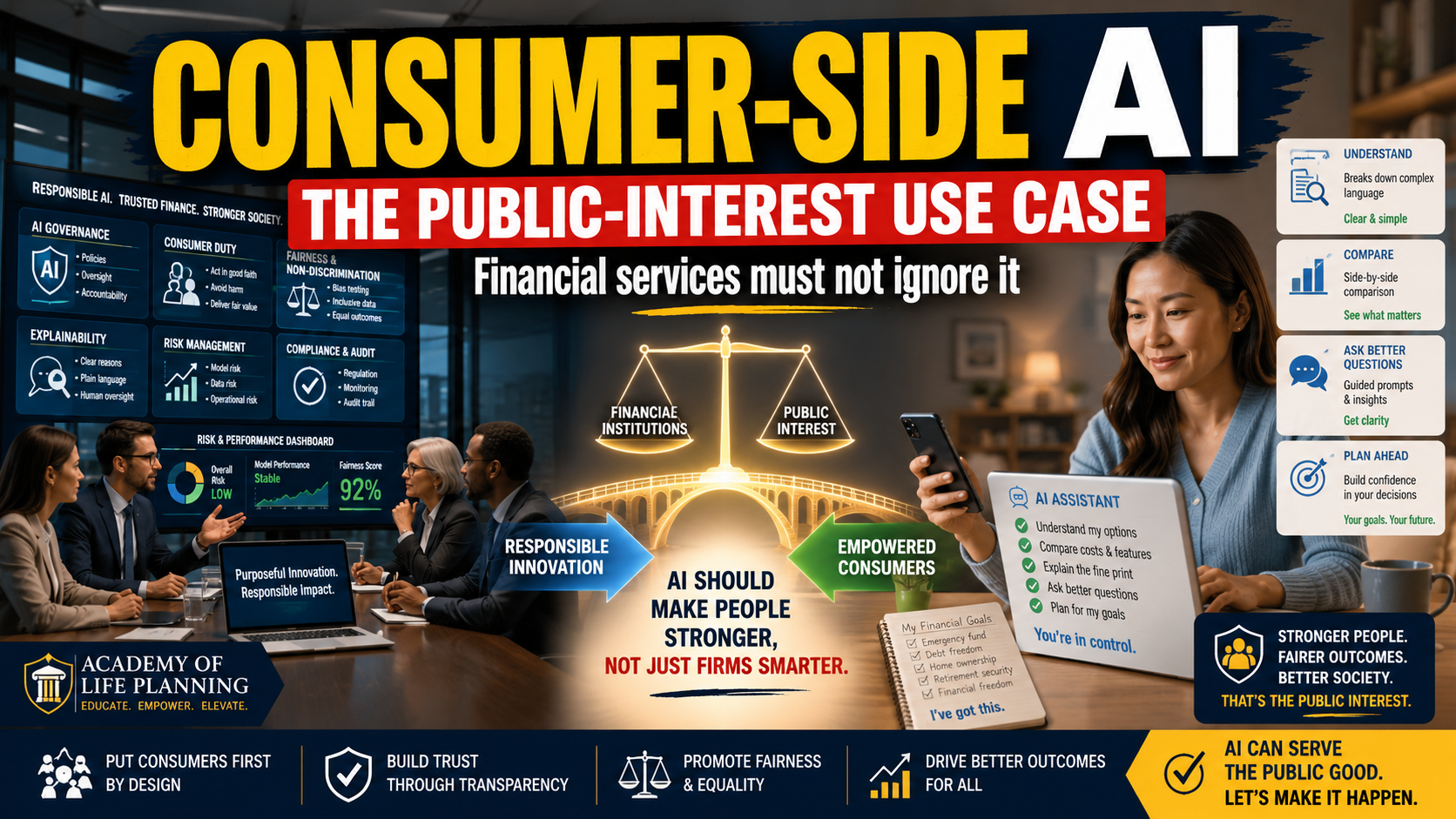
There is a missing half in the financial services AI conversation.
At the moment, much of the debate is about how firms use artificial intelligence. How firms govern it. How firms test it. How firms manage risk. How firms explain AI-assisted decisions. How firms improve efficiency, productivity, compliance, and customer service.
All of that matters.
But it is not enough.
If AI in financial services is discussed only as something firms deploy, we risk creating a new and deeper imbalance. Firms become faster, more efficient, more data-rich, and more capable. Consumers remain where they have too often been: trying to understand dense documents, complex charges, unclear recommendations, lengthy terms, and institutional processes they did not design.
That is not a future of restored human agency.
It is a future where the machinery becomes smarter, while the individual remains dependent.
The FCA has opened an important door
The Financial Conduct Authority has invited stakeholders to contribute examples of good and poor practice in the use of AI in financial services. This is welcome. The regulator is right to engage with firms, technologists, academics, industry participants, and consumer representatives.
AI is moving quickly. No regulator can govern this well from a distance. Practical evidence matters.
The FCA has also made clear that it does not currently intend to introduce a separate new regulatory regime for AI. Instead, it expects firms to apply existing frameworks, including the Consumer Duty, governance and controls, and senior management accountability.
That is a sensible starting point.
But there is a risk in the way the discussion is framed.
The current regulatory conversation still seems to place the firm at the centre of the AI story. The firm develops AI. The firm governs AI. The firm tests AI. The firm explains AI. The firm monitors outcomes.
The consumer appears mostly as someone affected by the firm’s AI system.
They are not yet being treated fully as a legitimate AI user in their own right.
That is the omission we have flagged in our response to the FCA’s AI Input Zone.
AI should not only make firms more capable
If a financial firm uses AI to draft, review, summarise, triage, assess, monitor, or explain, then why should an individual not use AI to understand, question, compare, organise, and protect themselves?
This is the core issue.
There is nothing inherently unsafe about a person using AI to make sense of a financial document. The danger lies in pretending that people are safer when they remain confused, passive, or dependent.
A consumer using AI to review a suitability report is not necessarily trying to replace professional advice. They may simply be trying to understand what they have been told.
A person using AI to check terms and conditions is not necessarily trying to act as a lawyer. They may be trying to spot clauses they should ask about before signing.
Someone using AI to organise evidence after financial harm is not necessarily trying to run litigation. They may be trying to restore clarity after distress, confusion, and institutional overwhelm.
These are not fringe use cases.
They are public-interest use cases.
The real issue is capability asymmetry
Financial services already suffers from a capability gap.
Firms have legal teams, compliance departments, data systems, specialist terminology, product architecture, document templates, and institutional memory. Individuals often have stress, limited time, partial understanding, emotional pressure, and a pile of documents they do not fully understand.
AI could narrow that gap.
Or it could widen it.
If firms adopt AI internally while consumers are discouraged from using AI externally, the asymmetry becomes worse. The firm becomes more capable. The person remains exposed.
That would be a poor outcome.
The point is not that consumers should blindly trust AI. They should not. AI can be wrong. It can miss context. It can overstate confidence. It can produce plausible but inaccurate responses.
But that is not a reason to deny or discourage consumer-side AI. It is a reason to design it properly.
Good consumer-side AI should explain rather than direct. It should flag uncertainty. It should encourage verification. It should help people ask better questions. It should distinguish between guidance, education, and regulated advice. It should support the person’s judgement, not replace it.
Above all, it should restore agency.
What consumer-side AI can do
Consumer-side AI has a very different purpose from firm-side AI.
It does not need to sell products. It does not need to increase assets under management. It does not need to accelerate distribution. It does not need to optimise conversion. It does not need to reduce firm operating costs.
Its public-interest purpose is simpler.
It helps people understand what is in front of them.
That may include:
Understanding a financial adviser’s suitability report.
Checking whether charges, risks, assumptions, and alternatives are clearly explained.
Reviewing terms and conditions before agreeing to them.
Identifying questions to ask before signing a settlement agreement or redress offer.
Organising a timeline after financial harm.
Summarising correspondence with a bank, pension provider, insurer, adviser, platform, or ombudsman service.
Preparing clear questions for a professional adviser.
Separating facts, assumptions, opinions, recommendations, and uncertainties.
Helping people communicate clearly when they are distressed, vulnerable, or overwhelmed.
This is not about creating amateur advisers.
It is about creating better-equipped citizens.
Vulnerability should not mean dependency
The FCA rightly emphasises the importance of fair treatment for customers, including those with features of vulnerability.
This is important. But vulnerability should not be treated only as something firms must manage. It should also be understood as a context in which people may need better tools to participate.
A bereaved spouse trying to understand pension options may need help structuring questions.
A person harmed by a scam may need help organising evidence.
An older customer may need help understanding what a long document actually says.
A financially inexperienced person may need help spotting where they do not yet understand something.
A distressed complainant may need help turning a confused story into a clear chronology.
AI can help with this.
Used carefully, it can give people a calmer second brain. It can slow things down. It can translate complexity into plain English. It can help people regain enough clarity to take the next safe step.
This is not the same as giving advice.
It is agency restoration.
The distinction that matters: explanation versus recommendation
One reason the consumer-side AI conversation becomes confused is that people often collapse several different functions into one word: advice.
But there is a major difference between an AI tool that says, “Transfer this pension,” and an AI tool that says, “Here are the risks, assumptions, charges, and questions you may wish to clarify before deciding.”
There is a major difference between an AI tool that recommends an investment and one that explains a document.
There is a major difference between an AI tool that directs an outcome and one that helps a person understand their options.
This distinction matters.
Financial services regulation rightly controls regulated advice, product recommendation, and arranging activity. But not every act of explanation is advice. Not every act of clarification is intermediation. Not every act of empowerment is distribution.
Consumer-side AI can sit in the space of literacy, understanding, evidence organisation, procedural clarity, and question formation.
That space is not peripheral.
It is where human agency is restored.
Good and poor practice must include how firms treat AI-enabled consumers
There is another issue the FCA should consider.
How do firms respond when a consumer uses AI?
If a customer says, “I used AI to review this suitability report, and it raised these questions,” does the firm respond constructively?
If a complainant uses AI to organise evidence, is the complaint taken more seriously or dismissed as machine-generated?
If a consumer uses AI to decode terms and conditions, does the firm engage with the substance or reject the process?
This matters.
A person using AI to ask clearer questions should not be treated as difficult. They may be more engaged than before. They may be better able to participate. They may be doing exactly what financial services has long claimed to want: becoming informed, active, and responsible.
Good practice should include firms responding respectfully to AI-enabled consumers.
Poor practice would include firms using AI themselves while discouraging consumers from doing the same.
The public-interest test
The public-interest test for AI in financial services should not be limited to whether it makes firms more efficient.
The better question is:
Does this use of AI make the individual more capable?
Does it reduce dependency?
Does it improve understanding?
Does it help people ask better questions?
Does it make hidden risks more visible?
Does it support vulnerable people to communicate more clearly?
Does it help people avoid harm before it happens?
Does it help people recover clarity after harm has occurred?
Does it move power closer to the person whose life is affected?
These are not soft questions. They are central questions.
Because financial services is not just a system of products, markets, platforms, models, and regulation. It is a system that touches people’s homes, retirements, businesses, inheritances, marriages, losses, illnesses, ageing, security, confidence, and sense of control.
AI should not merely optimise the system.
It should help people stand more safely within it.
Advice out. Agency in.
At the Academy of Life Planning, our position is simple.
The future of financial planning should not make people more dependent on experts. It should make genuine expertise progressively less necessary.
That does not mean expertise has no value. It means expertise should be used to restore agency, not capture it.
Consumer-side AI belongs in that future.
It can help individuals become less dependent on institutional explanations. It can help them prepare better questions. It can help them understand what they are signing. It can help them identify when they need regulated advice, legal advice, tax advice, debt advice, or specialist support. It can help them avoid surrendering authority simply because the system is complex.
This is not anti-adviser.
It is pro-person.
The best advisers, planners, firms, and regulators should welcome better-informed consumers. They should welcome people who ask clearer questions. They should welcome tools that help individuals understand the decisions affecting their lives.
If they do not, we should ask why.
The missing half of the AI conversation
The FCA’s AI work is important. Firm-side governance matters. Safe innovation matters. Testing, explainability, accountability, resilience, and fair treatment all matter.
But there is a missing half.
AI in financial services must not be understood only as something firms do to, for, or around consumers.
It must also be understood as something individuals can use for themselves.
That is the public-interest use case financial services must not ignore.
Because a safe AI future should not simply make firms smarter.
It should make people stronger.

