
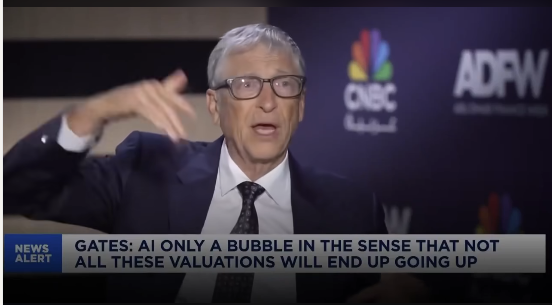
This interview is “Bill Gates on an AI bubble and eradicating polio” on CNBC International / YouTube. It was filmed at Abu Dhabi Finance Week, with CNBC’s Tania Bryer interviewing Bill Gates. The description says Gates discusses how “deeply profound” AI is, the AI bubble debate, and polio eradication.
AI is not an overhyped fad that is going to disappear.
Yes, there is a bubble. Bill Gates is clear about that. Not every inflated valuation will survive. Not every AI start-up will become the next great technology company. Some will fail. Some of today’s celebrated “unicorns” will become tomorrow’s cautionary tales.
That is what happens in every major technology wave.
But the underlying technology is real.
And it is likely to reshape the world more profoundly than anything since the internet.
Gates puts it plainly: AI is “the most important thing going on.” Not because of market speculation. Not because of investor excitement. But because of what it can make possible.
Expert-level medical support. Farming guidance. Education and tutoring. Practical help in people’s own languages. Support reaching communities that have historically been excluded from professional expertise.
The digital revolution built the rails.
AI is now becoming the capability layer on top.
It has the potential to transform health, education, agriculture, finance, law, work, planning, and almost every knowledge-based field.
But the real question is not whether AI is powerful.
It is who gets to use that power.
Will AI deepen dependency on large institutions, platforms, advisers, employers, and experts?
Or will it help ordinary people think more clearly, ask better questions, protect themselves, make better decisions, and restore agency in their own lives?
That is the opportunity.
At the Academy of Life Planning, this is where Academy OS fits.
The Leveller helps people question risks, promises, reports, contracts, terms, and recommendations before they commit.
Goliathon helps people organise evidence, build timelines, and recover clarity after financial harm.
Get Secure helps people identify and activate their own human capital, especially when income, confidence, or security feel under threat. Practical help in people’s own languages. Support reaching communities that have historically been excluded from professional expertise.
Total Wealth Plans helps people connect life, money, work, purpose, and practical choices in one structured environment.
This is not AI for extraction.
It is not AI for selling more products.
It is not AI for replacing one dependency with another.
It is AI-assisted agency restoration.
The winners in this next phase will not simply be those chasing valuations or building fashionable tools. They will be those applying AI to real human problems, with integrity, clarity, and scale.
The future has never been evenly distributed.
But AI gives us a serious chance to change that.
The question now is simple:
Are we using AI to make people more dependent?
Or are we using it to help them become more capable, more confident, and more free?
Gates’ framing appears broadly consistent with what he has said publicly: AI may contain bubble dynamics, but the underlying technology is profound, hyper-competitive, and likely to create enormous real-world value. Recent reporting has him warning that many highly valued AI companies may not survive, while still calling AI deeply important and comparable in significance to the internet era. There is also a sensible middle view emerging: AI is not pure hype, but neither is it a bubble-free miracle. A recent academic paper describes it as a “real technological revolution with localized bubble dynamics,” which is probably the most balanced assessment.
Where I’d sharpen the argument is this: the real question is not “Is AI powerful?” It plainly is. The real question is, who gets the agency?
That is where Academy OS fits almost perfectly.
Most AI narratives still assume expertise flows from the centre outward: big tech, foundations, institutions, employers, governments, advisers, platforms. The public are framed as recipients of AI-enabled expertise. Useful, yes. But still paternalistic.
Academy OS can occupy a different position:
AI as a restoration layer for human agency.
Not “AI replaces advisers.”
Not “AI gives better advice.”
Not “AI tells people what to do.”
But:
AI helps ordinary people stabilise, understand, question, organise, protect themselves, and act with greater confidence.
That distinction matters.
The Leveller fits as the front-line discernment tool. It helps people interrogate claims, offers, reports, contracts, terms, suitability explanations, “T&Cs apply” propositions, and red-flag risk. In the Gates framing, it is not just another app. It is expert-level critical thinking made available at the point where power asymmetry usually happens: before someone signs, agrees, transfers, delegates, or trusts.
Goliathon fits as the post-harm agency restoration tool. Where The Leveller helps people test risk before or during a decision, Goliathon helps people after things have gone wrong: structure evidence, build timelines, identify what matters, ask better questions, and present their story coherently. It does not turn people into lawyers. It helps overwhelmed people recover procedural agency.
Get Secure fits as the human capital activation tool. This is especially important because the AI revolution will not only disrupt financial advice; it will disrupt work, income, confidence, identity, and employability. Get Secure can help people look at what is already present in their lives — skills, relationships, experience, resilience, interests, capacity — and turn that into practical options. That is very aligned with the Gates point about AI widening access to expert support, but with your stronger emphasis on self-agency rather than institutional dependency.
The wider Academy OS then becomes the operating system for self-directed life and financial navigation. It is not a product marketplace. It is not a lead-generation funnel for regulated advice. It is not a prettier adviser portal. It is a structured thinking environment for people trying to make sense of complexity without surrendering authority over their lives.
The strongest positioning line is probably something like:
Bill Gates is right that AI can democratise expertise. But expertise alone is not enough. The next frontier is democratising agency.
That is the AoLP opening.
Because health, farming, education, finance, law, housing, pensions, employment and exploitation all share the same pattern: people are not merely short of information. They are often short of confidence, structure, language, challenge, options, and safe next steps.
Academy OS can therefore be framed as practical infrastructure for the AI age:
The Leveller helps people question before they commit.
Goliathon helps people organise after harm.
Get Secure helps people rebuild capability and income security.
Navigator/Total Wealth Plans helps people model life and money decisions.
Total Wealth Planner provides the human second-brain layer where people need support, without taking over.
AoLP trains practitioners to facilitate restored agency rather than create new dependency.
That gives us a distinctive answer to the question at the end of the quote: “What are you building with it today?”
Our answer is:
We are building AI-assisted agency restoration.
Not AI for extraction.
Not AI for institutional control.
Not AI for more scalable persuasion.
Not AI for selling more products.
AI for people who need to think clearly when systems are complex, stressful, conflicted, or structurally untrustworthy.
The caution I’d add is this: the quote has a very Silicon Valley “move fast, scale hard, winners and losers” energy. That can be useful for momentum, but Academy OS should not inherit the same extraction logic. Our strongest moral and commercial position is to say:
The AI opportunity is real. But the measure of success is not valuation. It is restored human agency at scale.
That is a much cleaner bridge between Gates’ optimism and the Academy’s mission.

