
There is a strange irony in trying to protect people before harm happens.
You build a tool that helps ordinary people read what they are being asked to sign. You make it simple. You make it affordable. You design it to slow people down at the moment of risk, before they give away rights, control, privacy, money, or future options.
Then, when the tool starts gaining visibility, you try to share a factual screenshot showing that it is doing well.
And the systems that claim to connect people to useful information begin to block, restrict, remove, or reject the message.
That is the uncomfortable position we found ourselves in with The Leveller.
The Leveller is an AI-assisted contract and document checker. Its purpose is straightforward: to help people understand terms, conditions, contracts, offers, settlement wording, red flags, and power imbalances before they sign. It is not a replacement for legal advice. It is not a financial adviser. It does not tell people what to do.
It helps people read.
It helps people pause.
It helps people ask better questions.
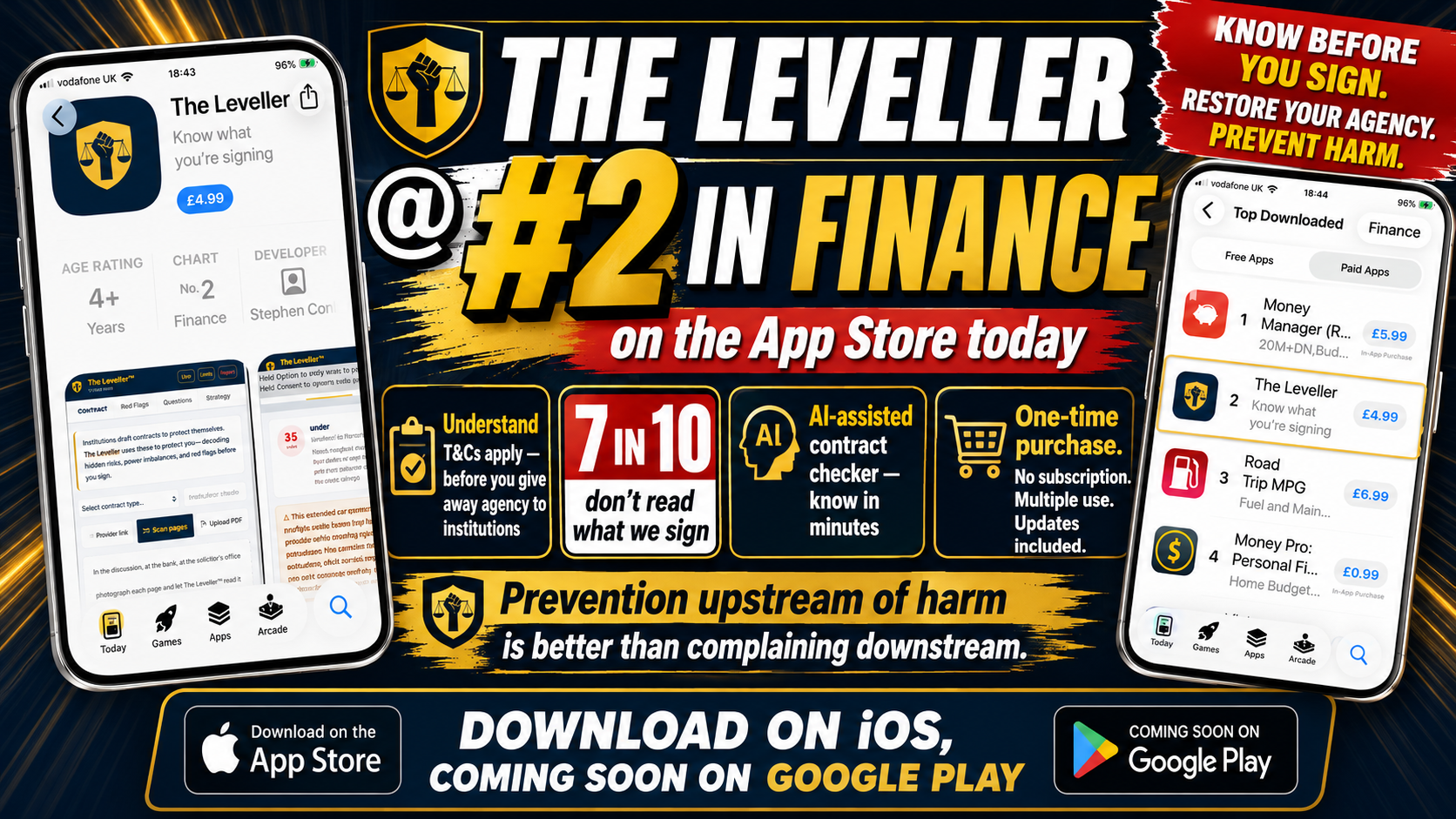
Recently, The Leveller appeared at number two in the Finance category on the iOS App Store. That is not a vague claim. It was visible in the App Store rankings. Screenshots were taken to evidence the fact.
Yet when those screenshots were shared through email and social media channels, problems began. Email systems rejected uploaded files with messages suggesting the file was “invalid or illegal”. On LinkedIn, posts or pages appeared unavailable. A simple factual screenshot of a consumer-protection app doing well in a public app marketplace became difficult to circulate.
We do not yet know exactly why.
It may have been automated moderation. It may have been image-recognition software. It may have been financial-services filtering. It may have been brand-protection rules around marketplace screenshots. It may have been an anti-spam system misclassifying a genuine public-interest update as promotional finance content.
Those distinctions matter technically. But socially, the effect is the same.
A public-interest harm prevention message becomes harder to share.
The problem is not one blocked image
The issue here is not merely that a post failed, or that an email platform rejected an image.
The deeper issue is what happens when automated institutional systems cannot distinguish between consumer harm and consumer protection.
A financial scam, a misleading investment promotion, and a public-interest contract-checking tool may all contain similar surface signals: finance, app, ranking, price, download, red flags, contracts, risk, protection.
To a machine, those words and images may sit in the same risk bucket.
To a human being, they are fundamentally different.
One may expose people to harm.
The other may help them avoid it.
When automated systems flatten that distinction, the public loses something important. It loses visibility of tools that could help people make more informed decisions before they are trapped inside processes of complaint, redress, litigation, or shame.
And this is where the agency question arises.
Who benefits when prevention is harder to see?
Prevention is upstream. Redress is downstream.
Most consumer-protection systems are built downstream.
They deal with harm after the event. A person signs. A problem emerges. They complain. They wait. They gather evidence. They become exhausted. They may face legal threats, procedural complexity, institutional delay, or emotional collapse.
By the time formal redress begins, the power imbalance has usually already done its work.
The person is now trying to recover agency inside a system they may not understand, against an institution with more money, more process, more legal support, more data, more time, and more confidence.
Upstream prevention is different.
It asks: what if people could check before they sign?
What if they could see the warning signs earlier?
What if they could understand the meaning of terms, conditions, exclusions, consent wording, settlement clauses, cooling-off provisions, liability limits, assignment terms, non-disclosure clauses, and hidden obligations before they became bound by them?
That is not radical.
It is basic human agency.
Yet our systems often treat upstream empowerment as disruptive. Not because it is harmful, but because it changes the timing of scrutiny. It moves scrutiny from after the institution has secured consent to before the person gives it.
That shift matters.
A person who understands what they are signing is harder to exploit.
A person who can identify red flags is harder to rush.
A person who can ask clear questions is harder to overwhelm.
A person who pauses before giving consent is harder to process.
Who is censorship protecting?
The word “censorship” should not be used lightly.
There is a difference between deliberate suppression and automated restriction. There is a difference between a platform making an editorial decision and a safety system misfiring. There is a difference between institutional intent and institutional effect.
But if the effect is that public-interest harm prevention content becomes less visible, the question remains legitimate:
Who is protected by that restriction?
Is the consumer protected?
Not obviously. The consumer loses access to a tool that might help them understand important documents before signing.
Is the public protected?
Again, not obviously. Public awareness of preventive tools is reduced.
Are platforms protected?
Possibly. Automated systems are designed to reduce legal, reputational, regulatory, intellectual property, and fraud risk at scale. From the platform’s perspective, over-blocking may be safer than under-blocking. A false positive is treated as acceptable collateral damage.
Are institutions protected?
Indirectly, yes. Not necessarily by design, but by outcome. If people are less able to discover tools that help them scrutinise institutional wording before signing, then institutional documents remain less challenged at the point of consent.
That is the uncomfortable answer.
The restriction may not be intended to protect powerful institutions. But it can have that effect.
And in consumer protection, effects matter.
The new gatekeepers are not always human
We often imagine censorship as a person deciding that something must not be said.
Increasingly, the gatekeeper is not a person.
It is a classifier.
It is a risk model.
It is a brand-safety rule.
It is a content integrity system.
It is an email security filter.
It is an automated moderation queue.
These systems are not neutral. They embody assumptions about risk. They are designed around institutional priorities: safety, compliance, liability management, fraud prevention, user protection, advertiser confidence, and brand control.
Those aims are not inherently wrong. Platforms do have real responsibilities. Scams exist. Fraud exists. Misleading financial promotions exist. Harmful content exists. Moderation is necessary.
But when the tools of moderation cannot tell the difference between exploitation and protection, they begin to reproduce the same asymmetry that consumer-protection work is trying to correct.
Large institutions have compliance teams, verified pages, advertising accounts, legal departments, brand channels, and established routes to visibility.
Small public-interest projects do not.
When a small project is incorrectly blocked, there may be no meaningful appeal route, no human conversation, no clear explanation, and no practical remedy. The system simply says no.
That is not merely a technical inconvenience.
It is an agency problem.
The asymmetry of speech
Institutions can communicate at scale.
They can advertise products. They can distribute terms. They can push consent flows. They can require people to accept conditions before accessing services. They can frame choices through carefully designed user journeys. They can rely on legal wording most people will never read.
But when a consumer-protection initiative says, “pause before you sign”, its visibility may depend on platforms that classify, filter, restrict, or remove content without context.
This creates an asymmetry of speech.
The institution can present the contract.
The individual may struggle to share the tool that helps them understand it.
The institution can automate consent.
The public-interest project may be blocked from automating comprehension.
The institution can scale its wording.
The consumer may be denied scalable help to read that wording.
This is why the question is not simply whether a post was removed. The question is whether our information systems are structurally better at distributing institutional demands than citizen capability.
That is the deeper concern.
This is not anti-platform. It is pro-agency.
It would be too easy to turn this into a simple attack on email providers or social media platforms.
That would miss the point.
The real issue is not whether one platform made one poor decision. The issue is whether modern moderation systems are capable of recognising public-interest prevention, especially when it appears in areas considered commercially or legally sensitive.
Finance is one of those areas.
Contracts are another.
AI is another.
Consumer harm is another.
Put all four together, and a genuine prevention tool may start to look risky to systems that cannot understand purpose.
This is the core problem.
The more important a harm-prevention tool becomes, the more likely it may be to touch sensitive subjects. The more sensitive the subject, the more likely automated systems are to restrict it. And the more those systems restrict it, the harder it becomes for people to discover help before harm occurs.
That is a perverse outcome.
A society serious about consumer protection should not make it harder to share tools that help people understand what they are signing.
The Academy’s position
The Academy of Life Planning exists to restore human agency.
That means helping people become less dependent on institutions, professionals, and opaque systems when making important life and financial decisions.
It does not mean rejecting expertise. It means ensuring expertise supports independence rather than dependency.
The Leveller sits within that philosophy. It gives people a way to bring scrutiny to documents that would otherwise be accepted unread, misunderstood, or signed under pressure.
The aim is not to create fear.
The aim is to create pause.
The aim is not to replace lawyers, advisers, or regulators.
The aim is to help people approach them with better questions, clearer understanding, and more confidence.
That is what human agency looks like in practice.
What should change?
Platforms and email systems need better public-interest pathways for harm-prevention tools.
If content is restricted, there should be a clear explanation.
If a factual public screenshot is blocked, there should be a practical route to review.
If automated systems classify consumer-protection material as risky finance promotion, there should be a way to distinguish between commercial exploitation and public-interest prevention.
And if society genuinely wants people to be more financially capable, digitally literate, and less vulnerable to exploitation, then visibility matters.
People cannot use tools they are not allowed to see.
They cannot protect themselves with knowledge they are prevented from encountering.
They cannot restore agency inside systems that treat their protection as suspicious.
The question remains
When public-interest harm prevention tools are restricted, who is being protected?
Sometimes the answer may be: the platform from risk.
Sometimes: the brand owner from unauthorised use.
Sometimes: the public from scams.
Those are real concerns.
But sometimes, whether by design or by accident, the effect is to protect institutional power from scrutiny.
That is where we need to pay attention.
Because consumer protection does not begin with complaint forms.
It begins before consent.
Before signature.
Before surrender.
Before the person says yes to something they do not understand.
That is why prevention matters.
And that is why people should be able to know before they sign.
Here is the Blocked Message in full:
The Leveller is #2 in Finance on the App Store today.
That matters because financial harm often starts upstream — at the point we sign something we do not fully understand.
Most people do not read the terms they accept.
Not because they are careless.
Because contracts are usually written by institutions, for institutions.
The Leveller helps people check contracts, terms, conditions and financial documents before they sign — using AI to highlight risks, red flags and power imbalances in minutes.
One-time purchase.
No subscription.
Multiple use.
Updates included.
Prevention upstream of harm is better than complaining downstream.
Know before you sign.
Restore your agency.
Prevent harm.
Available now on iOS.
Coming soon on Google Play.
Curious how others see this.
#TheLeveller #FinancialWellbeing #ConsumerProtection #AI #HumanAgency #FinancialPlanning #FinTech
Also useful post-harm — especially when checking settlement offers or NDA-bound terms.
When you feel you cannot safely talk to anyone outside legal privilege, you can still use The Leveller to read carefully, slow the process down, and spot red flags before you sign.
Available on App Store: https://apps.apple.com/us/app/the-leveller/id6771245040

