
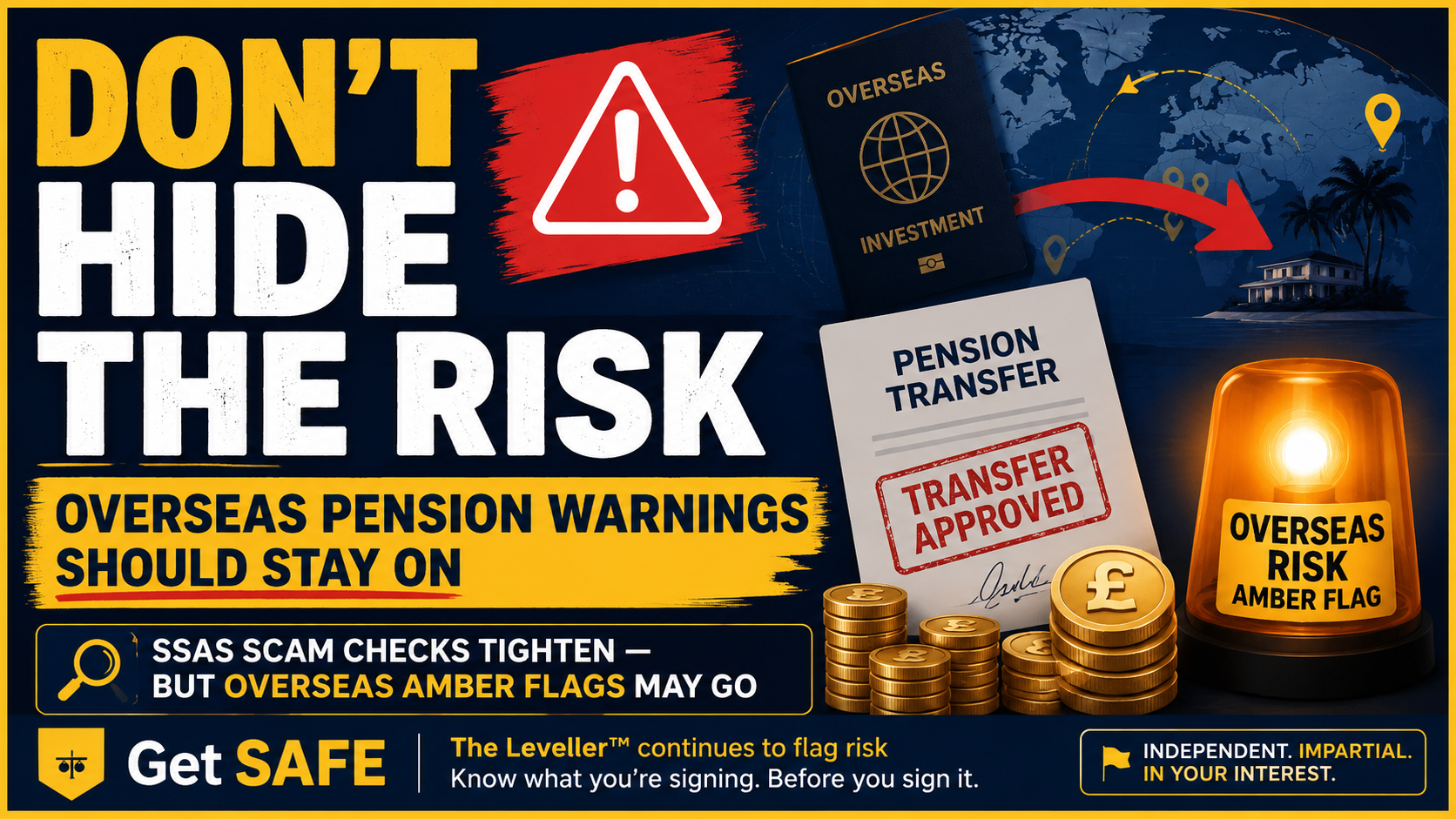
The Government has opened a consultation on new protections for people transferring pensions into Small Self-Administered Schemes, known as SSASs.
You can read the Government consultation here:
Protecting pension savers: proposals to amend the transfer regulations
Some of the proposed changes are welcome.
But one part of the proposal should concern anyone who cares about pension safety, consumer protection, and human agency.
The Government wants to remove the amber warning where a pension scheme includes overseas investments.
That may sound like a small technical change.
It is not.
It could remove one of the warning lights from an area where many British pension savers have already suffered serious harm.
What is changing?
Current pension transfer rules use “red flags” and “amber flags”.
A red flag can stop a transfer.
An amber flag does not usually stop the transfer, but it does trigger a pause. The saver may be required to take guidance before the transfer goes ahead.
The Government is proposing a new red flag for certain SSAS transfers. If someone wants to transfer into a SSAS but cannot show a real employment link with the sponsoring employer, the transfer could be refused.
That is sensible.
A SSAS can be a legitimate pension structure. It is often used by small business owners. But it can also be misused. If there is no real employment link, the structure may not be what it appears to be.
A stronger red flag in that area may help stop some pension scams before the money leaves the original scheme.
But at the same time, the Government is proposing to remove the amber warning for overseas investments.
That is much harder to justify.
Why overseas investment risk matters
Overseas investment is not automatically bad.
Many legitimate pensions invest globally. A normal UK pension fund may hold shares, bonds, or funds from many countries. That is not the issue.
The issue is different.
The concern is when pension money is transferred into arrangements where the investment, trustee, adviser, platform, product provider, or legal protections sit outside the UK system.
In those cases, people may face weaker protection, more complex enforcement, and fewer practical rights if something goes wrong.
If your pension remains in a UK-regulated environment, you may have access to UK complaints routes, UK regulatory standards, UK courts, UK compensation arrangements, and clearer accountability.
If your pension is moved into an overseas structure, those protections may be reduced, fragmented, or very hard to enforce.
That difference matters.
It matters especially when the person transferring is not a pensions expert, does not understand the legal structure, and is relying on people who may be paid if the transfer goes ahead.
The human cost has already been severe
There are currently believed to be more than 40,000 British expatriates affected by overseas pension losses, with estimated losses of around £10 billion in pension assets.
These are not just numbers.
They are homes not bought.
Retirements delayed.
Marriages strained.
Mental health damaged.
Families placed under stress.
People who worked for decades believed they were making a sensible decision. In many cases, they were told the transfer was approved, recognised, efficient, flexible, tax-smart, or suitable for life overseas.
Only later did they discover the real problem.
Their money had moved into a system where the protections were not as strong, the investments were not as safe, and their rights were not as enforceable.
For many, by the time the harm became visible, the damage had already been done.
Deregulation must not mean fewer warnings
The Government is under pressure to support growth.
That is understandable.
But pension savings are not ordinary capital.
They are deferred wages.
They are life security.
They are the money people rely on when they can no longer earn in the same way.
Removing a warning light may make transfers feel smoother. It may reduce friction for providers and administrators. It may support a policy mood that favours deregulation, efficiency, and growth.
But growth should not depend on making risk less visible to ordinary people.
If an overseas investment carries different legal protections, weaker enforceability, or a higher risk of consumer detriment, the saver deserves to know that before the transfer goes ahead.
A warning is not a ban.
It is a pause.
And sometimes a pause is the thing that saves a person from irreversible harm.
The real question is not whether overseas investment is allowed
This debate should not be framed as “overseas investment good” or “overseas investment bad”.
That is too crude.
The better question is:
Does the person understand what protections they may be giving up?
Do they know who is responsible if things go wrong?
Do they know which regulator applies?
Do they know where they would complain?
Do they know whether UK compensation protections apply?
Do they know whether the investment can be sold easily?
Do they know who is being paid?
Do they know whether the adviser, trustee, platform, and investment provider are all working in their interests?
If the answer is unclear, the risk should be flagged.
The Leveller will continue to flag this risk
Whatever the Government decides, The Leveller will continue to treat overseas investment risk as important.
That does not mean every overseas investment is unsafe.
It means the risk should be visible.
The Leveller is designed to help people read offers, documents, pension transfer material, settlement terms, and “T&Cs apply” promises with clearer eyes.
It looks for warning signs.
It asks better questions.
It helps people pause before they sign, transfer, agree, accept, or give up rights.
Its purpose is simple:
Help people preserve their agency before harm happens.
That matters more, not less, if formal warning systems are weakened.
Why unconflicted tools matter
Many people receive information from parties who have an interest in the transaction going ahead.
That does not automatically mean those parties are dishonest.
But incentives matter.
A pension transfer may generate fees.
An investment may pay commission.
A platform may receive assets.
An adviser may win a client.
A trustee may benefit from new business.
A product provider may gain funds under management.
When money moves, someone usually benefits.
The saver needs a way to stand outside that influence and ask:
“Is this safe for me?”
“Do I understand the risk?”
“What happens if this goes wrong?”
“What rights am I giving up?”
“Who benefits if I proceed?”
That is why unconflicted risk assessment tools matter.
They do not replace legal advice.
They do not replace regulated advice.
They do not tell people what to do.
They help people see the structure more clearly, so they can make safer, more informed decisions.
Protection should not depend only on institutions
The proposed SSAS red flag is a good example of institutional protection. Trustees and administrators may be given stronger grounds to stop a transfer where there is no real employment link.
That is useful.
But it is not enough.
People also need personal capability.
They need to understand the warning signs themselves.
They need language to ask questions.
They need time to pause.
They need tools that do not sell them a product.
They need support that restores confidence rather than takes over.
That is the Get SAFE approach.
Stabilise.
Structure.
Surface options.
Do not panic.
Do not rush.
Do not sign under pressure.
Do not assume that “approved”, “recognised”, “regulated”, or “overseas” means safe.
A simple checklist before transferring a pension overseas
Before any pension transfer involving overseas investment, ask these questions:
- What protection do I have now?
- What protection will I lose if I transfer?
- Which regulator will protect me afterwards?
- Which compensation scheme applies if the provider fails?
- Where would I complain if the advice or investment turns out to be harmful?
- Are the investments regulated, liquid, and easy to value?
- Who is paid if I transfer?
- Am I being rushed, reassured, or discouraged from getting independent support?
- Have I checked the documents with an unconflicted risk tool?
- Would I still proceed if I fully understood the worst-case outcome?
If you cannot get clear answers, pause.
A pause is not weakness.
A pause is self-protection.
The warning light should stay on
The Government is right to strengthen protections against SSAS misuse.
But removing the amber warning for overseas investments risks sending the wrong signal.
At a time when thousands of British expatriates have already suffered devastating pension losses, the answer should not be to make overseas risk less visible.
The answer should be better warnings, clearer questions, and stronger human agency.
People do not need more pressure to transfer.
They need more power to understand.
That is why Get SAFE supports tools, language, and structures that help people pause before harm happens.
Because once a pension has gone, recovery can take years.
And sometimes it never comes back.
The safest time to spot a risk is before the signature.
The safest time to preserve agency is before the money moves.

