
When people are harmed by powerful institutions, the first barrier is rarely the absence of evidence.
More often, the barrier is overwhelm.
The documents are there. The letters are there. The emails are there. The statements, decisions, timelines, contradictions and red flags are often scattered across inboxes, folders, drawers and memory. But when someone is under stress, exhausted by delay, or facing a bank, insurer, pension provider, care home, employer, claims company or public body alone, the task of making sense of it all can feel impossible.
That is why we created Goliathon.
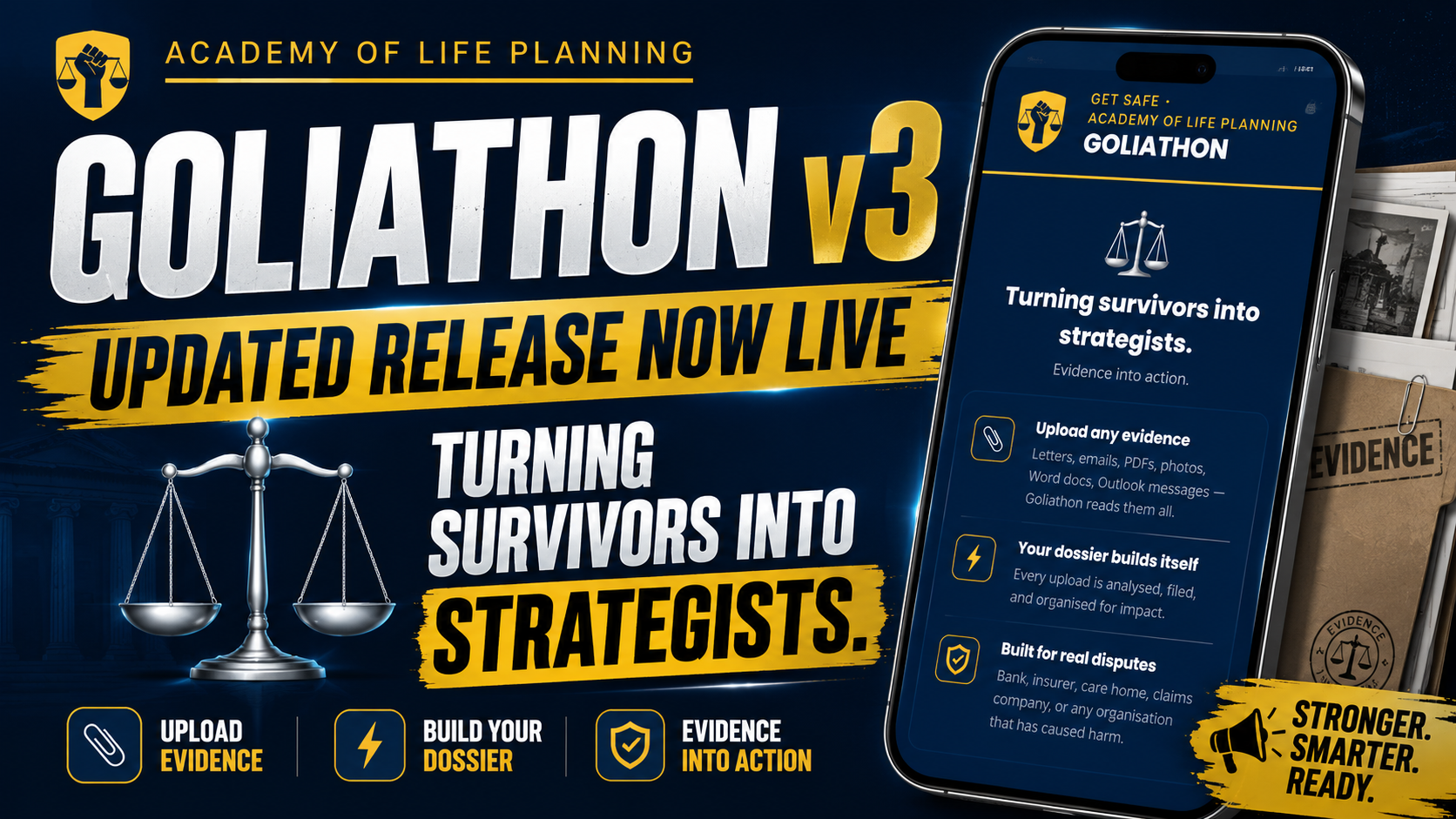
Goliathon is a free, AI-powered evidence dossier builder for people involved in disputes with institutions. Its purpose is simple: to help people turn scattered evidence into a structured, professional case dossier — without needing to understand legal formatting, complaint procedures, document management systems or AI prompting.
The updated Version 3 of Goliathon is now live at:
Its core principle remains:
“Turning survivors into strategists. Evidence into action.”
Why Goliathon Exists
Institutions usually have systems.
They have document management platforms, legal teams, compliance departments, internal notes, professional templates, procedural knowledge and experienced people who know how to frame a case.
Most harmed individuals have a pile of documents and a rising sense of panic.
That imbalance matters.
It does not mean the individual is wrong. It does not mean the case lacks merit. It often means the person has not yet had the structure needed to make the evidence visible, coherent and usable.
Goliathon helps close that capability gap.
It is not a legal service. It does not replace professional advice. It does not tell people what outcome they should seek. Instead, it helps them organise what has happened, identify what the evidence appears to show, and prepare a clear dossier that can be reviewed by a solicitor, MP, ombudsman, journalist, caseworker or trusted supporter.
This is agency-restoration in practical form.
What Version 3 Does
The updated version of Goliathon is built around one repeated action:
Upload a piece of evidence.
That is it.
After each upload, Goliathon reads the document and automatically updates the dossier. It extracts key facts, dates, parties and significance. It files the item into an Evidence Library with a reference number and summary. It adds the event to a chronological timeline. It updates the case overview. It extends the witness statement in the user’s own voice. It refreshes the next steps.
Nothing is left for the user to construct from scratch.
This matters because people in distress do not need more forms, more portals, more procedural burden or more “work it out yourself” technology. They need a simple first step that reduces cognitive load.
Goliathon’s design reflects that.
No registration. No login. No account required. No complex set-up. No long questionnaire before you begin.
You start by uploading evidence.
Five Panels That Build the Case
Goliathon Version 3 organises each case into five automatically updated dossier panels.
The Case Overview gives a professional third-person narrative of who is involved, what happened, the harm suffered, and the current status.
The Timeline places events in chronological order and links them back to supporting evidence.
The Witness Statement builds a first-person account in the user’s own voice, written with clarity and dignity.
The Evidence Library files each uploaded item with a reference number, date, document type, summary and red flags.
The Next Steps panel creates a prioritised action list, helping the user see what may need to be done next.
Together, these panels turn confusion into structure.
For someone facing an institution alone, that structure can be the difference between being dismissed as emotional, disorganised or confused — and being heard as someone with a coherent account supported by evidence.
More Ways to Upload Evidence
Version 3 also makes it easier to get evidence into the system.
Users can upload files, drag and drop documents, scan physical papers using a mobile camera, or add a URL for Goliathon to read public web content such as a news article, regulatory decision or company page.
Supported formats include images, PDFs, text files, Word documents, HTML files and Outlook email exports.
This matters because real cases are messy.
Evidence rarely arrives in one neat format. It may be a letter from a bank, a screenshot, an email, a PDF bundle, a photograph of a form, a regulatory notice, or an old Word document. Goliathon is designed for that reality.
Multiple Cases, Sharing and Downloads
Many people dealing with institutional harm are not dealing with one neat issue.
A pension dispute may connect to a mortgage problem. A bereavement case may involve a bank, a solicitor, an insurer and a care provider. A financial exploitation case may involve several institutions at once.
Version 3 supports multiple cases, allowing users to keep separate dossiers for separate disputes.
Each dossier can also be shared through a secure, unique link with a trusted person. The recipient sees a clean, read-only version of the case overview, timeline, witness statement, evidence library and next steps. As more evidence is added, the shared dossier updates automatically.
Users can also download professionally branded PDF versions of the complete dossier or individual sections, including the case overview, timeline, witness statement, evidence library and next steps.
This makes Goliathon useful not only for personal clarity, but also for preparing material for professionals and decision-makers.
Built for Vulnerable Users
Goliathon has been built with vulnerable users in mind.
That does not mean labelling people as helpless. It means recognising the reality of stress, trauma, cognitive overload and institutional fatigue.
When people have been harmed, bullied, ignored or delayed for months or years, even simple tasks can become difficult. Opening a letter can trigger anxiety. Re-reading documents can be overwhelming. Explaining the story yet again can feel unbearable.
Goliathon reduces the burden.
The user does not have to decide how to structure the case. They do not have to write a legal-style summary. They do not have to build a timeline manually. They do not have to turn distress into professional language alone.
They upload evidence, and the structure begins to form.
For supporters, this is equally important. A trusted friend, volunteer, family member or case supporter can help someone use Goliathon with consent. The tool gives both people a clearer shared picture of the case.
Privacy and Boundaries
Goliathon is free at point of use. It does not require an account. It uses no advertising. Data is not sold.
Dossier content is stored only where needed to enable a shareable link, identified by a random ID rather than a user account. Camera scans are compressed and sent for AI analysis but are not stored by Goliathon. Users can delete shared dossiers through the app or request deletion by email.
Goliathon is also clearly bounded.
It is an educational and peer-support tool. It is not legal, financial or mental-health advice. AI-assisted outputs should always be reviewed before official submission or publication. Where material is submitted to a regulator, ombudsman or court, it should be described as AI-assisted.
That boundary is important.
The purpose of Goliathon is not to replace solicitors, advisers, therapists or regulators. It is to help ordinary people become clearer, safer and better organised before they engage with those systems.
Why This Matters for the Academy of Life Planning
At the Academy of Life Planning, our wider mission is to restore human agency.
That means helping people become less dependent on institutional authority, not more. It means giving people the tools to understand their own position, organise their own evidence, ask better questions and make better decisions.
Goliathon is part of that mission.
It sits within Get SAFE — Support After Financial Exploitation — as a practical agency-restoration tool. It helps people stabilise, structure and surface options. It does not take over the case. It does not promise outcomes. It does not encourage reckless escalation. It helps people see what is already present and organise it into something usable.
That is often the first act of recovery.
Before justice, there must be clarity.
Before action, there must be structure.
Before confidence returns, the person must begin to see: “I am not powerless. I can understand this. I can organise this. I can take the next step.”
That is what Goliathon is here to support.
Try Goliathon Version 3
Goliathon Version 3 is now available free at:
It is for anyone trying to make sense of a difficult institutional dispute.
It is for survivors of financial exploitation.
It is for people facing mortgage, pension, insurance, care home, employment, consumer or inheritance disputes.
It is for supporters helping someone overwhelmed by evidence.
And it is for anyone who has ever had the sense that the truth was buried in the paperwork — but did not know how to bring it to the surface.
Goliathon helps turn evidence into action.
And action begins with one upload.

